
Litany of the Saints
(For Protection from the Evil One)
INTRODUCTION
TO THE LITANY OF SAINTS
The Litany of the Saints (Litania Sanctorum) is one of the oldest prayers in the Christian tradition, serving as the model for all other litanies. It consists of invocations to the Trinity, the Blessed Virgin Mary, angels, and saints in various categories (patriarchs, apostles, martyrs, confessors, virgins, etc.), followed by petitions for deliverance from evils and for various graces, with congregational responses such as “Pray for us,” “Lord, deliver us,” or “Lord, hear us.”
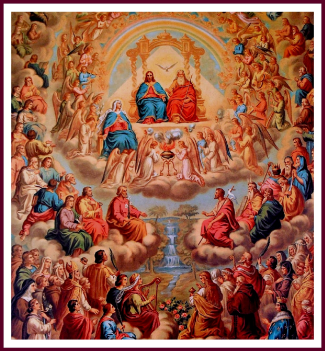
Its structure and use of the Litany of the Saints reflect the Church’s belief in the communion of saints—the intercession of the triumphant Church for the pilgrim Church—as described in Scripture (Revelation 7:9-10) and formalized in liturgy.
The Litany of the Saints have roots in the early Church, predating a single standardized text. Forms of litanies with saint invocations appear as early as St Gregory Thaumaturgus (213-270) and are clearly attested by St Basil the Great (330-379). Later the practice took hold in public processions. St Mamertus, Bishop of Vienne (d. 475), instituted rogation processions that included litanies.
The exact author and date of composition of the Litany of the Saints remains unknown, but its antiquity is evident: the order of the Apostles listed matches that in the Canon of the Mass, as noted by the 9th-century liturgist Walafrid Strabo (808-849). This suggests its origin was well before the 6th century.
An important early witness is the Stowe Missal, an Irish liturgical book dated c.792. It contains a Litany of the Saints with local Irish saints (including St Maelruain, d. 792), showing how the form had already spread, been adapted regionally, and integrated into Mass books by the late 8th century.
A pivotal moment came under Pope St. Gregory the Great (540-604, pope 590–604). In response to a devastating plague and flood in Rome around 590, he ordered the Litany of the Saints (“sevenfold litany”) procession. This involved seven groups—clergy, laity, monks, virgins, matrons, widows, and the poor/children—processing from different Roman churches to St Peter’s Basilica while chanting the Litany of the Saints. It was credited with ending the plague and became a model for public supplication.
By the 7th century, the litany was firmly established in the Church, as confirmed by the Vatican’s Directory on Popular Piety and the Liturgy (#235).
Initially, saints were invoked primarily by class or group. Over time, individual names (including local or recently canonized saints) were added in various places, though the Church later regulated this for uniformity (decrees from the Sacred Congregation of Rites in the 16th–19th centuries forbade unauthorized changes).
The litany became a staple of rogation days from the 9th century onward. It was also prescribed for numerous liturgical rites in the Roman Ritual and Pontifical, including:
- Easter Vigil (before blessing the baptismal font)
- Baptism
- Ordinations (bishop, priest, deacon)
- Consecration of virgins, religious profession, and dedication of churches/altars
- Exorcisms
- Commendation of the dying
- Processions for various needs (like, rain, plague, war)
Three main forms evolved: a full version for processions and major rites, an abbreviated one for certain Masses (like, Holy Saturday), and a shorter form for the dying.
Rogation days were removed from the universal liturgical calendar in the 20th century (post-Vatican II reforms), but the Litany of the Saints remains an official part of the Church’s liturgy and popular piety.
The 2001 Vatican’s Directory on Popular Piety and the Liturgy highlights its “subtle, simple, and popular” structure and its role in expressing confidence in the saints’ intercession and the unity of the Church triumphant and militant.
It continues to be sung or recited at key moments such as ordinations, church dedications, exorcisms, and the Easter Vigil. Pope Benedict XVI and others have reflected on its power, describing the experience of lying prostrate during ordination while the litany invokes the entire communion of saints as a profound source of strength.
In essence, the Litany of the Saints has endured for over 1,400 years with remarkable stability because it embodies the Church’s ancient conviction: the saints are not distant but active intercessors, joining the faithful on earth in crying out to God. Its history mirrors the development of Christian liturgy itself—from early supplications to a formalized, universal prayer that still unites heaven and earth today.
The Litany of the Saints is the first litany officially authorized by the Catholic Church. It is one of six litanies officially approved for public worship
SYMBOLS
[℣] Leader [℟] Response [Ⱥ] All together
SIGN OF THE CROSS
In the Name of the Father, and of the Son and of the Holy Spirit. Amen.
IF YOU HAVE, MENTION YOUR SPECIAL INTENTIONS HERE
- Lord have mercy. [℟] Lord have mercy.
- Christ have mercy [℟] Christ have mercy
- Lord have mercy. [℟] Lord have mercy.
- Christ hear us. [℟] Christ graciously hear us.
● ● ●
[℟] = have mercy on us.
- God, the Father of heaven, [℟]
- God the Son, Redeemer of the world, [℟]
- God the Holy Spirit, [℟]
- Holy Trinity, one God, [℟]
● ● ●
[℟] = pray for us.
- Holy Mary, [℟]
- Holy Mother of God, [℟]
- Holy Virgin of virgins, [℟]
♦ ♦ ♦
- Saint Michael, [℟]
- Saint Gabriel, [℟]
- Saint Raphael, [℟]
- All you holy angels and archangels, [℟]
- All you holy orders of blessed spirits, [℟]
♦ ♦ ♦
- Saint John the Baptist, [℟]
- Saint Joseph, [℟]
- All you holy patriarchs and prophets, [℟]
♦ ♦ ♦
- Saint Peter, [℟]
- Saint Paul, [℟]
- Saint Andrew, [℟]
- Saint James, [℟]
- Saint John, [℟]
- Saint Thomas, [℟]
- Saint James, [℟]
- Saint Philip, [℟]
- Saint Bartholomew, [℟]
- Saint Matthew, [℟]
- Saint Simon, [℟]
- Saint Thaddeus, [℟]
- Saint Matthias, [℟]
- Saint Barnabas, [℟]
- Saint Luke, [℟]
- Saint Mark, [℟]
- All you holy apostles and evangelists, [℟]
- All you holy disciples of the Lord, [℟]
♦ ♦ ♦
- Saint Stephen, [℟]
- Saint Lawrence, [℟]
- Saint Vincent, [℟]
- Saints Fabian and Sebastian, [℟]
- Saints John and Paul, [℟]
- Saints Cosmos and Damian, [℟]
- Saints Gervase and Protase, [℟]
- All you holy martyrs, [℟]
- All you holy innocents, [℟]
♦ ♦ ♦
- Saint Sylvester, [℟]
- Saint Gregory, [℟]
- Saint Ambrose, [℟]
- Saint Augustine, [℟]
- Saint Jerome, [℟]
- Saint Martin, [℟]
- Saint Nicholas, [℟]
- All you holy bishops and confessors, [℟]
- All you holy doctors, [℟]
♦ ♦ ♦
- Saint Anthony, [℟]
- Saint Benedict, [℟]
- Saint Bernard, [℟]
- Saint Dominic, [℟]
- Saint Francis, [℟]
- Saint Padre Pio, [℟]
- All you holy priests and Levites, [℟]
- All you holy monks and hermits, [℟]
♦ ♦ ♦
- Saint Mary Magdalene, [℟]
- Saint Agatha, [℟]
- Saint Lucy, [℟]
- Saint Agnes, [℟]
- Saint Cecilia, [℟]
- Saint Catherine, [℟]
- Saint Anastasia, [℟]
- Saint Clare, [℟]
- Saint Bernadette, [℟]
- Saint Faustina, [℟]
- All you holy virgins and widows, [℟]
♦ ♦ ♦
- All you holy men and women, saints of God, [℟] make intercession for us.
- Be merciful, [℟] spare us, O Lord.
- Be merciful, [℟] graciously hear us, O Lord.
● ● ●
[℟] = deliver us, O Lord.
- From all evil, [℟]
- From all sin, [℟]
- From the evil of idolatry, pervading our Church, [℟]
- From your wrath, [℟]
- From sudden and unprovided death, [℟]
- From the snares of the devil, [℟]
- From anger, and hatred, and all ill-will, [℟]
- From the spirit of fornication, [℟]
- From the scourge of earthquake, [℟]
- From plague, famine, and war, [℟]
- From lightning and tempest, [℟]
- From everlasting death, [℟]
● ● ●
[℟] = O Lord deliver us.
- Through the mystery of your holy Incarnation, [℟]
- Through your coming, [℟]
- Through your birth, [℟]
- Through your baptism and holy fasting, [℟]
- Through the institution of the Most Blessed Sacrament, [℟]
- Through your Cross and Passion, [℟]
- Through your Death and Burial, [℟]
- Through your Holy Resurrection, [℟]
- Through your admirable Ascension, [℟]
- Through the coming of the Holy Spirit the Paraclete, [℟]
- In the day of judgment, [℟]
● ● ●
[℟] = we beseech you, hear us, O Lord.
- We sinners, [℟]
- That you would spare us, [℟]
- That you would pardon us, [℟]
- That you would bring us to true penance, [℟]
- That you would govern and preserve your Holy Church, [℟]
- That you would preserve our Holy Father and all orders of the Church in Holy Religion, [℟]
- That you would humble the enemies of the Holy Church, [℟]
- That you would give peace and true concord to Christian kings and princes, [℟]
- That you would bring back to the unity of the Church all those who have strayed away, and lead to the light of the Gospel all unbelievers, [℟]
- That you would confirm and preserve us in your holy service, [℟]
- That you would lift our minds to heavenly desires, [℟]
- That you would render eternal blessings to all our benefactors, [℟]
- That you would deliver our souls, and the souls of our brethren, relatives, and benefactors from eternal damnation, [℟]
- That you would give and preserve the fruits of the earth, [℟]
- That you would grant eternal rest to all the faithful departed, [℟]
- That you would graciously to hear us, [℟]
- Son of God, [℟]
● ● ●
- Lamb of God, who takes away the sins of the world [℟] Spare us, O Lord.
- Lamb of God, who takes away the sins of the world [℟] Graciously hear us, O Lord.
- Lamb of God, who takes away the sins of the world [℟] Have mercy on us.
● ● ●
- Christ hear us. [℟] Christ graciously hear us.
- Lord have mercy. Our Father [the rest inaudibly until:] And lead us not into temptation. [Ⱥ] But deliver us from evil.
CONCLUDING PRAYER
[℣] Let us pray. God, whose nature is ever merciful and forgiving, accept our prayer that we and all your servants, bound by the chains of sin, may be pardoned by your loving kindness.
We beg you, Lord, hear the plea of your suppliants, pardon the sins of your penitents, and kindly grant us your tender forgiveness along with your peace.
Show us, O Lord, your indescribable mercy, blot out our transgressions, and graciously deliver us from the condemnation they deserve.
God, who are offended by our sins but appeased by our penances, may it please you to hear the entreaties of your people and to turn away the stripes that our transgressions rightly deserve.
Almighty everlasting God, be gracious to your servant, Pope <name>, our sovereign Pontiff, and in your kindness lead him on the path of everlasting salvation; may he by your grace seek only that which pleases you and carry it out with all his might. God, from whom come holy desires, right counsels, and good works, give to your servants that peace which the world cannot give; so that our hearts may be dedicated to the observance of your law, freed from fear of our enemies, and tranquil in the knowledge of your protection.
Lord, inflame our affections and our understanding with the fire of the Holy Spirit, that we may serve you with a chaste body and please you with a pure heart.
God, the Creator and Redeemer of all the faithful, grant to the souls of your departed servants’ remission of all sins; and by our fervent prayers may they obtain the pardon they have always desired. We beg you, Lord, let a breath of your grace prompt our undertakings and guide them along their course, so that our least prayer and work may ever begin in you and end in you.
Almighty everlasting God, Lord of both the living and the dead; deal mercifully with all whom you foresee shall be yours by faith and good works. Hear us, your lowly servants, and grant that those for whom we earnestly offer our prayers, whether this present world still detains them in the flesh or the world to come has already claimed their souls, may obtain pardon of all their sins, through your mercy and goodness and through the intercession of your saints. We ask this through our Lord Jesus Christ, your Son, who lives and reigns with you, in the unity of the Holy Spirit, God, forever and ever. [Ⱥ] Amen.
[℣] May the divine assistance remain always with us, [℟] and may the souls of the faithful departed, through the mercy of God, rest in peace. Amen.
SIGN OF THE CROSS
In the Name of the Father, and of the Son and of the Holy Spirit. Amen.