
WHAT IS THE ARIAN CONTROVERSY?
(The Greatest Heresy)
The Arian Controversy was a major theological dispute in early Christianity during the 4th century, centered on the nature of Jesus Christ (the Son) and his relationship to God the Father. It is considered the greatest internal conflict the Christian Church had faced up to that point and ultimately led to the formal confirmation of the doctrine of the Trinity as the church’s core teaching.
The controversy began around 318 AD in Alexandria, Egypt, as a clash between Arius (250–336), a popular presbyter and scholar, and his bishop, St Alexander of Alexandria.
Arius argued that the Son was not co-eternal with the Father but was created by the Father’s will. In his view: there was “a time when [the Son] was not.” The Son was subordinate to the Father and of a different (or similar but not identical) substance. While the Son was the highest of all creatures and existed before all other creation, he was not fully divine in the same way as the Father.
This teaching mixed elements of adoptionism (Jesus “adopted” as Son) and logos theology (the divine Word becoming human). Arius aimed to preserve strict monotheism while interpreting biblical language about the “Son” in a way that seemed logical and scriptural to many.
His opponents, including his bishop St Alexander (250-328) of Alexandria and especially St Athanasius (296–373), insisted that the Son was eternally begotten from the Father, fully divine, and of the same substance (Greek: homoousios) as the Father. For them, only a fully divine Christ could redeem humanity.
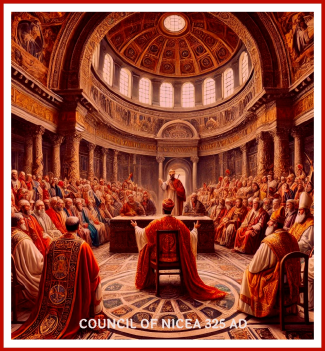
The First Council of Nicaea (325 AD)
Emperor Constantine, who had recently legalized Christianity, convened the First Council of Nicaea (in modern-day İznik, Turkey) to resolve the division, which threatened church unity and the stability of the Roman Empire.
About 220 bishops attended (mostly from the East). The council condemned Arianism as heresy. It produced the original Nicene Creed, which explicitly affirmed that the Son is “begotten, not made” and “of one substance [homoousios] with the Father.” Arius was exiled, and his writings were ordered burned.
Aftermath and Resolution
The controversy did not end at Nicaea. Arian views (or modified versions) remained popular in the Eastern church for decades: Some emperors (like Constantius II) favored Arian-leaning bishops and exiled Nicene defenders like St Athanasius multiple times.
“Semi-Arian” positions emerged, using terms like homoiousios (“of similar substance”) as compromises. The debate raged until the Council of Constantinople in 381, which reaffirmed and expanded the Nicene Creed, solidifying Trinitarian orthodoxy (Father, Son, and Holy Spirit as one God in three persons).
Arianism was largely suppressed in the Roman Empire but spread among some Germanic tribes (such as, the Visigoths, Goths, Vandals, and Lombards), who adopted an Arian form of Christianity when they converted.
Significance
The Arian controversy forced the church to clarify and define key doctrines using philosophical language (like homoousios, not found directly in Scripture) to counter interpretations of the Bible. It shaped the Nicene Creed, still recited by Christians today, and reinforced the Trinity as Christianity’s fundamental doctrine.
[While traditional accounts portray Arius as introducing a novel heresy, some modern scholarship notes it built on existing subordinationist trends in earlier theology*.]
The Arian controversy was a profound debate over whether Christ was created (Arian view) or eternally divine like the Father (orthodox view)—a question with massive implications for salvation, monotheism, and Christian identity.
* The trend of ‘subordinationism’ in early Christian theology can be traced back to the ante-Nicene period, where early Church Fathers like Justin Martyr, Tertullian, and Origen expressed the Son’s eternal generation but subordinate status to the Father’s monarchy. This view diverged from later Arianism, which radicalized the subordination into a creaturely status for the Son.
However, many subordinationists affirmed the Son’s eternal existence and co-divinity, albeit hierarchically ordered.
The doctrine faced increasing scrutiny as it risked undermining the Son’s full deity, contributing to the Arian controversy and prompting the Council of Nicaea (325 AD) to affirm the Son’s homoousios (same substance) with the Father, effectively rejecting subordinationist implications of inequality.
SEND A COMMENT
Links to our Massage Box
DOWNLOAD AS PDF
Printable version of this Page