
THE NICENE CREED
(Actually, the Niceno-Constantinopolitan Creed)
I believe in one God, the Father almighty, maker of heaven and earth, of all things visible and invisible.
I believe in one Lord Jesus Christ, the Only Begotten Son of God, born of the Father before all ages. God from God, Light from Light, true God from true God, begotten, not made, consubstantial with the Father; through him all things were made. For us men and for our salvation he came down from heaven, and by the Holy Spirit was incarnate of the Virgin Mary and became man. For our sake he was crucified under Pontius Pilate, he suffered death and was buried and rose again on the third day in accordance with the Scriptures. He ascended into heaven and is seated at the right hand of the Father. He will come again in glory to judge the living and the dead, and his kingdom will have no end.
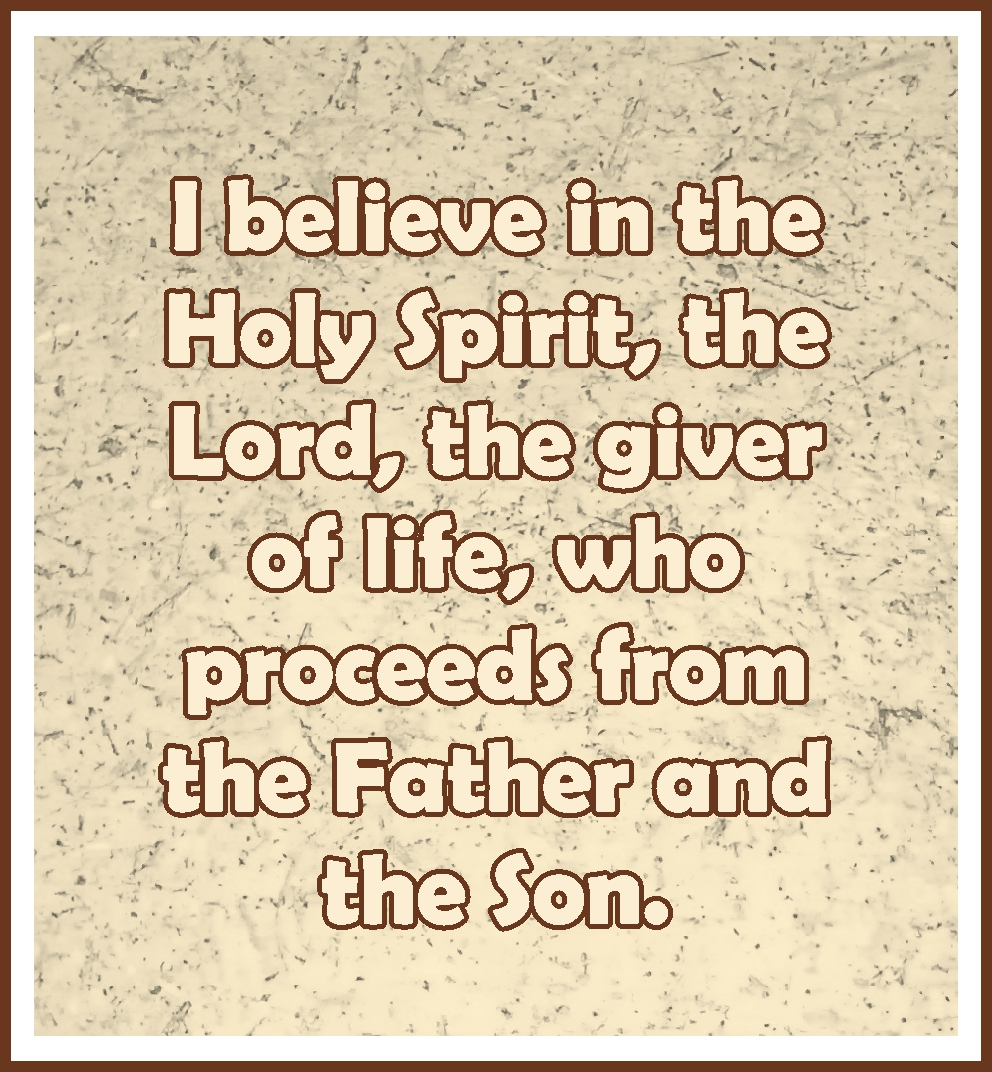
I believe in the Holy Spirit, the Lord, the giver of life, who proceeds from the Father and the Son, who with the Father and the Son is adored and glorified, who has spoken through the prophets.
I believe in one, holy, Catholic and Apostolic Church. I confess one Baptism for the forgiveness of sins and I look forward to the resurrection of the dead and the life of the world to come. Amen.
LATIN
| symbolum nicaeno-constantinopolitanum |
Credo in unum Deum, Patrem omnipotentem, factorem caeli et terrae, visibilium omnium et invisibilium.
Et in unum Dominum Iesum Christum, Filium Dei unigenitum, et ex Patre natum ante omnia saecula. Deum de Deo, lumen de lumine, Deum verum de Deo vero, genitum, non factum, consubstantialem Patri: per quem omnia facta sunt. Qui propter nos homines et propter nostram salutem descendit de caelis. et incarnatus est de Spiritu Sancto ex Maria Virgine, et homo factus est. Crucifixus etiam pro nobis sub Pontio Pilato; passus et sepultus est, et resurrexit tertia die, secundum Scripturas; et ascendit in caelum, sedet ad dexteram Patris, et iterum venturus est cum gloria, iudicare vivos et mortuos, cuius regni non erit finis.
Et in Spiritum Sanctum, Dominum et vivificantem: qui ex Patre Filioque procedit. qui cum Patre et Filio simul adoratur et conglorificatur: qui locutus est per prophetas.
Et unam, sanctam, catholicam et apostolicam Ecclesiam. confiteor unum baptisma in remissionem peccatorum. et expecto resurrectionem mortuorum, et vitam venturi saeculi. Amen.
The NICENE CREED (more precisely, the Niceno-Constantinopolitan Creed in its commonly used form) is the most important and widely accepted statement of Christian faith. It defines core beliefs about the Trinity and Christ’s divinity. It emerged from two major 4th-century ecumenical councils amid debates over Christ’s nature and the Trinity, particularly to counter Arianism controversy.
Origins
Early Christianity inherited Jewish monotheism while affirming Jesus as divine (like, John 1:1, John 20:28; Philippians 2:6–11) and the Holy Spirit’s role. Pre-Nicene creeds and baptismal formulas existed, but precise formulations were needed as Arian controversy arose.
Around 318 in Alexandria, presbyter Arius taught that the Son (Jesus) was a created being—begotten by the Father but not eternal or of the same substance (homoousios). He famously said there was “a time when [the Son] was not.” This view spread, dividing the church and threatening imperial unity after Emperor Constantine legalized Christianity (Edict of Milan, 313) and reunited the empire (324).
Constantine, a recent convert (baptized later), convened the First Council of Nicaea (modern İznik, Turkey) in May–July 325. About 220–318 bishops attended (mostly Eastern), with papal legates representing the West. Hosius of Corduba (256-357) played a key role.
The council condemned Arianism, exiled Arius, and produced a creed affirming the Son’s full divinity. The creed was likely based on or adapted from existing baptismal creeds, with anti-Arian insertions like homoousios (“of the same substance” or “consubstantial” with the Father). It ended with anathemas against Arian views.
Text of the Original Nicene Creed (325)
We believe in one God, the Father Almighty,
Maker of all things visible and invisible.
And in one Lord Jesus Christ,
the Son of God,
begotten of the Father, only-begotten,
that is, of the essence of the Father,
God from God,
Light from Light,
true God from true God,
begotten, not made,
of one substance with the Father,
by whom all things were made,
who for us men
and for our salvation
came down and was incarnate,
and was made man,
suffered,
and rose again the third day,
ascended into heaven,
and shall come again to judge the living and the dead.
And in the Holy Spirit.
But those who say: “There was a time when he was not,” and “He was not before he was begotten,” and “He was made out of nothing,” or who assert that he is of another substance or essence, or created, or subject to alteration or change — the Catholic and Apostolic Church anathematizes them.
This focused heavily on Christology. The Holy Spirit received only brief mention. Arianism and related views (like, Pneumatomachians, who diminished the Holy Spirit) persisted.
Emperor Theodosius I (a Nicene Creed supporter) called the First Council of Constantinople (May–July 381), attended mainly by Eastern bishops (Cappadocian Fathers like St Gregory of Nazianzus influenced it strongly). This council affirmed and adapted what is now commonly called the NICENE CREED—technically the Niceno-Constantinopolitan Creed.
It expanded the Holy Spirit section, added statements on the Church, baptism, resurrection, and life everlasting, and refined Christological language. It is not simply an edit of the 325 text but draws from other similar traditions as well.
NICENE CREED is the most important and widely accepted statement of Christian faith. It defines core beliefs about the Trinity and Christ’s divinity. It emerged from two major 4th-century ecumenical councils amid debates over Christ’s nature and the Trinity, particularly to counter Arianism.
MORE ON "NICENE CREED"
In the image at the head of this page, we have reproduced a snippet from the Nicene Creed: “I believe in the Holy Spirit, the Lord, the giver of life, who proceeds from the Father and the Son.” It turns out that this one line was the primary cause of the 1054 schism, that till today has separated many Orthodox churches for the Catholic Church.
The Filioque: A Catholic Perspective
The Filioque clause—”and the Son”—refers to the addition in the Latin version of the Niceno-Constantinopolitan Creed (often called the Nicene Creed) stating that the Holy Spirit “proceeds from the Father and the Son.” This phrase has been a source of theological discussion and division between the Catholic and Eastern Orthodox Churches for over a millennium.
From a Catholic viewpoint, the Filioque represents a required clarification of the ancient faith, rooted in Scripture and Tradition, that upholds the full divinity and equality of the Son while maintaining the unity of the Trinity.
The original Creed, as affirmed at the First Council of Constantinople in 381, states that the Holy Spirit “proceeds from the Father.” This was directed primarily against the Pneumatomachi (Macedonians), who denied the full divinity of the Holy Spirit. The Creed was received and ratified in the West by Pope St Leo I in 451.
The Filioque emerged in the West to counter Arianism, which subordinated the Son. It first appeared in local creeds and synods in Spain (like, the Third Council of Toledo in 589) as the Visigoths converted from Arianism. By the early 11th century, it had become standard in the Latin Church, with Rome adopting it liturgically around 1014.
Catholics maintain that the addition was not an unauthorized tampering with an ecumenical text but a development. The Creed itself evolved between Nicaea (325) and Constantinople (381).
The Catholic Church acknowledges the original Greek text’s authority while viewing clarifications as permissible when they preserve the faith. Eastern Catholic Churches often recite the Creed without the Filioque, reflecting diversity.
Catholic teaching holds that the Holy Spirit proceeds eternally from the Father and the Son as from one principle. This is grounded in Scripture.
The Holy Spirit is called the “Spirit of the Son” (Galatians 4:6) and the “Spirit of Christ” (Romans 8:9), paralleling His relation to the Father. Jesus breathes the Spirit on the Apostles (John 20:22), sends Him (John 15:26, 16:7), and says the Spirit “will receive of mine” (John 16:13-15). Revelation 22:1 depicts a “river of the water of life” flowing from the throne of God and of the Lamb, traditionally interpreted as the Holy Spirit proceeding from both.
Patristic support is strong in both East and West. Western Fathers such as Tertullian, St Hilary of Poitiers, St Ambrose, and especially St Augustine developed the theology explicitly. Augustine’s De Trinitate profoundly influenced Latin Trinitarian thought, emphasizing the Spirit as the bond of love between Father and Son.
Eastern Fathers also provide testimony. St Cyril of Alexandria spoke of the Spirit as proceeding from the Father through the Son or receiving from the Son. Didymus the Blind, Epiphanius, and others used language compatible with the Filioque.
Pope St Leo I confessed the doctrine dogmatically in 447. The Council of Florence (1438–1445) later affirmed that expressions like “through the Son” in the East align with the Latin understanding when properly interpreted.
The Church has defined the doctrine at multiple councils. The Fourth Lateran Council (1215), Second Council of Lyons (1274), and especially the Council of Florence declared that the Holy Spirit proceeds eternally from the Father and the Son, not as from two principles but as from one, by a single spiration. Florence emphasized that the Father gives everything to the Son (except Fatherhood), including the power to spirate the Spirit.
The Catechism of the Catholic Church (CCC §§246-248) explains this as a complementarity of traditions. The Latin formulation highlights the consubstantiality of Father and Son, while the Greek “from the Father through the Son” underscores the Father’s monarchy (source of the Trinity). These are not contradictory when neither is rigidified.
Critics sometimes claim the Filioque implies two sources in the Trinity or confuses persons and essence. Catholics reject this: there is one principle (Father and Son together), preserving the Father’s unique role as unoriginated source while affirming the Son’s full participation due to His consubstantiality.
Eastern objections center on three points: the unilateral addition to the Creed, perceived subordination of the Father’s monarchy, and potential blurring of Trinitarian distinctions.
Catholics respond that the addition addressed real heresies in the West and was a pastoral clarification, not a rejection of the original Creed. On monarchy, the doctrine upholds the Father as the source of the Son (by generation) and, with the Son, of the Spirit (by spiration).
Florence explicitly reconciled “through the Son” with the Latin view. Many modern ecumenical statements, including the 2003 North American Orthodox-Catholic Consultation, suggest the issue need not divide the Churches if understood in context.
The Filioque also has pastoral value: it underscores the equality of the Son against subordinationism and highlights the Spirit as the mutual love of Father and Son, enriching devotion to the Trinity.
Ecumenical Horizons
The Catholic Church has shown flexibility. Popes have recited the Creed without the Filioque in Greek contexts, and Eastern Catholics retain their traditions. John Paul II and others emphasized unity in diversity. While full reunion requires addressing primacy as well (regected after Florence), the Filioque is increasingly seen as a matter of legitimate theological emphasis rather than an insurmountable barrier.
Conclusion
From the Catholic perspective, the Filioque is a faithful development of apostolic doctrine. It confesses the eternal, dynamic life of the Trinity: The Father begets the Son, and from both proceeds the Holy Spirit as the perfect bond of love. Far from dividing the Church, a proper understanding can enrich both traditions. As the Council of Florence and modern dialogues show, when approached with charity the ancient formulas—”from the Father,” “through the Son,” and “from the Father and the Son”—point to the same ineffable mystery.
The Filioque ultimately invites believers deeper into the heart of Trinitarian faith, where the one God is eternally relational—Father, Son, and Holy Spirit, one in essence, three in Person. In professing it, we join the great chorus of the Church across the ages in glorifying the Triune God who reveals Himself as perfect communion.