
BREATHE INTO ME; SPIRIT OF GOD
()
Breathe into me, Spirit of God, that I may think what is holy.
Drive me, Spirit of God, that I may do what is holy.
Draw me, Spirit of God, that I may love what is holy.
Strengthen me, Spirit of God, that I may preserve what is holy.
Guide me, Spirit of God, that I may never lose what is holy. Amen.
The prayer BREATHE INTO ME; SPIRIT OF GOD is a modern devotional text, yet it stands firmly within the ancient Christian tradition of breath-centered prayer. While the exact wording does not appear in patristic writings or the Roman liturgy, its structure and themes resonate with practices that reach back to the earliest centuries of Christianity.
Roots
The biblical foundation for such prayers lies in the Hebrew ruach and Greek pneuma: Both words mean breath, spirit, wind, showing the inseparable link between physical life and the Divine Spirit. In Genesis 2:7, God breathes life into Adam, a motif that shaped Christian spirituality by linking divine breath with human life and prayer.
This connection was further developed by the Desert Fathers and Mothers in the 4th century, who cultivated short, repetitive prayers synchronized with breathing as a way to fulfill Paul’s exhortation to “pray without ceasing” (1Thessalonians 5:17).
Their most enduring example is the Jesus Prayer—“Lord Jesus Christ, Son of God, have mercy on me”—which was often prayed in rhythm with inhalation and exhalation. The prayer BREATHE INTO ME; SPIRIT OF GOD mirrors this ancient cadence.
Each petition—“Breathe into me… Drive me… Draw me… Strengthen me… Guide me…”—invokes the Spirit’s action and ties it to holiness, echoing biblical themes of sanctification and perseverance.
Though contemporary in wording, it reflects the same contemplative impulse found in traditional invocations of the Holy Spirit, such as “Veni Sancte Spiritus” (the medieval sequence hymn) and “Come, Holy Spirit” (a hymn widely used in Catholic liturgy). Its modernity lies in its accessible style: short, repeatable, and easily memorized, making it suitable for personal devotion.
Yet its continuity with tradition is unmistakable. By emphasizing the Spirit’s role in guiding thought, action, love, and fidelity, it participates in the living stream of Christian spirituality that has sought, for over sixteen centuries, to unite breath, prayer, and holiness.
Possible Origin
Scholars generally trace it to the Jesuit tradition of short invocations to the Holy Spirit, especially prayers used before study or preaching. It echoes the structure of older Latin prayers (imperatives addressed to the Spirit: Veni, Sancte Spiritus; Reple; Accende; Emitte), but the exact wording seems to be a 20th‑century English composition.
While the prayer “Breathe into me; Spirit of God” does not have a fixed liturgical or patristic origin, it belongs to the family of breath prayers—a contemplative practice deeply rooted in Scripture and early Christian tradition. Its wording is modern, but its spirit is ancient, embodying the enduring Christian desire to let every breath become prayer.
MORE ON "BREATHE INTO ME" prayer
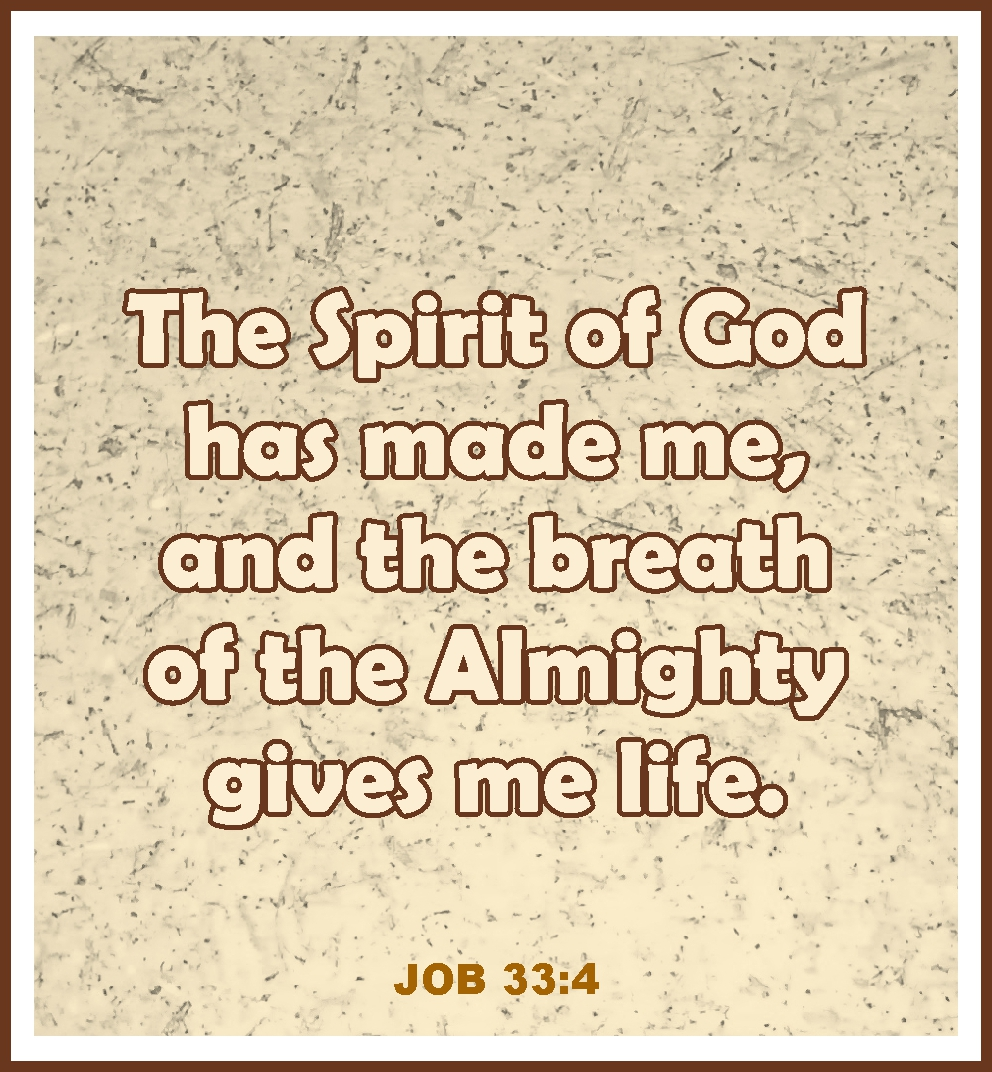
The image at the head of this page, has the verse from Job 33:4: “The Spirit of God has made me; the breath of the Almighty gives me life.”
The Desert Fathers and Mothers fled into the wilderness not to escape the world, but to breathe more deeply of God. In the silence of the desert, they discovered that prayer could be as simple and constant as the rhythm of inhaling and exhaling.
They teach us that prayer need not be complicated. A single phrase, whispered with each breath, can draw us into communion with God. Their wisdom shows that holiness is not found in many words, but in a heart that breathes God’s name with love.
Breath and the Spirit of God
In the beginning, God stooped over dust and breathed into Adam’s nostrils the breath of life (Genesis 2:7). That divine breath transformed clay into a living soul, reminding us that every heartbeat and inhale is sustained by Him.
Job confessed, “The Spirit of God has made me, and the breath of the Almighty gives me life” (Job 33:4). Here, breath and Spirit are inseparable — God’s Spirit is not distant, but as close as the air filling our lungs.
The prophet Ezekiel saw a valley of dry bones, lifeless and scattered. Yet God declared, “I will cause breath to enter you, and you shall live” (Ezekiel 37:5). The Spirit’s breath brings resurrection, hope, and renewal where despair reigns.
Jesus fulfilled this mystery when He appeared to His disciples after the resurrection. He breathed on them and said, “Receive the Holy Spirit” (John 20:22). Just as Adam’s life began with God’s breath, the Church’s mission began with Christ’s breath—a new creation empowered by the Spirit.
At Pentecost, the Spirit came as a rushing mighty wind (Acts 2:2), filling the room and igniting hearts with fire. Breath became wind, wind became Spirit, and Spirit became boldness to proclaim the Gospel to the nations.
Reflection
- Every breath is grace: A reminder that God sustains us moment by moment.
- The Spirit renews: Just as dry bones lived again, He revives weary souls.
- Christ breathes peace: His Spirit is not only power but also comfort.
- Pentecost continues: The same Spirit who filled the apostles fills us today.