
COME HOLY SPIRIT
(For Fire of Divine Love)
Come, Holy Spirit, fill the hearts of your faithful and enkindle in them the fire of your love. Send forth your Spirit and they shall be created, and you shall renew the face of the earth.
Let us pray: O God, who has instructed the hearts of your faithful by the light of the Holy Spirit, grant that by the same Holy Spirit we may have a right judgment in all things and evermore rejoice in his consolations. Through Christ Our Lord, Amen.
LATIN
| veni sancte spiritus |
Veni, Sancte Spiritus, reple tuorum corda fidelium, et tui amoris in eis ignem accende. Emitte Spiritum tuum, et creabuntur. Et renovabis faciem terrae.
Oremus: Deus, qui corda fidelium Sancti Spiritus illustratione docuisti, da nobis in eodem Spiritu recta sapere, et de eius semper consolatione gaudere. Per Christum Dominum nostrum. Amen.
The “COME, HOLY SPIRIT” prayer a popular invocation, in Catholic devotion, asking the Holy Spirit to fill believers with fire of Divine love and renew the face of the earth.
Roots
The prayer draws directly from Scripture and early Christian experience of the Holy Spirit at Pentecost (Acts 2). The apostles and disciples experienced the Holy Spirit’s dramatic arrival as wind and fire, empowering them for the mission. This event is central to the prayer’s themes of ‘filling’, ‘fire’, and ‘renewal’.
In John 20:22, Jesus breathes on the disciples and says, “Receive the Holy Spirit,” modeling the intimate invitation in the prayer.
Psalm 104:30: “Send forth your Spirit and they shall be created, and you shall renew the face of the earth” is quoted verbatim in the prayer.
Early Christians invoked the Spirit in worship and sacraments. For example, in the early 200s, theologian Hippolytus included an invocation like “…And we pray that you would send your Holy Spirit” in relation to the Eucharist and Ordination.
Origins
The prayer as known today emerged from medieval Latin liturgy, particularly around Pentecost. The 9th century hymn Veni Creator Spiritus (“Come, Creator Spirit”), attributed to the Benedictine monk and archbishop St Rabanus Maurus, provided an early sung form beginning “Come, Holy Spirit, Creator, come…” This equipped the Church to invoke the Spirit in worship.
In the 13th century the related but distinct Veni Sancte Spiritus (“Come, Holy Spirit”), known as the “Golden Sequence,” became prominent. This is a beautiful Latin poem/sequence. It is one of only four medieval sequences retained in the Roman Missal after the Council of Trent.
Authorship is uncertain but often attributed to the then Archbishop of Canterbury Stephen Langton (1150-1228) or Pope Innocent III (1160-1216). It dates to roughly the late 13th century and praises the Spirit as Comforter, Light, and Giver of gifts.
This specific popular prayer combines elements from the Pentecost liturgy: The opening lines come from the Alleluia verse sung before the Gospel on Pentecost. The Psalm 104 quote was part of associated chants. The concluding prayer adapts an older opening prayer for the feast or Votive Masses of the Holy Spirit.
It a popular prayer composed by the faithful from liturgical texts they heard repeatedly.
Later Use and Popularity
Post-Tridentine era (1570 onward): The Veni Sancte Spiritus sequence was standardized in the Roman Missal for Pentecost and its octave.
It became a staple in personal devotion, novenas (especially the Pentecost novena, echoing the apostles’ nine days of prayer in the Upper Room with Mary), ordinations, confirmations, and daily prayer.
Figures like St Ignatius of Loyola (and later Fr Theodore Hesburgh, CSC) popularized simple invocations of “Come, Holy Spirit” for guidance and inspiration.
In the 20th century, it featured prominently in the Charismatic Renewal and movements like the Vineyard, where “Come, Holy Spirit” became a spontaneous invitation for the Spirit’s power in worship and ministry.
The prayer’s enduring power lies in its simplicity, scriptural depth, and connection to Pentecost—invoking the Spirit as the dynamic presence of God who empowers, renews, and transforms. It remains a “prayer that never fails” for countless believers seeking wisdom, consolation, and renewal.
MORE ON "COME HOLY SPIRIT"
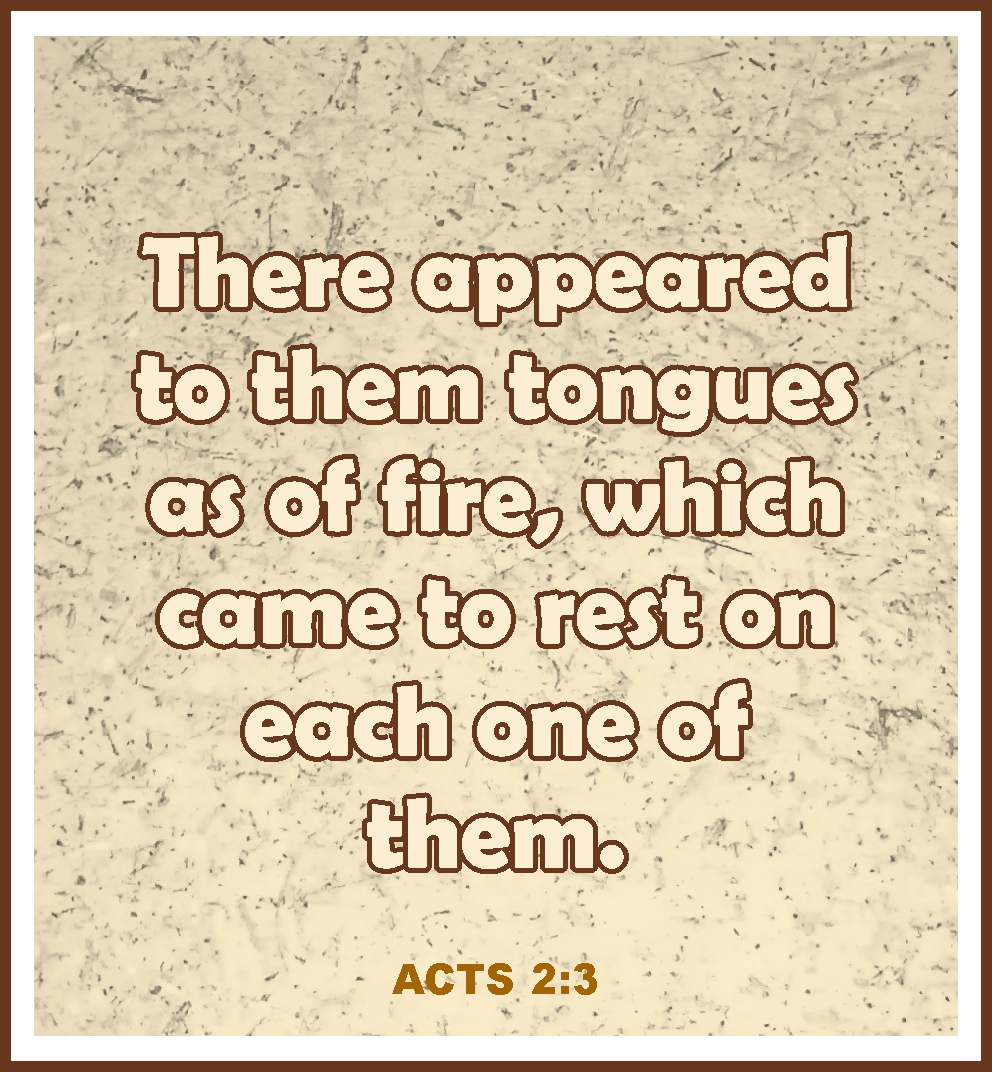
The image at the head of this page, has the verse from Acts 2:3: “Then there appeared to them tongues as of fire, which separated and came to rest on each one of them.”
That was the day of the Holy Spirit came down on Mary and the disciples in the upper room and inflamed the Church. He still continues to do with His fire of divine love.
The Fire of Pentecost in Daily Life
The fire of Pentecost was not a fleeting miracle confined to the upper room; it was the Spirit’s way of showing that God’s love is meant to burn within human hearts across all ages. When the apostles saw tongues of fire resting upon them, they were transformed from hesitant followers into bold witnesses.
That same flame is invoked every time we pray, “Come, Holy Spirit… and kindle in them the fire of your love.” The prayer is not simply poetic—it is a living continuation of Pentecost, asking the Spirit to keep us ignited.
To experience this fire practically today, we begin with prayerful openness. Just as the apostles waited in prayer, we too must create space for the Spirit to enter our lives. In moments of silence, in the rhythm of daily prayer, the Spirit’s flame purifies our distractions and kindles courage. The sacraments deepen this experience: in the Eucharist, Christ nourishes the flame of divine love, and in Confirmation, the Spirit seals us with strength, reminding us that Pentecost is not past history but present reality.
This fire also takes shape in acts of love. Love is not abstract; it burns in the small gestures of kindness, forgiveness, and service. When we reach out to the poor, reconcile with a neighbor, or encourage someone in despair, we are living a miniature Pentecost.
The Spirit’s fire emboldens us to witness with courage, just as the apostles did. It gives us strength to stand for truth, to share our faith without fear, and to live with integrity even when it costs us something.
Most profoundly, the Spirit’s fire transforms us interiorly. It burns away selfishness and ignites zeal for holiness. Sometimes this transformation is dramatic, but often it is quiet—the patience to endure trials, the perseverance to remain faithful in prayer, the joy that radiates in ordinary life.
In these ways, the Pentecost fire becomes the fire of the Come, Holy Spirit prayer: one is the spark that lit the Church, the other is the flame that keeps us burning with love today.
Thus, every time we whisper “Come, Holy Spirit,” we invite Pentecost to happen again—not in Jerusalem, but in our own hearts. The Spirit’s fire is not distant; it is alive, waiting to be kindled in prayer, nourished in the sacraments, expressed in love, and lived with courage. Pentecost is not just a feast day—it is the way of life.