
WHAT IS "SOLA SCRIPTURA"?
▬
The doctrine of ‘sola scriptura’—that the Bible alone is the sole deposit of faith—has been a hallmark of Protestantism since its inception 509 years ago. While it emphasizes the exclusive authority of the Bible, the Catholic Church rejects this view as incomplete and contrary to the fullness of Christian revelation. A Catholic response rests on Scripture itself, the witness of history, and theological reasoning.
▬
Scripture is the inspired Word of God, ‘breathed by the Holy Spirit’ [Greek theópneustos used in 2Timothy 3:16] and written through human authors. It is the heart of revelation, the living testimony of God’s covenant with his people.
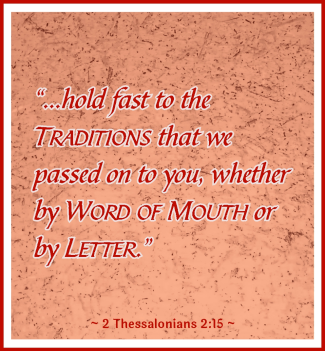
Yet Scripture itself points beyond the written pages. St Paul exhorts believers to “Stand firm and hold to the traditions which you were taught by us, either by word of mouth or by letter.” (2Thessalonians 2:15).
In John 21:25 we are told that everything Jesus did was not written down, showing that revelation extends beyond the text.
The Bible is not a closed book dropped from heaven, but a sacred text born from within the life of the Apostolic Church.
+
Tradition is the living memory of the Church, going back the Apostles and carried forward through liturgy, teaching, and the witness of faith. This witness is crucial as it boldly proclaimed Christ in both word and deed, even in the face of persecution.
So, it is Tradition that preserved the faith through persecution, it is Tradition that discerned the canon of Scripture, and Tradition that hands down the truths not explicitly written but faithfully believed. Without Tradition, the Bible itself would be incomprehensible, for it is Tradition that teaches us how to read it right.
The very existence of the Bible as we know it depends on the Church. The canon of Scripture was confirmed by councils such as Hippo (393) and Carthage (397), later ratified by Rome. Without Tradition, we would not even know which books belong to the Bible.
+
In Acts 8:30–31, the Ethiopian eunuch admits he cannot understand Scripture without guidance; this spotlights the need for authoritative interpretation. Thus, Scripture itself endorses the living teaching authority of the Church.
The early Fathers also testify to this truth. St Irenaeus (102-203) highlights apostolic succession as the safeguard of authentic teaching (Proof of the Apostolic Preaching), while St Augustine (354-430) famously declared: “I would not believe the Gospel unless moved by the authority of the Catholic Church” (in Against the Epistle of Manichaeus Called Fundamental). The Church’s authority validates Scripture, not the other way around.
Just as Israel had priests and prophets to interpret God’s word, the Church has a divinely appointed authority to guard the deposit of faith. The Magisterium does not add to revelation but serves it, ensuring that Scripture and Tradition are authentically understood, preventing fragmentation, and safeguarding unity.
ab ovo

Comment, Share, Download (PDF), Print and Subscribe for Free
ab ovo
Comment, Share, Download (PDF), Print and Subscribe for Free
In a world of countless interpretations, this threefold harmony ensures clarity and continuity that keeps the Church together.
Faith was never meant to be fragmented, yet sola scriptura has led to tens of thousands of Protestant denominations (~41,000), each interpreting Scripture differently. If Scripture alone were sufficient, everyone would arrive at the same truth, but history shows otherwise.
This fragmentation clearly demonstrates the danger of private interpretation without a guiding authority. In John 17:21, Christ prayed that his followers would be one, a unity that is safeguarded by a living teaching authority. The Catholic Church embodies this through its unified voice, preserving intact the faith transmitted by the Apostles.
The threefold harmony is the Catholic answer to sola scriptura. Scripture alone, without Tradition and Magisterium, becomes a solo voice detached from its eternal symphony, leading to discord and division.
But Scripture with Tradition, interpreted by the Magisterium, preserves the fullness of revelation. It ensures that the faith handed down from Apostolic beginnings remains alive, unbroken, and united across centuries. It is this harmony that allows the Church to proclaim with confidence the same Gospel today that was preached two thousand years ago.
In the end, the Catholic understanding is not “Scripture vs Tradition,” but Scripture with Tradition, safeguarded by the Magisterium. This threefold chord cannot be broken (Ecclesiastes 4:12), for it is woven by the Holy Spirit himself. It is the melody of God’s revelation, resonating through time, binding the Church together, and keeping the faith alive until Christ comes again.
▬
The road to Emmaus narrative points to Scripture in Christ’s exposition, Tradition in the Eucharistic act, and the teaching authority, all manifested in the person of Jesus.
An example that reveals the incompleteness of Sola Scriptura appears in the Road to Emmaus narrative in Luke 24:13-35. It was the day of Jesus’ resurrection. He joins two disciples walking from Jerusalem to Emmaus, about seven miles away. They were confused and sorrowful after his crucifixion because they did not know that he had risen.
As he spoke and ‘opened’ the Scriptures, explaining the prophecies concerning himself, the disciples experienced a profound internal response, they later described as “hearts burning” within them.
Yet they did not recognize him.
Only when Jesus took “bread, blessed it, broke it” and gave it to them—the Eucharistic act—were their eyes opened and they finally recognized him. On the day of the resurrection, the Eucharist act was already the Tradition.
Scripture prepares their heart, not by itself, but through Christ’s teaching authority, and the Eucharist unveils the living Christ in his risen presence.
This narrative spotlights Scripture and Tradition together forming the fullness of revelation. And the Magisterium flows from Christ’s own authority to teach which he transferred to his Church (Matthew 28:19–20).
IN SUMMARY
The disciples already possessed the Scripture and had undoubtedly read the prophecies concerning the Messiah, each forming their own interpretation (Scripture alone).
Jesus then authoritatively opened the Scripture to them, explaining their true meaning (the Magisterium). Yet even after this profound teaching—when their hearts were burning within them—they still did not recognize him.
Full recognition came only in the breaking of the bread, the Eucharistic act (the Tradition), which was not part of the written Scripture at that moment.
֍
CONTEMPLATION
“A cord with three strands is not easily broken.” (Ecclesiastes 4:12)
Further Comments on "WHAT IS "SOLA SCRIPTURA"?"
In the image at the head of this page, we have quoted 2Thessalonians 2:15, Paul’s wording shows that Scripture itself is part of Tradition. Notice how he says: “Stand firm and hold to the traditions which you were taught by us, either by word of mouth or by letter.”
The “letter” refers to the written Scriptures (like Paul’s epistles).
The “word of mouth” refers to oral teaching handed down directly from the apostles. Together, they form Sacred Tradition—the living transmission of the faith.
1st Prostistant Proof text: For Sola Scriptura
“All Scripture is inspired by God and profitable for teaching, for reproof, for correction, and for training in righteousness, that the man of God may be complete, equipped for every good work.” (2Timothy 3:16–17)
This passage is beautiful and true: Scripture is indeed God‑breathed (theopneustos), given for our instruction and sanctification. Catholics wholeheartedly affirm this. Yet, notice what Paul does not say. He does not claim that Scripture is sufficient by itself, nor that it is the only source of God’s Word. He simply declares its divine origin and usefulness.
Paul himself insists we must hold fast to both written and oral teaching (2Thessalonians 2:15). This shows that Scripture is part of a larger stream of Tradition. The Bible is the written portion of God’s Word, but the living Tradition of the Church carries the fullness of Apostolic teaching — in liturgy, preaching, and practice.
Thus, 2 Timothy 3:16–17 praises Scripture’s power, but it does not isolate it from Tradition. Instead, it situates Scripture within the Church’s life, where it is proclaimed, explained, and lived.
Paul’s words were written to Timothy, a bishop, entrusted with guarding the deposit of faith. Scripture equips him, but so does the Apostolic authority he received through ordination. The “man of God” is complete not because he has Scripture alone, but because he has Scripture and the Spirit‑guided ministry of the Church.
For us today, this passage is a call to love the Scriptures deeply. They are God’s living Word, shining light for our path. But it is also a reminder to read them with the Church, not apart from her.
Just as Timothy was guided by Paul, so we are guided by the Magisterium, which ensures that Scripture is never twisted or fragmented.
2 Timothy 3:16–17 is not proof of sola scriptura. It is proof of the inspiration and power of Scripture, which Catholics fully affirm. But Scripture is never alone — it belongs to the one deposit of faith, handed down in Tradition and safeguarded by the Church. In this harmony, the Word of God truly makes us complete.
2nd Prostistant Proof text: AGAINST SACRED TRADITION
“Why do you break the commandment of God for the sake of your tradition?” (Matthew 15:3). He then cites Isaiah: “This people honors me with their lips, but their heart is far from me; in vain do they worship me, teaching as doctrines the commandments of men.” (Matthew 15:8–9; Mark 7:6–7).
Here Jesus condemns human traditions that distort or override God’s law. This refers to the Jewish practice of Corban rule that allowed individuals to declare their possessions as “gifts to God,” thereby avoiding the obligation to support their parents. This practice was used by some to justify neglecting their familial duties, which Jesus criticized as a form of hypocrisy. The term “Corban” refers to something that is dedicated to God, but in this context, it was often used to evade the commandment to honor one’s parents. Such practices twisted devotion into an excuse for disobedience. Jesus exposes this hypocrisy: when tradition becomes a way to avoid God’s will, it is false worship.
Catholics agree wholeheartedly: any tradition that nullifies God’s word must be rejected. But the Church distinguishes between:
- Human traditions (like the Corban rule), which can be corrupt or misguided.
- Sacred Tradition, which is the living transmission of Christ’s teaching through the apostles, guided by the Holy Spirit.
Jesus is not condemning Sacred Tradition. In fact, the New Testament itself shows the Apostles handing on teachings orally (2Thessalonians 2:15) and through liturgical practice (1Corinthians 11:23–26).
Sacred Tradition is not man‑made rules, but the Spirit‑guided handing down of the Gospel.
The Protestant reading assumes that Jesus here rejects all tradition. But the Catholic reading sees that He rejects corrupt traditions that contradict God’s Word.
Sacred Tradition, by contrast, safeguards God’s Word and ensures it is faithfully lived. Without Tradition, even Scripture itself would be uncertain — for it was the Church, guided by Tradition, that discerned the canon of the Bible.
These verses remind us to examine our own hearts. Do we cling to customs or habits that keep us from obeying God’s command to love? Do we sometimes honor Him with our lips while our hearts are far away? Christ calls us to purity of worship — not empty ritual, but living faith.
For Catholics, this means cherishing Sacred Tradition as a gift, while being vigilant against human traditions that obscure the Gospel. True Tradition always leads us deeper into Christ, never away from Him.
Matthew 15 and Mark 7 are not a rejection of Tradition itself, but of false traditions that nullify God’s Word. The Catholic Church embraces Sacred Tradition as the Spirit‑guided transmission of Christ’s teaching, inseparably united with Scripture. Together, they form the living Word of God that equips us to worship Him in spirit and truth.