
REGINA CAELI
()
[℣] Queen of Heaven, rejoice, alleluia.
[℟] For He whom you did merit to bear, alleluia.
[℣] Has risen, as He said, alleluia.
[℟] Pray for us to God, alleluia.
[℣] Rejoice and be glad, O Virgin Mary, alleluia.
[℟] For the Lord has truly risen, alleluia.
[℣] Let us pray:
[Ⱥ] O God, who gave joy to the world through the Resurrection of Your Son, our Lord Jesus Christ, grant we beseech You, that through the intercession of the Virgin Mary, His Mother, we may obtain the joys of everlasting life. Through the same Christ our Lord. Amen
LATIN
| regina caeli |
[℣] Regina caeli, laetare, alleluia.
[℟] Quia quem meruisti portare, alleluia.
[℣] Resurrexit, sicut dixit, alleluia.
[℟] Ora pro nobis Deum, alleluia.
[℣] Gaude et laetare, Virgo Maria, alleluia.
[℟] Quia surrexit Dominus vere, alleluia.
[℣] Oremus:
[Ⱥ] Deus, qui per resurrectionem Filii tui, Domini nostri Iesu Christi, mundum laetificare dignatus es: praesta, quaesumus, ut per eius Genitricem Virginem Mariam perpetuae capiamus gaudia vitae. Per eundem Christum Dominum nostrum. Amen.
REGINA CAELI (traditionally spelt Regina Cœli) is a Marian antiphon in the Roman Rite of the Catholic Church, meaning “Queen of Heaven.” It is sung or recited during the Easter season (from Easter Sunday through Pentecost) in place of the Angelus, and it concludes Compline (Night Prayer) in the Liturgy of the Hours. It joyfully addresses Mary as Queen of Heaven, celebrates Christ’s Resurrection (which she “merited to bear”), and asks for her intercession. The repeated Alleluia underscores Easter joy, contrasting with the more somber or Incarnation-focused Angelus.
Origins
The authorship is unknown. Historians trace the text to the 12th century, with the earliest known appearance in an antiphonary from around 1200 preserved in St Peter’s Basilica in Rome.
It entered Franciscan use after Compline in the first half of the 13th century and spread widely through the Franciscans and the Roman Curia Office.
By the late Middle Ages, it became one of the four seasonal Marian antiphons (along with Alma Redemptoris Mater, Ave Regina Caelorum, and Salve Regina).
It has been set to music by many composers, including William Byrd, Gregor Aichinger, and Wolfgang Amadeus Mozart.
The Legend
A popular medieval legend, recorded in the 13th-century Golden Legend by Jacobus de Voragine, links it to Pope St Gregory the Great (reign: 590–604) during a plague in Rome. While leading a barefoot procession with an icon of the Virgin Mary (said to be painted by St Luke), angels were reportedly heard singing the first three lines of the antiphon. Gregory added the fourth line (“Ora pro nobis Deum, alleluia”). He then saw an angel (St Michael) sheathing a sword atop the Mausoleum of Hadrian (now Castel Sant’Angelo), signaling the end of the plague.
This story is devotional and symbolic rather than strictly historical—the text itself dates centuries later—but it ties the prayer to themes of Easter joy, Marian intercession, and deliverance from suffering. Similar legends exist for other Marian prayers.
Liturgical Role
The prayer emphasizes Mary’s role in the Resurrection and invites believers to share her joy. It replaced the Angelus during Eastertide because it shifts focus from the Annunciation/Incarnation to the triumph of the Resurrection. It remains a staple in monasteries, churches, and personal devotion, often prayed at 6 am, noon, and 6 pm during Easter.
While rooted in a 6th-century legend, the REGINA CAELI as we know it emerged in the High Middle Ages as a joyful Easter acclamation to Mary, quickly becoming a beloved part of Western Christian liturgy and music.
MORE ON "REGINA CAELI"
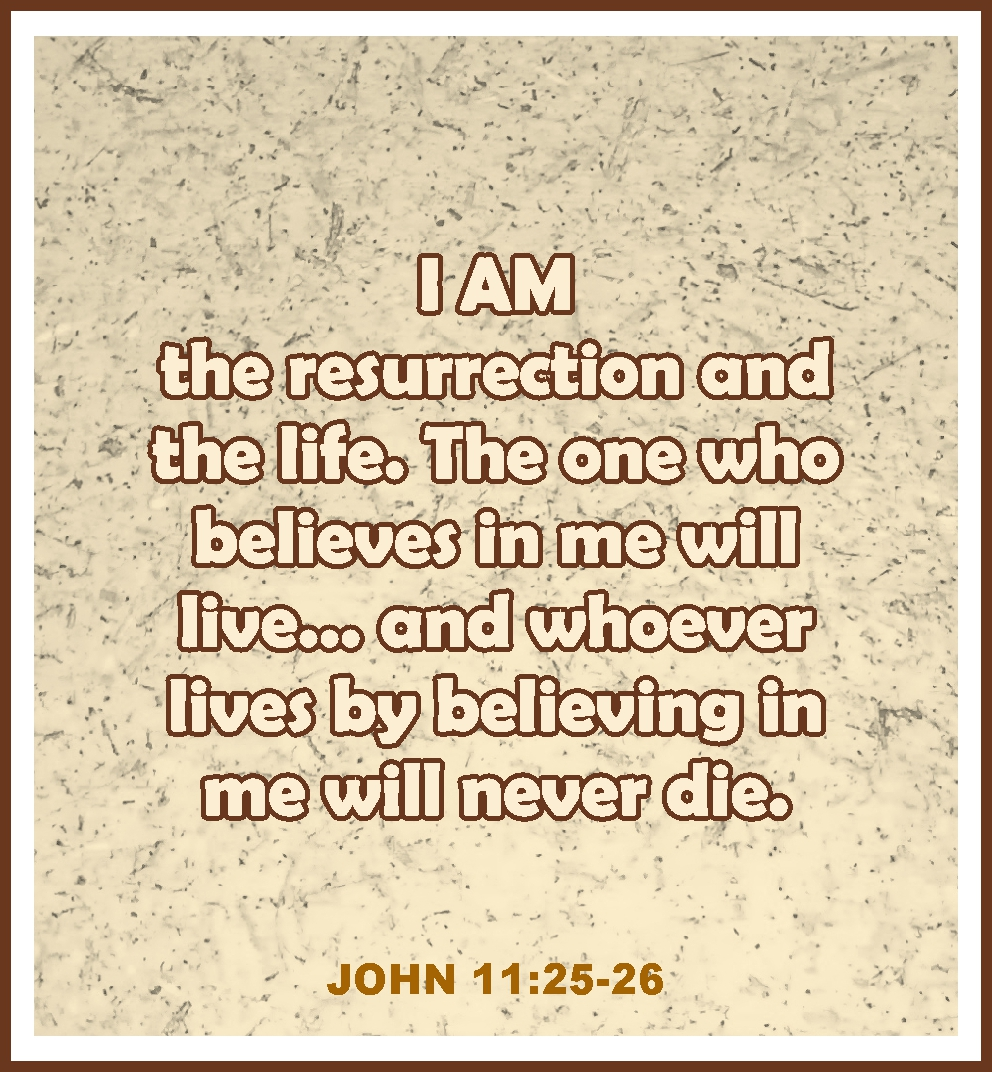
The image at the head of this page, we have quoted from John 11:25-26. Mary’s Assumption is woven into the Johannine promise, showing her as both Mother of the Resurrection and living witness to Christ’s victory over death.
Mother of the resurrection and the life
Mary’s motherhood of the divine Person ties directly into John 11:25–26. She bore the One who is Resurrection and Life, and in her own destiny we see His promise fulfilled: “everyone who lives and believes in me shall never die.”
Her Assumption is the radiant proof that Christ’s word is trustworthy. To contemplate Mary is to see the Resurrection already at work, and to be strengthened in hope that what was fulfilled in her will one day be fulfilled in us.
When Jesus declared to Martha, “I am the resurrection and the life. Whoever believes in me, though he die, yet shall he live, and everyone who lives and believes in me shall never die” (John 11:25–26), He revealed Himself as the living source of eternal life.
These words are not mere consolation but the very identity of Christ: Resurrection incarnate. And it is precisely here that Mary’s divine motherhood becomes luminous.
Mary did not give birth to one who points to resurrection; she bore in her womb the One who is Resurrection. Her fiat at the Annunciation made possible the enfleshment of the eternal Word, the Lord of life who would conquer death. Thus, her motherhood is inseparable from the mystery proclaimed at Bethany: she is Mother of the Resurrection, Mother of the One who can truthfully promise that death will never have the final word.
The words of Jesus to Martha—“everyone who lives and believes in me shall never die”—find a singular fulfillment in Mary herself. According to the faith of the Church, Mary, preserved from sin and wholly united to her Son, was assumed body and soul into heavenly glory. She did not undergo corruption in the grave, but was drawn into the fullness of life by the One she bore. In her, the promise of Christ is not only spoken but embodied: she believed, she lived in Him, and she never tasted death as we know it.
Mary is thus the first fruit of the victory Jesus proclaimed, a living sign that His words are true.
Martha was invited to move from abstract belief in a future resurrection to personal trust in Jesus as Resurrection itself. Mary had already lived this mystery in her motherhood. She carried within her the divine Person who is Life, and she entrusted herself completely to Him. Her Assumption shows that the promise of John 11:26 is not distant but real: those who live and believe in Christ will never die, for death has no power over those fully united to Him.