
THE LORD'S PRAYER
(A Direct Gift from Jesus)
Our Father who is in heaven, hallowed be your name. Your kingdom come. Your WILL be done on earth, as it is in Heaven. Give us this day our daily bread and forgive us our trespasses as we forgive those who trespass against us, and lead us not into temptation, but deliver us from evil. Amen.
LATIN
| pater noster |
Pater Noster, qui es in caelis, sanctificetur nomen tuum. Adveniat regnum tuum. Fiat voluntas tua, sicut in caelo et in terra. Panem nostrum quotidianum da nobis hodie, et dimitte nobis debita nostra sicut et nos dimittimus debitoribus nostris. Et ne nos inducas in tentationem, sed libera nos a malo. Amen.
The LORD’S PRAYER is the central prayer taught by Jesus to His disciples. It is both a model of how to pray and a summary of the Gospel message. In its simple yet profound words, we praise God’s holiness, seek His kingdom, ask for daily sustenance, forgiveness, and deliverance from evil. This prayer unites Christians across traditions, forming the heart of personal devotion and communal worship. It is often called the ‘perfect prayer’ because it embraces adoration, petition, and trust in God’s providence.
Origins
The Lord’s Prayer (also known as the Our Father or Pater Noster) is the prayer Jesus taught his disciples, recorded in two versions in the New Testament—Longer form in Matthew and the Shorter in Luke:
“Our Father in heaven, hallowed be your name. Your kingdom come. Your will be done on earth as it is in heaven. Give us this day our daily bread. And forgive us our tresspasses as we forgive those who tresspass against us. Lead us not into temptation, but deliver us from the evil.” (Matthew 6:9-13)
“Father, hallowed be your name. Your kingdom come. Give us each day our daily bread. And forgive us our sins, for we ourselves forgive everyone who is in debt to us. And do not lead us into temptation.” (Luke 11:2-4)
The general view is that Luke’s shorter version as closer to the original, with Matthew expanding it for liturgical or teaching purposes. Both draw from Jewish prayer traditions, such as the Kaddish and the Amidah.
Early Christian Use
By the late 1st century, the prayer appears in the Didache (Teaching of the Twelve Apostles), a manual of church instruction. It uses a version nearly identical to Matthew’s, including a simple doxology (“for yours is the power and the glory forever“). The Didache instructs Christians to pray it three times a day, distinguishing it from Jewish practices.
The familiar doxology (“For thine is the kingdom, and the power, and the glory, forever. Amen“) is absent from the earliest manuscripts of Matthew and Luke. It likely originated as a liturgical addition in the early Church, influenced by Jewish prayer endings (such as in 1Chronicles 29:11). It appears in the Didache and later Byzantine manuscripts, becoming standard in Eastern traditions. Latin rite omitted it directly from the prayer.
From the 3rd–4th centuries, Church Fathers like Tertullian, Cyprian of Carthage, and Origen wrote extensive commentaries, emphasizing role of the Lord’s Prayer in daily prayer, baptismal preparation, and Eucharist. It became central in liturgy: recited before Communion, in daily offices, and as a model for all prayer. By the Middle Ages, it was said in Latin (Pater Noster) universally.
Today
Catholics use Matthew’s version without the doxology in the prayer itself (added separately in Mass after an embolism).
Protestants include the doxology (from KJV tradition and Byzantine texts).
Orthodox use a form with an expanded Trinitarian doxology in liturgy: “For Thine is the kingdom and the power and the glory, of the Father and of the Son and of the Holy Spirit, now and ever, and unto ages of ages. Amen.”
Visual comparisons also highlight wording differences across traditions (“trespasses” vs “debts” vs “sins”)—See the commentary on this in the link below: MORE ON “LORD’S PRAYER”
The LORD’S PRAYER remains Christianity’s most universal prayer, a direct gift from Jesus blending praise, petition, and eschatological hope, rooted in Jewish tradition yet transformative for Christians.
MORE ON "LORD'S PRAYER"
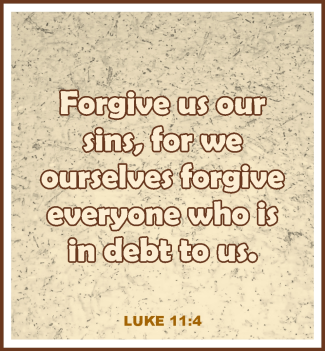
In the image at the head of this page we have quoted from the literal translation from the LORD’S PRAYER in Luke: “forgive us our sins, as we forgive everyone who is in debt to us“
This petition is both a plea and a challenge. We ask God to release us from the burden of our sins, acknowledging that we cannot stand righteous on our own. Yet the prayer immediately binds us to a condition: as we receive mercy, we must extend mercy. The word “debt” reminds us that sin creates an obligation, a rupture in justice, that only forgiveness can heal. By forgiving others, we imitate the generosity of God, and our hearts are opened to receive His forgiveness more fully. In this way, the prayer teaches that reconciliation with God and reconciliation with neighbor are inseparable.
TRESPASSES vs DEBTS vs SINS
The Lord’s Prayer, taught by Jesus in the Gospels of Matthew and Luke, contains one of Christianity’s most familiar yet variably rendered petitions: the request for forgiveness.
Matthew 6:12 reads (in literal translations), “And forgive us our debts, as we also have forgiven our debtors.”
Luke 11:4 states, “And forgive us our sins, for we ourselves forgive everyone who is indebted to us.”
A third rendering, “Forgive us our trespasses, as we forgive those who trespass against us,” appears widely in liturgy.
These differences reflect translation choices, linguistic nuances, and liturgical tradition rather than any doctrinal conflict.
In the original Greek of Matthew, the words are opheilēmata (debts) and opheiletais (debtors), from opheilō, meaning “to owe” or “to be obligated.” This carries both literal financial connotations and a powerful metaphorical sense of moral or spiritual obligation—sins as unpaid debts to God’s justice and holiness. Jesus reinforces this in the following verses (Matthew 6:14-15), shifting to paraptōmata (“trespasses” or “transgressions”), meaning to step over a boundary or violate a standard. Luke employs the common term for sin, hamartias (missing the mark), while retaining the debt imagery in the second half.
Both evangelists convey the same reality: human wrongdoing creates a debt that only God’s mercy can cancel, conditional on our willingness to forgive others.
The “trespasses” version entered English through William Tyndale’s 1526 New Testament translation. Tyndale rendered Matthew’s opheilēmata as “trespasses,” likely to emphasize moral transgression over financial imagery. This choice was adopted in the 1549 Book of Common Prayer, influencing Anglican, Methodist, Lutheran, and English Catholic liturgy for centuries.
Many Protestant Bibles following the King James Version tradition retained “debts/debtors” for literal fidelity to Matthew. Modern translations sometimes use “sins” to clarify the metaphor for contemporary readers, echoing Luke’s directness.
All three terms converge on the same theological truth. “Debts” highlights indebtedness and the impossibility of self-repayment, evoking the parable of the unforgiving servant (Matthew 18:23-35).
“Trespasses” underscores willful violation of God’s law and relational boundaries. “Sins” is the broadest and most explicit term for any offense against divine holiness. The conditional clause—“as we forgive”—remains consistent: God’s forgiveness, while unmerited, flows through a merciful heart. As St Augustine and others noted, refusing to forgive others blocks the channel through which we receive pardon.
In every form, the petition humbles us, binds forgiveness received to forgiveness offered, and points to the Cross, were Christ paid humanity’s unpayable debt. Whether one says debts, trespasses, or sins, the prayer remains a daily plea for grace that transforms both the vertical relationship with God and horizontal relationships with neighbor.