
WHAT IS KERYGMA?
(First Proclamation of Love)
▬
The kerygma is the Church’s first words and her last. It is the alpha and omega of evangelization, the seed and the fruit, the cry and the song. To rediscover it is to rediscover the freshness of faith itself. For those who have known Catholicism since infancy, encountering the kerygma anew is like finding a hidden spring in a familiar desert—water that refreshes, renews, and restores.
▬
In the early Church, the kerygma [Greek, for proclamation] referred to the very first announcement of the Good News: the core message that set hearts ablaze and turned the world upside down.
Before theology was systematized, before catechisms were written, before councils defined doctrines, there was the kerygma: the living cry of the apostles, declaring that Jesus Christ died for our sins, rose from the dead, and now reigns as Lord and King.
This is not just information; it is transformation. The kerygma is the seed from which all theology, liturgy, and catechesis grow. It is the beating heart of evangelization, the spark that ignites faith.
Pope Francis called it “the first proclamation, the one which we must hear again and again in different ways, the one which we must announce in one form or another throughout the process of catechesis, at every level and every moment.” (Message to the First International Catechetical Symposium, Buenos Aires, 2017)
The kerygma can be seen as a fourfold movement:
Creation and Love—God created us only out of love, desiring communion with his children.
Fall and Sin—Humanity turned away, choosing pride and disobedience, and so became enslaved to sin and death.
Christ and Redemption—In Jesus, God entered history, bore our sins, died on the Cross, and rose victorious, breaking the chains of death.
Response and Mission—We are invited to repent, believe, be baptized, and live as disciples, sharing this Good News with the world.
This simple yet profound proclamation is the essence of Christianity. It is not merely a doctrine to be studied but a Person to be encountered—Jesus Christ alive and present.
+
For many Catholics, faith can feel like a collection of rituals, rules, and traditions. Beautiful though these are, they can lose their vitality if disconnected from the kerygma. Without the proclamation of Christ’s saving love, the faith risks becoming cultural rather than personal, inherited rather than embraced
ab ovo

Comment, Share, Download (PDF), Print and Subscribe for Free
ab ovo
FREE SUBSCRIPTION
Rediscovering the kerygma is like hearing the Gospel for the very first time.
It breaks through the familiar words and routines, awakening joy that feels fresh and uncontainable, rekindling hope where weariness has settled, and reminding us that Christianity is not about our striving to please God, but first about God’s astonishing initiative in Christ.
The kerygma shifts our gaze: from duty to delight, from obligation to gift, from routine to relationship. It is the difference between a faith lived as burden and a faith lived as belovedness.
To rediscover the kerygma is to stand again at the empty tomb, to hear the angel’s announcement with awe and wonder, and to realize that the heart of the Christian life is not what we achieve for God, but what God has already accomplished for us in Jesus through his love and mercy.
This rediscovery reorients everything—our prayer, our work, our mission—because it roots them not in fear or performance, but in gratitude and love.
+
In his Pentecost sermon in Acts 2:14-41 St Peter proclaims the fulfillment of Old Testament prophesy, Jesus as the crucified and the risen Messiah, the call to repentance and baptism.
In 1Corinthians 15:3-5 St Paul’s summarizes this: “…what I received I passed on to you as of first importance: that Christ died for our sins according to the Scriptures, that he was buried, that he was raised on the third day according to the Scriptures, and that he appeared to Cephas, and then to the Twelve.”
Pope John Paul II expressed this spirit: “Kerygma—the first ardent proclamation that one day transformed man and led him to the decision to give himself to Jesus Christ by faith” (Catechesi Tradendae §25).
The saints, too, lived from this proclamation. St Francis of Assisi, St Dominic, St Faustina each in their own way became living heralds of the kerygma, announcing mercy, love, and the victory of Christ.
+
To embrace the kerygma is to allow Christ’s death and resurrection to shape our daily lives: our joys, our sufferings, our relationships, our mission. It is not a one-time message but a continuous hymn, sung in different keys as we journey through life.
When we pray, when we work, when we suffer, when we celebrate, the kerygma whispers: You are loved. You are redeemed. Christ is risen. You are sent.
֍
CONTEMPLATION
“…Jesus as Lord and belief in His resurrection as the path to salvation.” (Romans 10:9)
Further Comments on "KERYGMA"
First Proclamation of Love
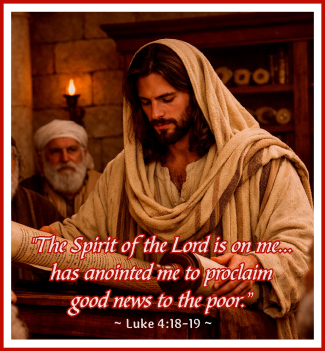
In the synagogue at Nazareth, Jesus unrolls the scroll of Isaiah and declares: “The Spirit of the Lord is upon me, because he has anointed me to bring good news to the poor. He has sent me to proclaim release to the captives and recovery of sight to the blind, to let the oppressed go free, to proclaim the year of the Lord’s favor” (Luke 4:18–19). Then he said, “Today this Scripture has been fulfilled in your hearing.” (Luke 4:21)
This moment unveils the kerygma—the first proclamation of salvation.
This is not an abstract idea; it is the living announcement that God’s promises are fulfilled in Jesus Christ. In this Gospel passage, Jesus is the Good News in person: he is the anointed one who brings liberation, healing, and divine mercy.
The poor hear hope, the captives taste freedom, the blind see light, and the oppressed find dignity. This is the essence of kerygma—the proclamation that God’s love has entered history in Jesus, and that his mission is for everyone.
Luke 4 also reveals that the kerygma is not only personal salvation but also about transformation of the world. The “year of the Lord’s favor” reverberates the Jubilee of Israel, when debts were forgiven and slaves set free. In Christ, this Jubilee becomes eternal: the chains of sin are broken, and humanity is invited into a new life of grace. The kerygma, then, is both vertical (reconciling us to God) and horizontal (restoring justice, mercy, and peace among people).
+
When the Church proclaims the kerygma today, it continues Christ’s mission from Nazareth. To announce the Good News is to bring hope to the poor, freedom to those bound by sin or despair, and healing to wounded hearts. Luke 4:18–19 tells us that evangelization is not merely words but a Spirit-filled witness that makes the Gospel tangible in the lives of others.
OVERVIEW
The Good News is not a message but a living Person—Jesus Christ—and his mission is the proclamation of God’s saving love. When the kerygma is rediscovered Christ’s voice can be heard anew, resonating through time, announcing liberty to the captive, healing to the broken, and favor to the poor in spirit.
It is to realize that this proclamation is not some distant memory but a living word that still resounds in the Church and within every heart open to him.
Rediscovery awakens the freshness of grace, where faith is no longer just fulfilling obligations but becomes an encounter. An encounter that rekindles joy, restores hope, and transforms discipleship. In hearing the kerygma again, the soul stands at the threshold of the Gospel as if for the first time, seized by wonder that God’s love is not earned but freely given through Jesus Christ.