
WILL CHRISTIANS BE JUSTIFIED BY FAITH ALONE?
▬
Among the many foundational beliefs of Protestantism, perhaps the most unique is its doctrine of ‘sola fide’, meaning that only faith is sufficient for salvation and good works have no role in that scheme, quoting Romans 3:28, and other scriptural passages in support of this doctrine.
Catholic belief, on the other hand, states that faith and good works are both necessary for salvation, because Christ demands “faith working through charity” (Galatians 5:6).
▬
In Matthew 25:31–46, we are told that the Last Judgment will be based on works of charity, and this is in keeping with Mark 12:30–31: “And ‘You shall love the Lord your God with all your heart, and with all your soul, and with all your mind, and with all your strength’. The second is this, ‘You shall love your neighbor as yourself.’ There are no other commandments greater than these.” Further when the rich young man asked Jesus what he must do to gain eternal life, he answered: “Keep the commandments” (Matthew 19:17).
Thus, it is evident that though faith is the beginning of the Christian journey, it is not the complete fulfillment of the will of God.
Very significantly, Jesus himself declared that good works will be rewarded in heaven; “For the Son of man… will repay every man according to his deeds” (Matthew 16:27); “And whoever… gives to one of these little ones even a cup of cold water to drink, truly I say to you, he shall not lose his reward” (Matthew 10:42).
+
The concept of sola fide, in the Bible, is conspicuous by its absence. And when “faith alone” is present (James 2:24) it is to refute the idea.
So how do we understand—”For we maintain that a man is justified by faith apart from works of the Law” in Romans 3:28? Clearly here St Paul was only referring to works peculiar to the old Jewish law, as he cited circumcision as an example (Romans 4:10). In fact, he categorically says that neglecting certain types of good works is like denying the faith:
“…if anyone does not provide for his own, and especially for those of his household, he has denied the faith and is worse than an unbeliever.” (1Timothy 5:8)
Indeed, he urges us to believe, that “each will receive his own reward according to his own labor” (1Corinthians 3:8); “For God is not unjust so as to forget your work and the love which you have shown toward his name, in having ministered and in still ministering to the saints” (Hebrews. 6:10).
Still, as Catholics we know that, strictly speaking, God never owes us anything. Even after obeying all God’s commandments, we must still say: “We are unworthy slaves; we have done only that which we ought to have done.” (Luke 17:10)
If faith ruled out the necessity of good works for salvation, would the following words be found in the Bible? “You see that a person is considered righteous by what they do and not by faith alone” (James 2:24); or, “As the body without the spirit is dead, so faith without deeds is dead” (James 2:26); or, “What good is it, my brothers and sisters, if someone claims to have faith but has no deeds? Can such faith save them?” (James 2:14).
And then, very significantly, had Paul meant that faith ruled out the necessity of good works for salvation, would he have written: “…and if I should have all faith, so that I could move mountains, and have not charity, I am nothing” (1Corinthians 13:2).
ab ovo

Comment, Share, Download (PDF), Print and Subscribe for Free
ab ovo
FREE SUBSCRIPTION
Salvation will not come if one has faith in Jesus and does evil deeds, nor will it come by good deeds without faith in Jesus.
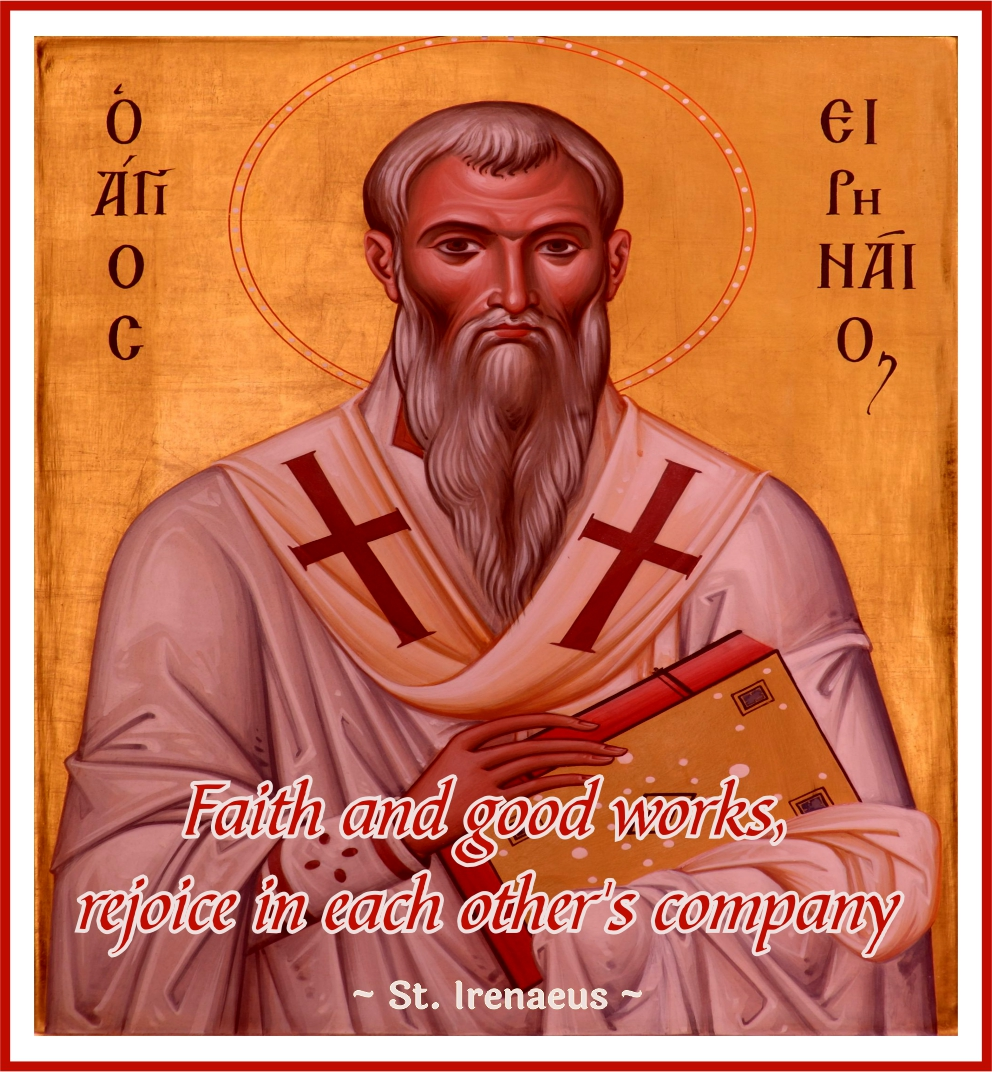
St Irenaeus (115–142), the ancient Father of the Church has written: “For what is the use of knowing the truth in word, while defiling the body and accomplishing the works of evil? Or what real good at all can bodily holiness do, if truth be not in the soul? For these two, faith and good works, rejoice in each other’s company, and agree together and fight side by side to set man in the Presence of God…” (from his Proof of the Apostolic Preaching)
Catholic teaching holds that both faith and works are needed for our justification. By living out good works, we share in Christ’s redemption and make the Gospel shine before the world:
“You are the light of the world. A town built on a hill cannot be hidden. Neither do people light a lamp and put it under a bowl. Instead, they put it on its stand, and it gives light to everyone in the house. In the same way, let your light shine before others, that they may see your good deeds and glorify your Father in heaven.” (Matthew 5:14–16)
+
Faith is the tree of Christian life, but without the fruit of charity the tree is worthless, as good as dead. Where Adam’s disobedience severed faith from works, Christ’s obedience restored them in perfect harmony. Thus, to separate faith from works is to repeat the Eden error; to unite them is to walk in Christ’s way.
Faith Without Works is Dead
There is a quiet tragedy in a faith that lives only in the mind or on the lips. It may feel warm during worship, comforting in crisis, and certain in conversation—yet if it never moves our hands, our feet, or our choices, it is like a body without breath.
The Bible does not mince words on this: “In the same way, faith by itself, if it is not accompanied by action, is dead.” (James 2:17). This should not be seen as a threat; but a diagnosis. St James, writing to believers who already professed faith in Christ, calls them—and us—to a deeper, more honest reflection: Is our faith alive, or is it merely a beautiful idea we profess?
+
We often treat faith as personal conviction. We say we trust God for provision, yet we hoard resources out of fear. We declare that God is love, yet we withhold kindness maybe from the difficult neighbor or the struggling coworker. We claim Christ as Lord, yet our daily decisions look remarkably like everyone else’s—driven by ambition, comfort, or self-protection.
James confronts this illusion directly: “What good is it, my brothers and sisters, if someone claims to have faith but has no deeds? Can such faith save them?” (James 2:14).
The question is devastating and practical. A hungry brother or sister stands before us, and we respond with prayer and pleasant words: “Go in peace; keep warm and well fed, but does nothing about their physical needs, what good is it?” (James 2:16). We have exercised language, emotion, and even theology, but we have not exercised love. In that moment, faith has not been disproven—it has simply been revealed as lifeless. It exists in theory but not in reality. Like a seed that never breaks the soil, it produces no fruit, no harvest, no life for others.
+
True faith is not opposed to works; it is completed by them. When Abraham offered Isaac on the altar, his obedience did not earn God’s favor—it demonstrated that his trust was real (James 2:21-23). The Scripture says, “Abraham believed God, and it was credited to him as righteousness” (Romans 4:3), but it was the offering of his son that showed the belief had taken root deep enough to reshape his most treasured possession and future. His faith and his works “working together,” and by works his faith was “complete” (James 2:22).
This is the pattern. Rahab the harlot did not merely confess belief in the God of Israel; she hid the spies and lowered them to safety at great personal risk (James 2:25). Her action became the visible signature of her faith.
These stories are revealing. Faith that costs us nothing has cost us nothing because it has changed nothing. In practical terms, this means faith must shape everyday life through acts of trust and mercy.
It shows up in the way we handle our money—not just offerings on Sunday but also making sacrificial choices: like, deliberately forgoing luxuries, opting for a simpler lifestyle etc.
It appears in how we use our time: like, choosing to mentor the young, visit the lonely, visit sick, visit the imprisoned etc.
It reveals itself when we forgive the one who wounded us deeply, not because it feels good, but because we believe the mercy we have received must flow through us.
Mercy is among the greatest of works. Jesus blesses the merciful (Matthew 5:7), and the Church has long spoken of the Corporal and Spiritual Works of Mercy: feeding the hungry, forgiving offenses, visiting the sick, praying for the living and the dead.
These are not optional but the very fruit by which faith is proven alive. These are not ‘extra credit’ for super-Christians. They are the natural respiration of living faith.
+
Where is faith asking us to move today? Perhaps it is the uncomfortable conversation we have been avoiding. Maybe it is generosity toward someone who cannot repay us. It could be the steady, quiet habit of prayer and honesty in private. These are not attempts to impress God; they are the evidence that we actually believe He is who He says He is.
Jesus himself embodied this union perfectly. His faith in the Father was never abstract. It led Him to touch lepers, eat with sinners, wash dusty feet, and ultimately stretch out his arms on the cross. His works were the inevitable expression of his trust. “…the Son can do nothing by himself; he can do only what he sees his Father doing” (John 5:19). Obedience flowed from intimate dependence.
When our faith and works walk together, something beautiful happens. We become complete. Doubt loses its grip because we have tested God’s faithfulness in real time. Others see a credible witness—not because we argue better, but because we live differently. The world does not need more eloquent believers; it desperately needs believable ones whose lives match their lips.
+
Faith without works is dead, but the opposite is gloriously true: faith with works pulses with resurrection life. It breathes hope into dead places—broken relationships, weary communities, cynical cultures.
It refuses to let belief remain theoretical. It steps out, reaches down, stands up, and keeps going even when the results are not yet visible.
So let us examine ourselves, not with condemnation but with honest hunger. Has our faith grown stagnant in words alone? What small or great obedience is the Spirit inviting us to? Every act of costly love, every quiet integrity, every risk taken in trust becomes a testimony that our God is alive—and that our faith in him is alive too.
The words of James are not judgment but a gracious awakening. That our lives answer with the beautiful, ordinary, powerful proof that faith and works are dancing together: “Show me your faith without deeds, and I will show you my faith by my deeds. (James 2:18).
This is the faith that honors God. This is the faith of the Apostles. This is the faith that changed and continues to change the world. This is faith that is alive.
֍
CONTEMPLATION
“Every tree that does not bear good fruit is cut down and thrown into the fire” (Matthew 7:19)
Further Comments on "Justified by Faith Alone"
The image at the head of this page is adapted from an original Eastern Orthodox icon depicting St Irenaeus of Lyons (also known as St Eirenaios in Greek). St Irenaeus was the 2nd-century Bishop of Lugdunum (modern-day Lyon, France), a theologian, and early Church Father known for his foundational text in Christian theology—that refutes Gnostic beliefs—”Against Heresies“. He also wrote the treatise “Proof of the Apostolic Preaching.”
The Greek inscription “Ὁ Ἅγιος” (Ho Hagios) on the left means “The Saint” and on the right “Εἰρηναῖος” (Eirēnaios). The icon is presented the traditional Byzantine style.
COMMENT
“Salvation will not come if one has faith in Jesus and does evil deeds, nor will it come by good deeds without faith in Jesus”
This statement is quoted from the main article to analyze if this was taught by Early Church Fathers.
Yes, the statement aligns with teachings found in the writings of several Early Church Fathers, who emphasized that salvation requires both faith in Christ and a life of good works (or avoidance of evil), with neither sufficing on its own. This view reflects a holistic understanding of justification, where faith is the foundation but must be lived out through obedience and righteousness.
While some Protestant interpretations of certain patristic texts argue for “faith alone” (sola fide) in a way that separates it from meritorious works, the broader consensus from the Fathers’ writings support the integration of faith and works. Below, are some relevant quotes from key figures, drawn from historical analyses and compilations.
Faith Without Good Works (or With Evil Deeds) Does Not Save
Many Fathers explicitly warned that mere belief or profession of faith, without corresponding righteous living, is insufficient for salvation. This echoes James 2:14-26 in the New Testament, which describes faith without works as “dead.”
St. Clement of Rome (c.96):
“Let us therefore join with those to whom grace is given by God. Let us clothe ourselves in concord, being humble and self-controlled, keeping ourselves far from all backbiting and slander, being justified by works and not by words… Why was our Father Abraham blessed? Was it not because of his deeds of justice and truth, wrought in faith?… So we, having been called through his will in Christ Jesus, were not justified through ourselves or through our own wisdom or understanding or piety or works which we wrought in holiness of heart, but through faith, whereby the almighty God justified all men.” (Letter to the Corinthians 30:3, 31:2, 32:3-4).
Here, St. Clement ties justification to faith but illustrates it through Abraham’s works, showing they are inseparable.
Origen (226-232):
“Whoever dies in his sins, even if he professes to believe in Christ, does not truly believe in him; and even if that which exists without works be called faith, such faith is dead in itself, as we read in the epistle bearing the name of James.” (Commentaries on John 19:6).
St Gregory of Nyssa (335-394):
“Paul, joining righteousness to faith and weaving them together, constructs of them the breastplates for the infantryman, armoring the soldier properly and safely on both sides. A soldier cannot be considered safely armored when either shield is disjoined from the other. Faith without works of justice is not sufficient for salvation; neither is righteous living secure in itself of salvation, if it is disjoined from faith.” (Homilies on Ecclesiastes 8).
St John Chrysostom (c.391):
“‘He that believes in the Son has everlasting life.’ ‘Is it enough, then, to believe in the Son,’ someone will say, ‘in order to have everlasting life?’ By no means! Listen to Christ declare this himself when he says, ‘Not everyone who says to me, “Lord! Lord!” shall enter into the kingdom of heaven’; and the blasphemy against the Spirit is alone sufficient to cast him into hell. But why should I speak of a part of our teaching? For if a man believe rightly in the Father and in the Son and in the Holy Spirit, but does not live rightly, his faith will avail him nothing toward salvation.” (Homilies on the Gospel of John 31:1).
St Chrysostom directly addresses the insufficiency of faith without righteous living.
St Jerome (386):
“‘But since in the Law no one is justified before God, it is evident that the just man lives by faith.’ It should be noted that he does not say that a man, a person, lives by faith, lest it be thought that he is condemning good works. Rather, he says the ‘just’ man lives by faith. He implies thereby that whoever would be faithful and would conduct his life according to the faith can in no other way arrive at the faith or live in it except first he be a just man of pure life, coming up to the faith by certain degrees.” (Commentaries on Galatians 2:3:11).
Good Works Without Faith Do Not Save
The Fathers also stressed that moral actions or “good deeds” apart from faith in Christ are inadequate, often contrasting this with pre-Christian or pagan efforts at righteousness.
St Theophilus of Antioch (c.181):
“Give studious attention to the prophetic writings, and they will lead you on a clearer path to escape the eternal punishments and to obtain the eternal good things of God. He who gave the mouth for speech and formed the ears for hearing and made eyes for seeing will examine everything and will judge justly, granting recompense to each according to merit. To those who seek immortality by the patient exercise of good works, he will give everlasting life, joy, peace, rest, and all good things… For the unbelievers and for the contemptuous, and for those who do not submit to the truth but assent to iniquity… there will be wrath and indignation, tribulation and anguish, and in the end such men as these will be detained in everlasting fire.” (To Autolycus 1:14).
Good works lead to reward only for those who submit to the Truth (Faith in Christ, see John 14:6).
St Clement of Alexandria (202):
“When we hear, ‘Your faith has saved you,’ we do not understand the Lord to say simply that they will be saved who have believed in whatever manner, even if works have not followed. To begin with, it was to the Jews alone that he spoke this phrase, who had lived in accord with the law and blamelessly and who had lacked only faith in the Lord.” (Stromateis 6:14:108:4).
This implies that blameless living under the law (good deeds) without faith in Christ falls short.
St Cyprian (252):
Emphasizes purification through almsgiving and works of justice, but frames it within faith in Christ, implying works alone (without Christ’s “white garment“) are insufficient. (Works and Almsgiving 14).
Broader Context and Counterarguments
Historical surveys, such as those from Catholic scholars, conclude that the Early Church unanimously rejected a separation of faith from works in salvation.
For instance, a review of patristic literature notes that most Fathers believed “faith and works must both exist for a person to be a true Christian.”
This is seen as consistent with New Testament passages like Matthew 7:21 and Galatians 5:6.
However, some Protestant analyses highlight phrases like “justified by faith alone” in figures such as Ambrosiaster (366-384), who wrote:
“They are justified freely because they have not done anything nor given anything in return, but by faith alone they have been made holy by the gift of God.” (Commentary on Romans 3:24).
These are often interpreted as excluding “works of the law” (Mosaic rituals) rather than all good works, and in full context, even these writers link faith to moral living or “natural law.”
We can argue such readings impose 16th-century Reformation categories on earlier texts, where “sola fide” typically meant faith apart from Jewish law, not apart from Christian obedience (John 14:15).
The statement at the beginning of this comment can indeed be substantiated from the Early Church Fathers, as their writings consistently portray salvation as a process involving both faith in Jesus and a transformed life of good deeds. For deeper study, primary sources like the Ante-Nicene Fathers collections are recommended.