
DID JESUS PREACH SOCIALISM?
▬
Jesus taught—and with great emphasis—the importance of compassion and care for the less fortunate, but he did not teach socialism as an instrument of compassion. Socialism is a political ideology that typically involves collective or state ownership of the means of production, most often with coerced redistribution of private property.
Socialism emphasizes: ‘what others have and what I lack’. This sanctifies envy: the desire to pull down the wealthy rather than lift up the poor. The moral danger is that envy corrodes the soul—it makes us resentful, always measuring ourselves against others, rather than cultivating gratitude or generosity.
▬
Jesus’ emphasizes personal generosity, detachment from wealth, and voluntary care for the poor, but he also affirms private property and individual responsibility rather than mandating general equality through any form of force or coercion.
Jesus frequently warns us against the dangers of riches and calls for radical generosity: He tells the rich young ruler: “Sell what you have and give to the poor” (Matthew 19:21; Mark 10:21; Luke 18:22)—the personal challenge here is to place the Kingdom of God over worldly possessions. He does not call for governmental seizure of his property.
Jesus upholds the 8th Commandment (“You shall not steal,” Exodus 20:15), which he reaffirms (in Mark 10:19; Luke 18:20). The prohibitions on theft clearly presume legitimate private property rights—stealing then implies something that rightfully belongs to another.
When Jesus declares, “You cannot serve God and mammon” (Matthew 6:24), He is not abolishing private ownership but exposing the spiritual danger of misplaced allegiance. The word “mammon” carries more than the idea of coins or property—it signifies wealth enthroned as a rival master. To serve mammon is to let material gain dictate one’s choices, values, and security, until it becomes an idol that competes with God himself. Yet Christ’s warning does not erase the legitimacy of possessions. Parables like the Talents (Matthew 25:14–30) praise stewardship of private resources, rewarding faithful management and implying personal accountability.
Jesus’ words force a piercing question: Who rules my heart? Do I treat money as a servant of God’s purposes, or has it quietly become my master? True freedom is found not in renouncing ownership, but in renouncing slavery to wealth. When possessions serve love, they fulfill their purpose; when love serves possessions, they harm the soul.
ab ovo

Comment, Share, Download (PDF), Print and Subscribe for Free
ab ovo
FREE SUBSCRIPTION
Passages often cited as ‘socialistic’ include:
“All the believers were together and owned everything in common. They would sell their property and possessions and distribute the proceeds to all according to what each one needed.”—Acts 2:44–45.
Then Acts 4:32–35 describes believers sharing so “there was not a needy person among them.”
This was voluntary community sharing amongst early Christians, not state-enforced socialism or communism: it was temporary and descriptive (story of early Jerusalem church), not prescriptive for all Christians. Believers retained private property (for example, Ananias and Sapphira owned land and were punished for lying, not for owning—Acts 5:1–11).
Paul exhorts Christians to provide for their families and to share generously. The early Church, while practicing radical charity, never mandated the abolition of property. Instead, the consistent thread is stewardship: wealth is permitted, but it must remain a servant of love, never its master. Later New Testament churches had rich and poor members with private homes and businesses (Philemon owned slaves/property; Lydia of Thyatira was a merchant).
Catholic social teaching captures this balance in the principle of the universal destination of goods. Creation is meant for all, but private property is a legitimate means of ordering resources responsibly. The danger lies not in ownership but in attachment—when possessions cease to be tools for justice and charity and instead become chains that bind our heart.
+
Jesus calls us to extraordinary generosity and to prioritize spiritual over material wealth (Matthew 6:19-20), but he does not endorse socialism in any form whatsoever. He called for individuals and the Church to live generously, sacrificially, and with compassion. His command to “love your neighbor as yourself” and to care for “the least of these” are directed at disciples, not the state.
When Jesus commands generosity, He is not drafting an economic program. His call is personal, not systemic. “Give to everyone who begs from you” (Luke 6:30) is not a blueprint for solving poverty at scale, but a summons to open-handedness in the face of others need.
Socialism frames justice in terms of redistribution and equality of outcome (Social Justice). The danger is that this shifts the focus from love to resentment: the poor are defined by what they lack, the rich by what they must surrender, and envy becomes the hidden drive of the ideology.
“Wrath is cruel… but who can stand before envy?” (Proverbs 27:4)
Jesus, by contrast, places the weight on individual generosity. He does not ask us to solve the receiver’s economic problems, but to let our possessions serve love. The widow’s two coins (Mark 12:41–44) did not abolish poverty, yet her gift was highly praised because it sprang from a heart surrendered to God.
The Gospel’s vision is not economic equality but spiritual freedom: possessions are tools, not masters. Generosity liberates the giver and the receiver, creating communion rather than competition. Jesus’ mission was to establish the Kingdom (“… not of this world,” John 18:36) that would transform hearts and communities.
Thus, Jesus’ teaching resists being collapsed into socialism. His concern is not to equalize wealth but to sanctify hearts by making giving a participation in divine love rather than a forced redistribution of goods.
MORE ON "DID JESUS PREACH SOCIALISM?"
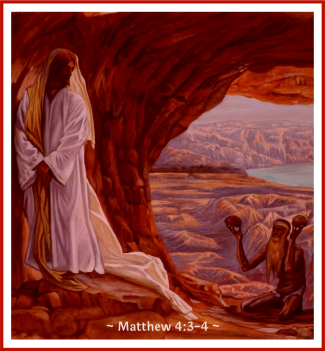
The painting at the head of this page is “Jesus Tempted in the Wilderness” by James Tissot, created between 1886 and 1894 as part of his “The Life of Our Lord Jesus Christ” series. It depicts the biblical scene (from Matthew 4:1-4), where Satan tempts Jesus to turn stones into bread after his 40-day fast in the desert.
SOCIALISM DIRECTLY OPPOSES CHRIST’S MISSION
Fulton Sheen (1895–1979), a renowned Catholic Archbishop and evangelist, extensively discussed the temptations of Jesus in his writings and talks, such as in his book Life of Christ. He framed them as Satan’s attempts to divert Christ from the path of the Cross by offering three “shortcuts”: an economic one, one based on marvels, and a political one.
These temptations represent broader human struggles with the lust of the flesh, the lust of the eyes, and the pride of life, but Jesus resisted them to fulfill salvation through sacrifice and its memorial rather than popularity or power.
The First Temptation: Stones to Bread (Economic Shortcut)
After Jesus fasted for 40 days, Satan tempted Him to turn stones into bread to satisfy hunger as an appeal to become a “social reformer” focused on material needs, promising to make us materially satisfied without making us holier.
Jesus rejected it, quoting Scripture: “Man does not live by bread alone, but by every word that comes forth from the mouth of God” (Matthew 4:4), prioritizing spiritual sustenance over mere earthly provisions. (See Deuteronomy 8:3 and compare with John 6:30-40)
Socialism is clearly in direct (Satanic) opposition to Christ’s mission of eternal salvation through the Cross.
֍
“The world and its desires pass away, but whoever does the will of God lives forever.“
(1John 2:17)