
HAIL HOLY QUEEN
()
Hail, Holy Queen, Mother of mercy, our life, our sweetness, and our hope. To you do we cry, poor banished children of Eve. To you do we send up our sighs, mourning and weeping in this valley of tears. Turn then, most gracious Advocate, your eyes of mercy toward us. And after this exile, show unto us the blessed fruit of your womb, Jesus. O clement, O loving, O sweet Virgin Mary.
LATIN
| salve regina |
Salve, Regina, Mater misericordiae, vita, dulcedo, et spes nostra, salve. Ad te clamamus, exsules filii Hevae. Ad te suspiramus, gementes et flentes in hac lacrimarum valle. Eia ergo, Advocata nostra, illos tuos misericordes oculos ad nos converte. Et Jesum, benedictum fructum ventris tui, nobis post hoc exsilium ostende. O clemens, O pia, O dulcis Virgo Maria.The HAIL HOLY QUEEN prayer, known in Latin as SALVE REGINA, arose in the 11th century. First sung in monasteries, it quickly became one of the four great Marian antiphons of the Church, and later adopted as the closing prayer of the Rosary. Its words honor Mary as Queen, Mother of Mercy, and Advocate, expressing the pilgrim soul’s longing for her intercession in exile. From medieval chant to modern devotion, the HAIL HOLY QUEEN remains a living bridge between the Church’s ancient liturgy and the faithful’s daily prayer, reminding us that Mary always points us to the blessed fruit of her womb, Jesus.
Origins
Tradition attributes this prayer to Blessed Hermann of Reichenau (1013–1054), though some scholars also credit Bernard of Clairvaux. It first appeared in Latin—the universal language of the Church. Adopted by monastic communities, especially the Abbey of Cluny in the 12th century, where it was used as a processional hymn on Marian feasts.
It became one of the four Marian antiphons sung at the end of Compline (night prayer). The other three being: Alma Redemptoris Mater, Ave Regina Caelorum, and Regina Caeli,
By the 13th century, Dominicans, who were a preaching order, spread their liturgical practices wherever they established priories and universities. Their nightly chanting of the SALVE REGINA became a hallmark of Dominican spirituality. which helped popularize it across Europe. Pope Gregory IX institutionalized its use in Rome, further embedding it in liturgy.
The title “Queen” reflects the ancient Jewish custom where the king’s mother held the queenly role (cf. 1 Kings 2:19). Revelation 12 also portrays Mary as crowned in heaven. It acknowledges human exile (“poor banished children of Eve”) and entrusts hope to Mary’s intercession, asking her to show us “the blessed fruit of thy womb, Jesus.”
The prayer was popular among sailors, students, and lay confraternities. It was sung in universities and even used in rituals like blessing ships.
Today
St Alphonsus Liguori’s The Glories of Mary (18th century) was structured around the SALVE REGINA, cementing its theological and devotional importance.
By the late Middle Ages, the prayer became the standard conclusion to the Rosary—making it one of the most familiar Marian prayers worldwide—a practice that continues today. While the Latin text remains central, vernacular versions are widely used in parish and personal prayer.
MORE ON "HAIL HOLY QUEEN"
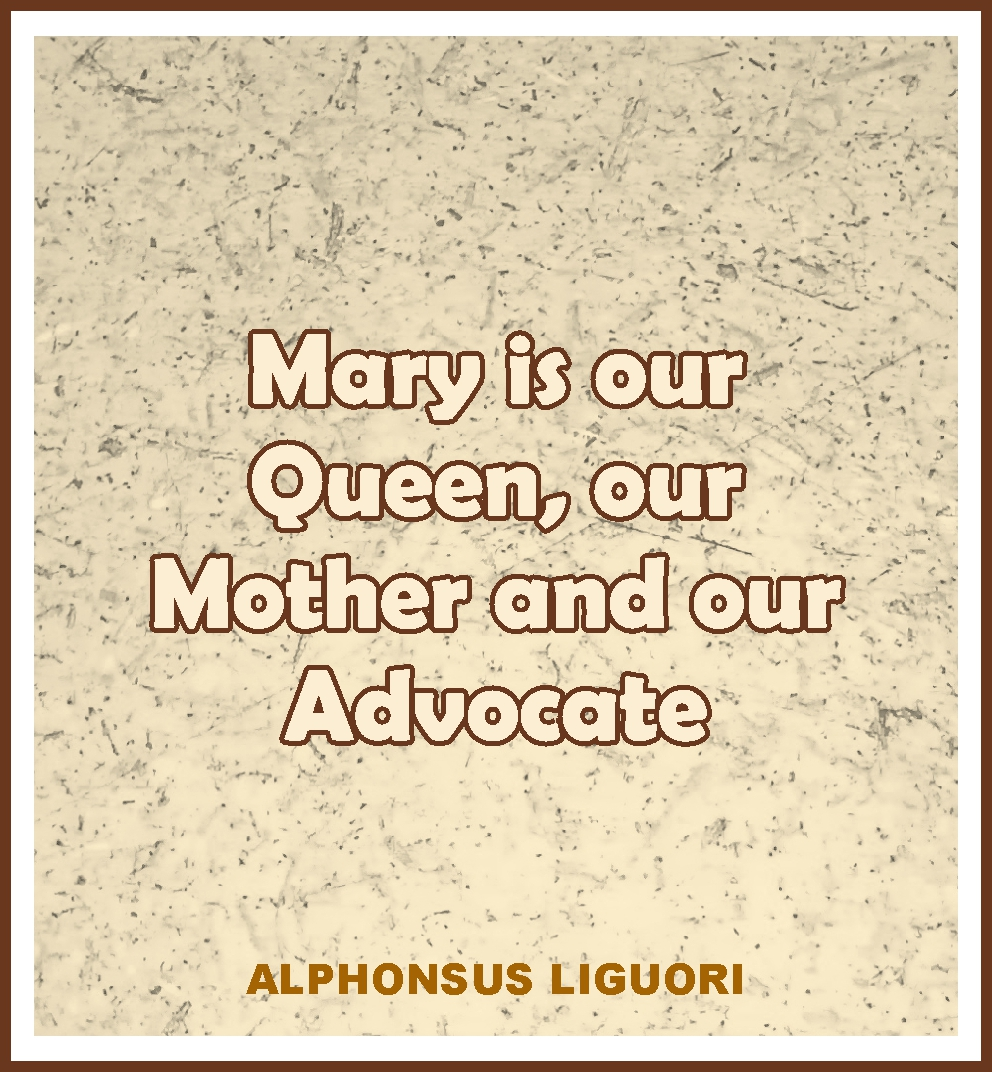
In his seminal work The Glories of Mary Alphonsus Liguori reflects on Salve Regina which attributes three titles to Mary. The image at the head of this page highlights those—Queen, Mother and Advocate—and how those are tied to Mercy.
Mary as Queen, Mother, and Advocate,
insights from Alphonsus Liguori’s ‘The Glories of Mary’
Mary as Queen
The Church honors Mary as Queen not because she rules apart from Christ, but because she shares uniquely in His kingship. As the Mother of the King of Kings, she is exalted above all creatures. Her queenship is not one of worldly power but of maternal care—she reigns by love. St Alphonsus Liguori reminds us that Mary’s crown is woven from her humility and obedience: she who said “let it be done to me according to your word” now reigns in heaven as the Queen who leads souls to her Son.
Mary as Mother
Mary’s queenship is inseparable from her title as Mother of Mercy. Unlike earthly rulers who may judge harshly, Mary’s reign is marked by compassion. In The Glories of Mary, St Alphonsus beautifully writes that Mary is “the ladder of sinners,” the one who bends down to lift us when we fall. She does not hoard grace but pours it out, interceding for those who feel furthest from God. To call her Mother is to acknowledge that in our exile, we find in her a tender heart that never despairs of us.
Mary as Advocate
The Salve Regina names Mary our Advocate, the one who turns her merciful eyes toward us and pleads before her Son. St Alphonsus emphasizes that Mary’s advocacy is not weak or hesitant; it is powerful because it is maternal. Just as at Cana she interceded for the wedding couple, today she intercedes for us, presenting our needs to Christ with a mother’s urgency. Her advocacy is not about replacing Christ’s mediation but about participating in it—she is the Queen Mother who whispers our petitions into the ear of the King.
Living the Titles Today
To honor Mary as Queen, Mother, and Advocate is not merely to recite titles but to live under her care. When we pray the Salve Regina, we entrust ourselves to her maternal reign, confident that mercy will meet us in our weakness. In times of trial, we can turn to her as Advocate, knowing she will never abandon us. And in moments of joy, we crown her anew with our gratitude, recognizing that every grace that flows through her hands leads us to Christ.
Mary’s queenship is mercy, her motherhood is advocacy, and her advocacy is love. St Alphonsus Liguori saw in her the sure refuge of sinners and the radiant Queen who never ceases to guide her children home. To pray Hail Holy Queen is to step into that reality: to be embraced by the Mother of Mercy, defended by our Advocate, and led by our Queen into the eternal kingdom of her Son.