
WHAT IS THE GREATEST VIRTUE?
(Antidote for All Sin)
▬
Let’s spell it out straight: Christ-like humility is the greatest virtue. It is a deep attitude of selflessness, service, and submission to God’s will, modeled after the life and teachings of Jesus Christ. Humility is not about self-condemnation or false modesty but rather recognizing one’s true worth in relation to God and others, leading to voluntary lowering of oneself for the benefit of others, even in the most difficult situation.
▬
Humility leads to greatness and true greatness comes through serving, as Jesus declared: “Whoever wants to become great among you must be your servant” (read Matthew 20:26-28). A servant is a humble, often humiliating, position.
+
The call to Christ-like humility is very clearly configured in Philippians 2:5-11—often called the kenosis [Greek for emptying] passage—where, St Paul urges us to adopt the attitude of Christ. For Jesus, though divine and equal with God, did not cling to his privileges. He “emptied himself” by taking human form, becoming a servant, and humbling himself to the point of obedient death on the Cross. As a result, God the Father exalted him, showing that true humility precedes great honor. This also reveals that humility is a conscious choice: surrendering power, status, or rights, out of love and obedience to God.
“In your relationships with one another, have the same mindset as Christ Jesus:
“Who, being in very nature God, did not consider equality with God something to be used to his own advantage; rather, he made himself nothing by taking the very nature of a servant, being made in human likeness. And being found in appearance as a man, he humbled himself by becoming obedient to death—even death on a cross!
“Therefore God exalted him to the highest place and gave him the name that is above every name, that at the name of Jesus every knee should bow, in heaven and on earth and under the earth, and every tongue acknowledge that Jesus Christ is Lord, to the glory of God the Father.” (Philippians 2:5-11 NIV)
Obedience to God involves aligning one’s will with God’s, even in suffering. In the Garden of Gethsemane, Jesus prayed, “Not my will, but yours be done” (Luke 22:42), submitting despite knowing the horrific agony that lay ahead.
Unlike worldly wisdom, Christ’s humility avoided seeking personal glory. Like when Jesus withdrew from crowds that wanted to make him king (John 6:15) and when he attributed his works to the Father (John 5:19).
This is transformative: it counters pride (the root of all sin) and fosters unity, as St Paul notes in Ephesians 4:2, urging Christians to be “completely humble and gentle.”
In practice, being humble means keeping the needs of others over our own (Philippians 2:3-4), forgiving offenses, and pursuing reconciliation, all while relying on God’s grace (Philippians 2:13).
ab ovo

Comment, Share, Download (PDF), Print and Subscribe for Free
ab ovo
FREE SUBSCRIPTION
+
“…and learn from Me, for I am meek and humble of heart…” (Matthew 11:29). This verse is the most loaded emphasis on humility in the Bible. And this is the only verse where Jesus directly points us to his “heart”.
When Jesus reveals his heart, he does not point to his miracles, his teachings or his divine authority, but to his meekness and humility. Meekness is not weakness, but a child-like dependence on divine strength. Meekness is courage that is born of complete trust in God. Humility is the soil in which love takes root, the willingness to serve rather than be served.
And the “learn from Me”: this not a call to listen to the words of a teacher, rather it is an invitation to shape our lives by following his example of humility.
He could have validly said: learn from me charity, compassion, peacefulness, service, wisdom, and even holiness, but instead he focused upon meekness and humility. Why?
Because, discipleship means permitting his gentleness to soften our harshness, his humility to dismantle our pride. In this imitation lies the paradox of the Gospel: the more we lower ourselves, the more we are lifted (Matthew 23:12). Humility is indeed the foundation upon which a truly virtuous life is built on.
As St Augustine of Hippo (354–430) wrote, “Humility is the foundation of all the other virtues hence, in the soul in which this virtue does not exist there cannot be any other virtue except in mere appearance.“ (commonly used paraphrase from Letter 118.22)
In a similar way St Thomas of Villanova (1488–1555) taught: “Humility is the mother of many virtues because, from it are born: obedience, fear, reverence, patience, modesty, meekness and peace. He who is humble easily obeys everyone, fears to offend anyone, is at peace with everyone, is kind to all!“ (Sermons on Humility)
+
In secular terms, humility is about being modest, self‑aware, and respectful toward others with element of self‑assertion and self-consciousness woven into it. But Christ‑like humility flows from the knowledge that we are children of God, secure in his love, and therefore free to serve without craving recognition or validation.
While humility liberates pride is exhausting. While meekness brings rest, self‑assertion can be a burden (Matthew 11:28). The promise of Christ is not an escape from struggle but find peace within it: a rest that comes from surrendering our hearts to his.
+
Sin, at its root, is pride—the refusal to acknowledge God as God and the desire to exalt oneself above him and others around. Every transgression, whether subtle or grave, springs from this inward turning: “I will do it my way.” Pride is the poisoned soil from which envy, anger, lust, greed, and every other vice grow. As Proverbs 16:18 states, “Pride goes before destruction…”
Humility is a powerful antidote for that poison. Humility acts as a ‘spiritual vitamin’ or foundational virtue that directly undermines all sin by fostering reliance on Divine Grace, gratitude, and service to others.
Though, traditional teachings pair each deadly sin with a specific ‘heavenly virtue’ as its primary countermeasure, with humility explicitly tied to pride while others have their own antidotes. However, humility’s emphasis on selflessness and truth can flow outward, supporting the growth of those other virtues and reducing our susceptibility to the sin.
Pride: Excessive self-importance or arrogance, viewing oneself as superior to others and in some cases even God. Antidote—Humility
Humility directly opposes pride by encouraging a realistic self-view, acknowledgment of flaws, and dependence on God rather than self-elevation. Practices like prayer or reflecting on one’s limitations foster this grounding.
Greed: Insatiable desire for material wealth or gain, often at others’ expense. Antidote—Charity
Humility reminds us that possessions and status are temporary and not measures of worth, reducing the urge to hoard by shifting focus to gratitude and sharing with those in need.
Lust: Uncontrolled sexual desire or objectification of others. Antidote—Chastity
Humility curbs lust by promoting respect for others as equals created by God, rather than objects for personal gratification, and encourages self-discipline over permissiveness.
Envy: Resentment toward others’ success, traits, or possessions, wishing harm upon them. Antidote—Kindness
Humility counters envy by fostering contentment with one’s own gifts and celebrating others’ achievements, recognizing that all blessings come from a common source rather than competing for them.
Gluttony: Overindulgence in food, drink, or comforts beyond necessity. Antidote—Temperance
Humility encourages moderation by acknowledging human frailty and the value of self-denial, viewing excess as a distraction from spiritual growth and service.
Anger: Uncontrolled rage, hatred, or desire for vengeance. Antidote—Patience
Humility diffuses anger/wrath by promoting empathy and forgiveness, understanding that holding grudges stems from an inflated sense of personal justice, and instead seeking peace through meekness.
Sloth: Laziness or neglect of responsibilities, especially spiritual ones. Antidote—Zeal
Humility combats sloth by instilling a sense of purpose and accountability to God and community, motivating action through recognition that one’s talents are meant for use, not waste.
The Cross is the supreme revelation of this antidote. Christ humbled Himself “unto death, even death on a cross” (Philippians 2:8), and in that humility he conquered sin’s power. To walk in his humility is to share in his victory.
Thus, humility is not merely one virtue among many; it is the greatest virtue because it dismantles pride, the root of all sin, and opens the soul to the transforming grace of God.
+
Early Christian saints built on New Testament foundations, viewing Christ-like humility as the root of all virtues and a defense against sin. They drew from Scripture to emphasize self-knowledge, submission to God, and service to others.
St Clement I (1st–2nd century) said: “We should let God be the One to praise us and not praise ourselves. For God detests those who commend themselves. Let others applaud our good deeds.“
St Jerome (343–420) taught: “Whoever humbles himself like this child, he is the greatest in the Kingdom of Heaven. Just as this child, whose example I show you, does not persist in anger, does not long remember injury suffered, is not enamored inordinately by the sight of a beautiful woman, does not think one thing and say another, so you too, unless you have similar innocence and purity of mind, will not be able to enter the Kingdom of Heaven.“
St Basil the Great (329–379) stated: “Humility is not just about self-mistrust but about the entrusting of ourselves to God. Distrusting ourselves and our own strength, produces trust in God and, from that trust, generosity of soul is born.“
St Ambrose (340–397) encouraged: “Let your door stand open to receive Him, unlock your soul to Him, offer Him a welcome in your mind and then you will see the riches of simplicity, the treasures of peace, the joy of grace. Throw wide the gate of your heart, stand before the Sun of the Everlasting Light!“
St. Gregory of Nyssa (335–395) reflected: “What could be more wretched for God, than to take the form of a slave? What lowlier for the King of the Universe, than to share our human nature?… Consider the excessiveness of His voluntary poverty!“
These Early Church Fathers saw humility as the greatest Christian virtue for spiritual growth, often linking it to Christ’s incarnation and the battle against pride.
Further Comments on "Greatest Virtue"
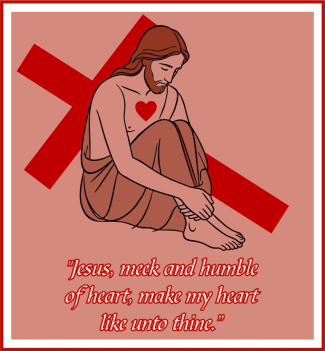
The prayer—quoted in the image at the top of this page—”Jesus, meek and humble of heart, make my heart like unto Thine“, draws directly from the Bible, specifically Matthew 11:29, where Jesus describes himself as “meek and humble of heart“.
As a standalone prayer or aspiration, it gained prominence in Catholic devotion to the Sacred Heart of Jesus, which originated in the 17th century through the visions of St Margaret Mary Alacoque.
However, the exact wording referenced is most famously used as the refrain in the Litany of Humility, a prayer that emerged in the 19th century. The litany focuses on seeking deliverance from pride and embracing humility, aligning with the Sacred Heart devotion’s emphasis on imitating Christ’s gentle heart.
ST AUGUSTINE’S VIEW ON HUMILITY
St Augustine of Hippo (354–430), one of the most influential Church Fathers, was a philosopher, theologian, and Bishop whose works like ‘Confessions‘ and ‘City of God‘ shaped Christianity. His teachings on humility stem from his dramatic conversion from a life of intellectual pride and moral struggle to one of deep faith and submission.
For Augustine, humility was not mere self-deprecation but the essential virtue that counters pride—the root of sin—and opens the path to God. He viewed it as the foundation for all spiritual growth, drawing from Scripture, his personal experiences, and Christ’s example. In his letter to Dioscorus, he famously emphasized: “This way is first humility, second humility, third humility and no matter how often you keep asking me I will say the same over and over again.”
This underscores how humility permeated his theology.
Humility as the Foundation of All Virtues
Augustine taught that humility is the bedrock upon which other virtues stand. Without it, even what looks like good deeds are tainted by pride. He wrote: “Humility is the foundation of all the other virtues hence, in the soul in which this virtue does not exist there cannot be any other virtue except in mere appearance.”
This idea reflects his belief that pride bloats the self, leading to spiritual downfall, while humility keeps us grounded in reality before God. In “Confessions”, he contrasts his pre-conversion pride—such as dismissing Scripture due to its “unpolished” style—with the humility that allowed him to ultimately embrace truth.
He saw humility as the “first rung on the Christian ladder,” enabling acceptance of God’s grace amid human weakness.
The Contrast Between Pride and Humility
Pride, for Augustine, was the original sin that “changed angels into devils,” while humility “makes men as angels.” He described pride as a “swelling” or infirmity that distorts self-perception, leading to harm.
In his sermons and writings, he warned that pride must be feared even in virtuous acts: “It is true that other defects have to be feared in our sins, but pride is to be feared in our very acts of virtue.”
Humility, conversely, exalts the heart: “There is something in humility which, strangely enough, exalts the heart, and something in pride which debases it.”
This transformation occurred in his own life; during his conversion, his “heart went into labor and gave birth to humility.”
Christ’s Humility as the Ultimate Example and Remedy
Augustine often portrayed Christ as the “physician” who heals the sickness of pride through His own humility. Exhibited in the Incarnation and Crucifixion, Christ’s descent from Divine Glory to human suffering provides the model: “Christ humbled himself in crucifixion,” inviting followers to learn from his meekness (Matthew 11:28-29).
This humility remedies sin by deflating human arrogance, as Augustine noted: “The humble Christ emptied Himself on Calvary to atone for Adam’s sin of pride.”
Salvation comes not through self-ascent but by “falling before Christ,” leading to exaltation and the “happy life.”
Humility in Daily Life and Spiritual Practice
Augustine emphasized humility’s practical application: it must “accompany all our actions” and be present “everywhere,” lest pride nullify good works.
He advised building spiritual “towers” on humility’s deep foundation: “Do you wish to rise? Begin by descending. You plan a tower that will pierce the clouds? Lay first the foundation of humility.”
In relations with others and God, it involves submission, gratitude, and contrition—willingness to let God be God and acknowledge dependence.
He contrasted biblical humility (rejoicing in God’s goodness) with pagan versions (devaluing life arrogantly).
Humility also enables charity: “You cannot attain to charity except through humility.”
Influence and Legacy
Augustine’s teachings influenced later saints like St Thomas Aquinas (1225-1274) and St Teresa of Ávila (1515-1582), who echoed his view of humility as essential for virtue.
In modern Christianity, his ideas remind us that true greatness comes through service and dependence on God, not self-elevation. His personal humility—evident in the honest self-examination in “Confessions“—continues to inspire, showing how embracing weakness leads to divine strength.
֍
“[God] guides the humble in what is right and teaches them his way.”
(Psalm 25:9)