
CAN THE LAITY DISAGREE WITH THE POPE?
Yes, the laity (and the clergy) can disagree with the Pope on his personal views. Catholic teaching draws a clear distinction between the Pope’s private opinions—as a theologian, individual, or public figure—and his official exercise of the Church’s magisterium. Personal views carry no binding authority and are not protected from error.
Papal infallibility is extremely limited. It applies only when the Pope speaks ex cathedra, as supreme pastor and teacher of all the faithful, and intentionally defines a doctrine on faith or morals to be held by the whole Church (see Vatican I, Pastor Aeternus, and the Catechism of the Catholic Church (CCC §§890–892). This has happened rarely in history.
Everything else—including interviews, books, homilies, tweets, private theological opinions, or even non-definitive statements on prudential matters (like, politics, science, or pastoral applications)—falls outside infallibility. A pope’s private theological opinions are not infallible.
The laity and even the clergy have no obligation of assent of faith or even religious submission of intellect and will to the Pope’s personal views, because those views are not acts of the magisterium at all.
The Code of Canon Law (Canon752) and documents like the Congregation for the Doctrine of the Faith’s Donum Veritatis apply submission requirements only to authentic, official, but non-infallible teachings of the Pope or bishops—not to offhand or private remarks.
What the Laity Can (and Cannot) Do
On personal views, open disagreement is permissible and has always been part of Catholic life. The Pope is not infallible as a private person; he can be wrong on economics, science, history, or even certain theological speculations. Faithful Catholics have historically critiqued popes charitably on such matters (such as, St Paul publicly opposing St Peter’s behavior in Galatians 2, though that was not about a doctrinal teaching but it had implications). Modern examples include lay and clerical pushback on a pope’s off-the-cuff comments or personal writings that are not presented as definitive teaching.
However, opposition must be respectful, rooted in sound reasoning, and aimed at truth rather than undermining the papal office or Church unity. The laity share in the Church’s sensus fidei—the supernatural appreciation of the faith by the whole people of God (Lumen Gentium 12)—which can even serve as a check against error in non-infallible areas.
Dissent from authoritative but non-infallible teachings is possible in limited cases (say theologians and the CDF), but it requires careful justification and cannot extend to definitive doctrines.
The Pope’s personal opinions do not bind the conscience in the way official teachings do. The laity remain free to evaluate and, if necessary, oppose them—while always rendering due respect to the successor of Peter as the visible head of the Church. This balance preserves both truth-seeking and ecclesial communion.
SEND A COMMENT
Links to our Massage Box
DOWNLOAD AS PDF
Printable version of this Page
Further Comments on "CAN THE LAITY DISAGREE WITH THE POPE?"
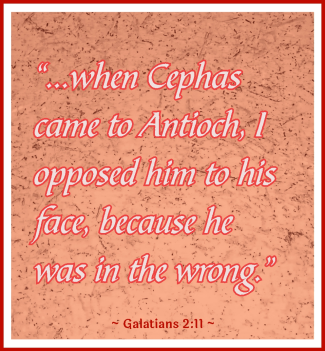
The image at the head of this page has the quote from Galatians 2:11: “when Cephas came to Antioch, I opposed him to his face, because he was in the wrong.”
Galatians 2 highlights the unity of the Gospel and the principle that salvation is by faith in Christ alone, not by adherence to the Mosaic Law. It also shows Paul’s boldness in defending the truth of the Gospel, even against prominent leaders, to preserve the integrity of Christian teaching.
Galatians 2 foreshadows ongoing tensions and differences within the Church regarding doctrine, personal opinions, and the behavior of leaders, including Popes. It does so not by undermining core authority or unity but by vividly illustrating human fallibility, the priority of the gospel, and the necessity of fraternal correction—even among the highest leaders.
The Incident in Galatians 2
In Galatians 2:11-14, Paul recounts publicly opposing Peter (Cephas) in Antioch: “When Cephas came to Antioch, I opposed him to his face, because he stood condemned. For before certain men came from James, he used to eat with the Gentiles. But when they arrived, he began to draw back and separate himself from the Gentiles because he was afraid of those who belonged to the circumcision group.” Other Jewish Christians, including Barnabas, followed Peter’s example. Paul confronted him: “You are a Jew, yet you live like a Gentile and not like a Jew. How is it, then, that you force Gentiles to follow Jewish customs?” (v. 14).
This was not a minor personal disagreement. Peter’s withdrawal from table fellowship with Gentile Christians compromised the gospel’s truth—that justification comes through faith in Christ, not works of the Jewish law (as Paul elaborates in the rest of the chapter). Peter’s action, driven by fear of criticism from the “circumcision group,” created division and hypocrisy, pressuring Gentiles toward legalism. Paul’s public rebuke defended the unity and freedom of the gospel.
Earlier in the chapter, Paul describes harmony at the Jerusalem meeting (often linked to Acts 15), where the pillars—James, Peter, and John—affirmed his ministry to the Gentiles without adding requirements. Yet the Antioch incident shows harmony can fracture under social and cultural pressure.
Foreshadowing Future Differences
This episode anticipates recurring patterns in Church history:
Human Leaders Are Fallible: Peter, the rock upon whom Christ built His Church (Matthew 16:18) and a foundational apostle, erred in behavior and its implications for practice. He did not deny core doctrine but acted inconsistently with it. This foreshadows that popes and bishops, as successors, remain sinners capable of poor judgment, personal failings, scandalous behavior, or inconsistent application of teaching. Catholic theology distinguishes this sharply from infallibility, which applies narrowly to definitive proclamations on faith and morals under specific conditions—not to personal opinions, prudential decisions, or daily conduct.
Differences on Application, Not Always Core Doctrine:
The conflict centered on praxis—how Jewish and Gentile Christians should relate—rather than outright heresy. It highlighted tensions between unity in essentials and diversity in non-essentials. Church history is full of such debates: rites (Latin vs. Eastern), disciplines (celibacy, fasting), pastoral approaches to culture, and responses to new challenges. Leaders may differ in emphasis, strategy, or personal style without rupturing the deposit of faith.
Public Correction as a Feature, Not a Bug: Paul’s bold, public stand models accountability. It shows that respect for apostolic authority does not mean silence in the face of error. This has echoed in later confrontations—bishops correcting popes, saints admonishing leaders (e.g., Catherine of Siena), or theologians debating popes on non-infallible matters. It foreshadows a living Church where differences arise and are worked through, often messily, rather than a monolithic institution without dissent or reform.
Implications for Doctrine, Opinions, and Behavior
Doctrine: Galatians 2 reinforces that the gospel (justification by faith, inclusion of all in Christ) stands above personalities. It does not predict doctrinal relativism but warns against allowing personal weakness or politics to distort it. Future councils (e.g., Nicaea, Chalcedon, Trent, Vatican II) and papal definitions often resolved disputes while preserving continuity. Differences have sometimes led to schisms (East-West, Reformation), underscoring the stakes.
Personal Opinions and Behavior: Popes have held varying theological opinions before election, shown favoritism, made strategic errors, or lived imperfectly (as with any long line of human leaders). Galatians 2 normalizes this reality. Peter’s fear-driven hypocrisy prefigures times when leaders might prioritize peace, politics, or cultural accommodation over gospel clarity. It calls the Church to vigilance, not despair.
Unity Amid Diversity: The chapter as a whole balances collegiality (the Jerusalem agreement) with bold correction (Antioch). It foreshadows a Church that is one, holy, catholic, and apostolic—yet visibly marked by debate, as seen from the Acts of the Apostles onward through medieval disputations, Reformation-era conflicts, and modern synodal processes.
Balanced Perspective
Protestants often cite this passage to challenge papal primacy or infallibility, seeing it as evidence of equality among apostles or rejection of a supreme office. Catholic responses emphasize that Peter was not exercising infallible teaching authority here—he was acting personally and inconsistently—and that Paul’s rebuke affirms rather than denies Peter’s role, as fraternal correction strengthens the Church.
The text does not “prove” one ecclesiology over another but richly supports a realistic view: leaders matter enormously, yet they are accountable to the truth of Christ. The Church endures not because its leaders are impeccable, but because the Holy Spirit guides it despite their flaws.
In sum, Galatians 2 does foreshadow future differences—on emphasis, application, personal conduct, and opinions—within the Church. It calls believers to prioritize the gospel, practice humility, and exercise charity in correction. Far from a scandal to be hidden, it is a paradigm for maturity: truth matters more than personalities, and unity is maintained through fidelity to Christ, not the pretense of perpetual harmony. This ancient confrontation remains relevant for navigating leadership in every age.