
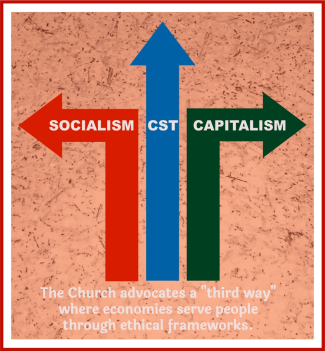
WHY CST IS NOT SOCIALISM?
Catholic Social Teaching aka CST is not socialism as we will clearly lay it out here. Though some superficial overlaps primarily ‘concern for the poor’ and ‘critiques of inequality’ have led to some confusion. The Church has consistently distinguished and often condemned socialism, particularly in its classical forms (expounded by Karl Marx and others), while promoting a distinct vision that upholds private property, subsidiarity, and human freedom.
Popes like Leo XIII (Rerum Novarum) and Pius XI (Quadragesimo Anno) rejected socialism as incompatible with Christianity, viewing it as atheistic, materialistic, and destructive of private property and family structures. John Paul II (Centesimus Annus) criticized socialism’s flaws, including inefficiency, suppression of initiative, and roots in class struggle and atheism.
The Church sees socialism as subordinating the individual to the state or collective, violating human dignity and subsidiarity. “Real socialism” is deemed “intrinsically perverse.”
Key Differences between CST and Socialism
Private Property and Economy:
CST affirms private property as a natural right, but with a social function (universal destination of goods ensures access for all). Socialism always seeks to abolish or severely limit private ownership, transferring it to the state.
The Church supports market economies when regulated for the common good, rejecting unchecked capitalism but not equating social justice with state control.
Role of the State:
Subsidiarity limits state intervention to supportive roles, not dominance. Socialism tends toward centralization, which CST warns against as bureaucratic and dehumanizing.
Anthropology and Ends:
CST is theocentric rooted in God’s love and human transcendence. Socialism is most often anthropocentric or atheistic, focused on material equality via class conflict, which the Church rejects as divisive.
Means vs. Ends:
While both address inequality, CST prioritizes personal virtue, solidarity, and institutional reform over coercive redistribution. Social justice is about enabling opportunity and dignity, not enforced equality.
Nuances on “Democratic Socialism”:
Some Catholics argue that milder forms like Democratic Socialism (welfare states with democratic processes) could align with CST if they respect subsidiarity, dignity, and private initiative—such as through policies promoting equitable access without abolishing markets.
Pope Benedict XVI (in his essay Europe and Its Discontents) praised aspects of Democratic Socialism while condemning totalitarianism.
However, even this is incompatible because of the inherent danger of state expanding its power excessively, undermining subsidiarity or promoting ideologies contrary to Church teaching (example, on life or family). (For more on this click the link below this article— MORE ON “WHY CST IS NOT SOCIALISM.)
The Church critiques both socialism and capitalism, advocating a “third way” where economies serve people through ethical frameworks.
Catholic social justice promotes a society of human dignity, solidarity, and subsidiarity, critiquing any system—socialist or capitalist—that dehumanizes or excludes. No, CST is not socialism, which the Church has repeatedly rejected as flawed in principle and practice.
SEND A COMMENT
Links to our Massage Box
DOWNLOAD AS PDF
Printable version of this Page
MORE ON "WHY CST IS NOT SOCIALISM?"
Here we are examining Cardinal Joseph Ratzinger’s (later Pope Benedict XVI) positive assessment of “democratic socialism” in his 2006 essay “Europe and Its Discontents”.
COMMENT
The counterarguments come primarily from theologians, economists, and commentators who adhere closely to earlier papal encyclicals on Catholic Social Teaching (CST).
They argue that this remark—while accurate as a descriptive note on 19th-century European history—does not constitute an endorsement of democratic socialism as a system compatible with the full body of CST.
In the essay, Cardinal Ratzinger sketches three European models of the state:
- the French revolutionary model,
- the English/Germanic liberal model, and
- socialism (which split into totalitarian/Marxist and democratic branches).
He notes that democratic socialism “managed to fit within the two existing models as a welcome counterweight to the radical liberal positions, which it developed and corrected,” appealed to Catholic groups historically, and that “in many respects, democratic socialism was and is close to Catholic social doctrine and has in any case made a remarkable contribution to the formation of a social consciousness.”
He immediately contrasts this with totalitarian socialism’s atheistic materialism, moral relativism, and destruction of human dignity.
Critics emphasize this is historical observation, not a policy prescription. The essay’s larger point is Europe’s spiritual crisis and the need for a moral foundation grounded in Christianity and natural law—not an economic blueprint. Some analysts argue the passage is often misread or selectively quoted to imply broader approval.
Catholic critics (drawing from Leo XIII, Pius XI, and principles like subsidiarity and private property) raise these points:
The Church’s consistent magisterial condemnation of socialism—Popes from Pius IX through John Paul II have rejected socialism (in all forms) as fundamentally incompatible with Catholicism.
Leo XIII’s Rerum Novarum (1891) and Pius XI’s Quadragesimo Anno (1931) condemn it for denying private property (a natural right essential to human dignity and freedom), promoting class conflict, and subordinating the person to the collective or state.
Pius XI famously declared that “no one can be at the same time a sincere Catholic and a true socialist.” Even when noting that moderate socialist programs “often strikingly approach the just demands of Christian social reformers,” the Church maintains that socialism’s core errors remain.
Democratic variants are seen by many as still violating these principles through expansive state redistribution and control.
CST’s principle of subsidiarity (decisions should be made at the most local level possible) clashes with democratic socialism’s typical reliance on large-scale government welfare programs, taxation, and regulation.
Critics argue this fosters dependency, undermines family and community initiative, and concentrates power in the state—contrary to the person-centered anthropology of CST.
Pope Benedict himself elsewhere stressed that fundamental rights precede the state and that the state must not create or override human dignity.
CST strongly affirms the right to private property as a safeguard of freedom (not absolute but protected against arbitrary seizure).
Socialism—democratic or otherwise—is seen as treating productive property as inherently suspect or subject to collective redistribution, which critics label as institutionalized theft or envy.
This is contrasted with the Church’s view that profit, enterprise, and ownership are morally good when ordered to the common good.
Even “democratic” forms can lead to excessive bureaucracy, moral relativism in policy (like on family, bioethics etc.), and erosion of the profit motive and personal virtue.
Some point out that Benedict’s own later writings (like, Caritas in Veritate) critique both unchecked markets and overly statist solutions while upholding ethical markets and fraternity—not socialism.
Benedict’s comment highlights a historical overlap in social concerns (e.g., workers’ rights, countering radical individualism), but it is not a blanket approval. A significant body of Catholic thought—rooted in the encyclical tradition, subsidiarity, and private property—maintains that no form of socialism, democratic or otherwise, is fully reconcilable with CST.
Instead, proposals must be judged individually against the Church’s principles, with many preferring distributism or morally regulated markets as truer expressions of Catholic social doctrine.
The Church has no official “approval” of democratic socialism as a system; CST remains its own distinct path.