
DO WE DISOBEY JESUS BY CALLING PRIESTS FATHER?
The literal reading of the Bible is a stumbling block for many and Matthew 23:9—”And call no man your father upon the earth: for one is your Father, which is in heaven“—is arguably the biggest. Needless to say, that literal reading of this verse overlooks the deeper context, the biblical usage of the word ‘father’, and Jesus’ rhetorical style.
Let us start by reading the whole passage: “But you are not to be called ‘Rabbi,’ for you have one Teacher, and you are all brothers. And do not call anyone on earth ‘father,’ for you have one Father, and he is in heaven. Nor are you to be called ‘masters’, for you have one master, the Messiah.” (Matthew 23: 8-10).
[It is interesting that although Jesus seems to prohibit the use of the title ‘teacher’, he himself, later, appointed certain men to be teachers in his Church (Matthew 28:19-20).]
Jesus delivers this line in a scathing critique of the Pharisees and religious leaders (Matthew 23:1–12). He’s condemning their hypocrisy, love of titles, and abuse of authority to exalt themselves above God and others. The chapter uses hyperbolic language to drive home the point: “They do all their deeds to be seen by others… They love the place of honor at feasts… Woe to you, scribes and Pharisees, hypocrites!“. The command isn’t a literal ban on the title ‘father’ (or ‘teacher’ and ‘master’).
Jesus, as he often did, was putting his point across through a hyperbolic expression to make a strong position against the proud and sinful attitude of the scribes and Pharisees.
Jesus often uses hyperbole. For example, when he said— “If your right eye causes you to stumble, gouge it out and throw it away.” (Matthew 5:29. See also Matthew 18:9 and Mark 9:47)—certainly he did not intend this for literal application, for otherwise all Christians would be blind and amputees, for “If we claim to be without sin, we deceive ourselves and the truth is not in us.” (1John 1:8).
Using strong words in Mathew 23, Jesus condemned the lust and misuse of authority rather than the use of titles like ‘teacher’, ‘father’ and ‘master’. In the use of the word ‘father’, Jesus is forbidding us not to confuse any human fatherly relationship with the spiritual Fatherhood that God alone has. We must, in all things, be conscious that all authority, very specifically in titles that denote authority, comes from God alone. Hence when we address priests as ‘father’ we always do so with the recognition that God is our true father.
In the Bible the ‘father’ is not just restricted to a biological parent and God but is used for foster parent (Luke 2:48), wise counselors (Genesis 45:8), benefactors of the poor (Job 29:16), leaders (Isaiah 22:20-21). Elisa cries, “My father, my father!” to Elijah as the whirlwind carried the latter up to heaven (2Kings 2:12). Later Elisa himself is called a father by the king of Israel (2Kings 6:21).
The ancient Christian practice of calling priests ‘father’ goes all the way back to the time of the apostles, and the theology behind this is evident in Scripture. While on trial before the Sanhedrin, Stephen addresses them formally as “brothers and fathers” (Acts 7:2). This is a very important passage in this context: the Scripture tells us that Stephan was filled with the Holy Spirit and spoke these words under the inspiration of the Holy Spirit (Acts 7:55). There is no way the Holy Spirit could have inspired Stephen to address the Jewish priests as ‘fathers’ if indeed Christ had forbidden its use.
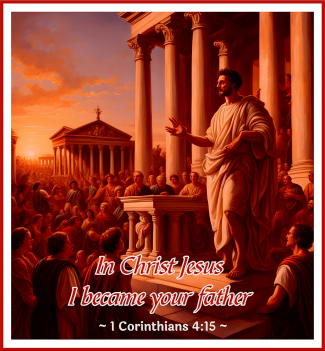
And perhaps the most pointed New Testament reference to spiritual fatherhood of priests is found in 1Corinthians 4:14-15. In Catholic tradition, priests are “spiritual fathers” who bring forth faith through preaching, sacraments, and direction—echoing Paul’s self-description. It’s not about elevating priests above God but honoring their God-given role, much like calling a doctor “doctor” doesn’t deny God’s sovereignty over health.
Failure to acknowledge this in fact is a failure to recognize and honor a great gift God has bestowed on the Church: the spiritual fatherhood of the priesthood.
SEND A COMMENT
Links to our Massage Box
DOWNLOAD AS PDF
Printable version of this Page
Further Comments on 'Calling Priests Father'
The image at the head of this page is composed with a painting titled “Paul Preaching at Athens” by Ralph Pallen Coleman (1892–1968), an American illustrator known for his work in magazines like the Saturday Evening Post and for religious and biblical illustrations. The artwork depicts the Apostle Paul delivering a sermon to a crowd in ancient Athens, as described in Acts 17 of the New Testament, set against a dramatic sunset in a grand classical forum with temples and columns. The piece has a realistic, mid-20th-century illustrative style, often used in Bible storybooks and religious publications.
COMMENT
Catholic interpretations of Scripture are guided by Sacred Tradition, the Magisterium (teaching authority of the Church), and the writings of the Church Fathers, alongside the Biblical text itself. 1Corinthians 4:14-15 is often highlighted in Catholic apologetics and theology to affirm the concept of spiritual fatherhood, which supports practices like addressing priests as “Father.”
The Full Text: “I am writing this not to shame you but to warn you as my dear children. Even if you had ten thousand guardians in Christ, you do not have many fathers, for in Christ Jesus I became your father through the gospel.” (1 Corinthians 4:14-15)
In Catholic exegesis, 1Corinthians is seen as Paul’s pastoral letter addressing divisions in the early Church at Corinth, a community he founded around AD 50-51. The city was a hub of pagan influences, intellectual pride, and moral challenges, leading to factions among believers who aligned with different leaders (Paul, Apollos, or Cephas; see 1Corinthians 1:12). Paul, as an apostle, exercises his God-given authority to correct these issues, modeling the hierarchical structure of the Church that Catholics trace back to apostolic times.
Chapter 4 concludes Paul’s discourse on true apostleship versus worldly wisdom. The preceding verses (1Corinthians 4:8-13) use irony to contrast the apostles’ humility and suffering with the Corinthians’ arrogance. From a Catholic lens, this underscores the sacrificial nature of ordained ministry, akin to the priesthood today.
Paul transitions to a fatherly tone in verses 14-15, invoking familial imagery that resonates with the Church as the “family of God” (cf. Ephesians 2:19; CCC §1655)
Church Fathers like St. Ignatius of Antioch and St. Clement of Rome echoed this paternal authority, reinforcing apostolic succession—a key Catholic doctrine where bishops inherit the apostles’ teaching and governing role.
Verse-by-Verse Breakdown
Verse 14: “I do not write this to make you ashamed, but to admonish you as my beloved children.” Paul’s intent is not humiliation but loving correction (nouthetéō in Greek, meaning to instruct or warn). This reflects the father-child relationship, were discipline stems from affection, not domination.
Father MacEvilly, a 19th-century Irish bishop and commentator, explains that Paul softens his rebuke by calling them “beloved children,” emphasizing his role as a spiritual parent who begot them in faith. This aligns with Catholic teaching on fraternal correction as an act of charity (CCC §1829), and it prefigures the priest’s role in sacraments like Baptism, where new life in Christ is imparted.
Verse 15: “For though you have countless guides in Christ, you do not have many fathers. For I became your father in Christ Jesus through the gospel.“
Here, Paul distinguishes his foundational role from other teachers. The term “guides” (paidagōgoi) refers to tutors or guardians in ancient households—subordinate figures who instruct but do not originate life. In contrast, Paul is the “father” (patēr) who “begot” (egennēsa) them through the gospel, meaning he evangelized and brought them to the Faith.
This highlights the biblical warrant for calling priests “Father,” countering interpretations of Matthew 23:9 (“Call no one on earth your father“) as a prohibition against all such titles. Instead, Jesus warned against hypocritical or prideful use, not legitimate spiritual fatherhood, as Paul exemplifies here.
This reinforces Paul’s fatherhood is “in Christ,” tying it to the sacramental economy where priests act in persona Christi (in the person of Christ).
Theological Implications
Spiritual Fatherhood and Priesthood: This text is foundational for the Catholic practice of addressing clergy as “Father.” Paul’s self-description validates hierarchical roles in the Church, where bishops and priests, as successors to the apostles, exercise paternal care over the faithful (CCC §1268}.
Apostolic Succession and Authority: Catholics view Paul’s claim as evidence of the apostles’ unique authority, passed down through ordination. Unlike mere instructors, true shepherds like Paul provide not just knowledge but life-giving Gospel proclamation, mirroring the Magisterium’s role in interpreting Scripture and Tradition.
Discipline and Love in the Church: Paul’s admonition models how Church authority—whether papal, episcopal, or priestly—should be exercised with mercy. This echoes Vatican II’s Lumen Gentium §26-27 1, which calls bishops “fathers and pastors” who guide with gentleness. It also connects to the sacrament of Reconciliation, where priests offer fatherly forgiveness.
Unity and Humility: Amid Corinthian divisions, Paul’s appeal promotes ecclesial unity under legitimate authority, a theme central to Catholic ecclesiology. It warns against individualism, encouraging imitation of apostolic ways (as in verse 16: “Be imitators of me, as I am of Christ“).
Modern Application in Catholic Life
Today, this passage inspires Catholics to honor spiritual leaders while recognizing God’s ultimate paternity. In parish settings, it encourages viewing priests as fathers who nurture faith through sacraments and teaching.
For families, it models parental discipline rooted in love.
In apologetics, it’s a key response to objections about clerical titles, affirming that such practices are biblically grounded and Christ-centered.
Footnotes
- ↑ — Lumen Gentium (26) It is a flock of which God Himself foretold He would be the shepherd, (27) and whose sheep, although ruled by human shepherds; are nevertheless continuously led and nourished by Christ Himself, the Good Shepherd and the Prince of the shepherds…