
THE APOSTLES’ CREED
(Oldest Confession of Christian Faith)
I believe in God, the Father almighty, creator of heaven and earth, and in Jesus Christ, his only Son, our Lord, who was conceived by the Holy Spirit, born of the Virgin Mary, suffered under Pontius Pilate, was crucified, died and was buried; he descended into hell; on the third day he rose again from the dead; he ascended into heaven, and is seated at the right hand of God the Father almighty; from there he will come to judge the living and the dead.
I believe in the Holy Spirit, the Holy Catholic Church, the communion of saints, the forgiveness of sins, the resurrection of the body, and life everlasting. Amen.
LATIN
| credo |
Credo in Deum, Patrem omnipotentem, Creatorem caeli et terrae. Et in Iesum Christum, Filium eius unicum, Dominum nostrum: qui conceptus est de Spiritu Sancto, natus ex Maria Virgine, passus sub Pontio Pilato, crucifixus, mortuus, et sepultus, descendit ad infernos, tertia die resurrexit a mortuis, ascendit ad caelos, sedet ad dexteram Dei Patris omnipotentis, inde venturus est iudicare vivos et mortuos.
Credo in Spiritum Sanctum, sanctam Ecclesiam catholicam, sanctorum communionem, remissionem peccatorum, carnis resurrectionem, vitam aeternam. Amen.
When we profess, “I believe in God the Father, and in Jesus Christ His Son, and in the Holy Spirit,” we are joining our voices to a confession that stretches back nearly two thousand years. The APOSTLES’ CREED is not simply a text to be recited; it is the distilled faith of the early Church, handed down through generations, and still prayed today.
Origins
In the 2nd century, new Christians were asked to declare their faith before baptism. These short formulas, called the “rule of faith,” contained the essentials: belief in the Trinity, Christ’s Incarnation, His death and Resurrection, and the promise of eternal life.
St Irenaeus of Lyons (in 180) described this faith: “The Church, though dispersed throughout the whole world, carefully guards this faith… believing in one God, the Father Almighty… and in Christ Jesus, the Son of God, who became incarnate for our salvation… and in the Holy Spirit… and the resurrection of the flesh, and eternal life.” Already, the Creed’s backbone was present.
As heresies arose, the Church expanded these baptismal confessions to clarify what was truly believed. Tertullian (in 200) wrote of the baptismal profession: “We believe in one God Almighty, the Creator… and in Jesus Christ, the Son of God, born of the Virgin Mary, crucified under Pontius Pilate, raised again the third day, received into heaven, and coming to judge the living and the dead.” This language is strikingly close to the Creed we recite today.
From Local Formulas to Universal Creed
By the 4th century, Origen of Alexandria (165-253) and St Augustine of Hippo were preaching and teaching the Creed line by line, showing its power as a catechetical tool. Augustine urged his flock: “This is the faith which you are to hold, which you are to confess, which you are to recite. The Creed is learned by hearing, is retained by memory, and is recited by the tongue.”
Over time, additions such as Christ’s descent into hell and the communion of saints enriched the text.
By the 8th century, under the influence of the Frankish Church, the APOSTLES’ CREED reached the standardized form we know today.
Today
Unlike the Nicene Creed, which is recited at Mass, the APOSTLES’ CREED became the prayer of daily devotion. It is said at Baptism, woven into the Rosary, and cherished in personal prayer. Its simplicity makes it accessible, yet its depth makes it timeless.
When we pray the Creed, we are not just repeating ancient words. We are professing the same faith that sustained martyrs, inspired saints, and continues to unite Christians across centuries and continents.
The APOSTLES’ CREED is the Church’s heartbeat: a prayer born in the baptismal waters of the early centuries, refined through struggle and teaching, and still alive today. To say “I believe” is to stand with Irenaeus, Tertullian, Augustine, and countless believers who have carried this faith forward. It is both history and devotion, doctrine and prayer — a bridge between the earliest Christians and us.
MORE ON "Apostles' Creed"
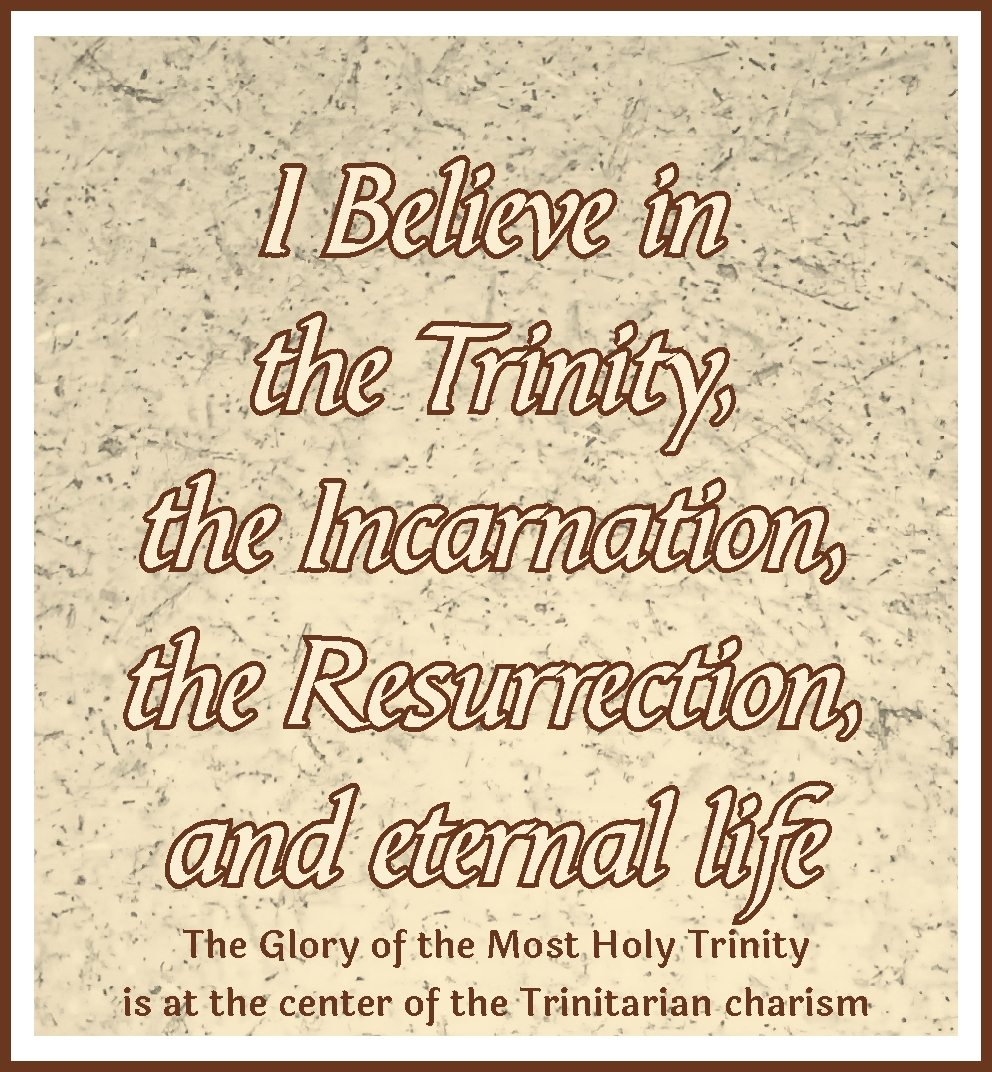
In the image at the head of this page, we have stated: “I believe in the Trinity, the Incarnation, the Resurrection, and eternal life.” These simple affirmations echo the heart of the Christian faith that the early Church sought to preserve. These core convictions—God as Father, Son, and Spirit; Christ’s coming in the flesh; His rising from the dead; and the promise of everlasting life—were gradually shaped into a concise formula of belief.
St Irenaeus (180, in Against Heresies) outlines this “rule of faith,” stressing belief in one God the Father, Jesus Christ incarnate, the Holy Spirit, the resurrection of the flesh, and eternal life. This is essentially the seed from which the APOSTLES’ CREED grew.
Timeline of the development of the Apostles’ Creed
2nd century (Rome)
The Old Roman Symbol emerges as a baptismal profession of faith. Short, simple statements affirm belief in God the Father, Jesus Christ, and the Holy Spirit.
3rd–4th centuries
Local variations of baptismal creeds appear in different churches. These creeds are used to instruct catechumens and to safeguard orthodoxy against heresies like Gnosticism and Arianism.
4th century
The Nicene Creed is composed at the Councils of Nicaea (325) and Constantinople (381). While distinct, it influences the theological precision of Western baptismal creeds.
5th–7th centuries
The Old Roman Symbol is expanded in Gaul and other regions. Additions clarify doctrines such as Christ’s descent into hell and the resurrection of the body.
8th century (final form)
The APOSTLES’ CREED reaches its standardized form in the Frankish Church under Charlemagne. It becomes widely adopted in the Western Church as the definitive baptismal creed.
Medieval period onward
The Creed is firmly established in catechesis, liturgy, and private devotion. It is recited in the Rosary, the Divine Office, and at Baptism.
The APOSTLES’ CREED grew from the Old Roman baptismal confession into a universal summary of Christian belief. By the 8th century, it had crystallized into the form we know today, and it remains a cornerstone of Catholic faith.