
ANGELUS
()
[℣] The angel of the Lord declared unto Mary. [℟] And she conceived of the Holy Spirit.
Hail Mary, full of grace. The Lord is with you. Blessed are you among women, and blessed is the fruit of your womb, Jesus. Holy Mary, Mother of God, pray for us sinners, now and at the hour of our death, Amen.
[℣] Behold the handmaid of the Lord. [℟] Let it be done unto me according to your word.
Hail Mary, full of grace. The Lord is with you. Blessed are you among women, and blessed is the fruit of your womb, Jesus. Holy Mary, Mother of God, pray for us sinners, now and at the hour of our death, Amen.
[℣]. And the Word was made flesh. [℟] And dwelt among us.
Hail Mary, full of grace. The Lord is with you. Blessed are you among women, and blessed is the fruit of your womb, Jesus. Holy Mary, Mother of God, pray for us sinners, now and at the hour of our death, Amen.
[℣] Pray for us, O holy Mother of God [℟] That we may be made worthy of the promises of Christ.
[℣] Let us pray:
[Ⱥ] Pour forth, we beseech you, O Lord, your grace into our hearts, that we, to whom the Incarnation of Christ your Son was made known by the message of an angel, may, by his Passion and Cross, be brought to the glory of his Resurrection through the same Christ, our Lord. Amen.
LATIN
| angelus |
[℣] Angelus Domini nuntiavit Mariae, [℟] Et concepit de Spiritu Sancto.
Ave Maria, gratia plena, Dominus tecum; benedicta tu in mulieribus, et benedictus fructus ventris tui, Iesus.
[℣] Ecce ancilla Domini, [℟] Fiat mihi secundum verbum tuum.
Ave Maria, gratia plena, Dominus tecum; benedicta tu in mulieribus, et benedictus fructus ventris tui, Iesus.
[℣] Et Verbum caro factum est, [℟] Et habitavit in nobis.
Ave Maria, gratia plena, Dominus tecum; benedicta tu in mulieribus, et benedictus fructus ventris tui, Iesus.
[℣] Ora pro nobis, sancta Dei Genetrix, [℟] Ut digni efficiamur promissionibus Christi.
[℣] Oremus:
[Ⱥ] Gratiam tuam, quaesumus, Domine, mentibus nostris infunde; ut qui, Angelo nuntiante, Christi Filii tui incarnationem cognovimus, per passionem eius et crucem ad resurrectionis gloriam perducamur. Per eundem Christum Dominum nostrum. Amen.
The ANGELUS is a traditional devotion commemorating the Incarnation of Jesus Christ. It is named after its opening words: Angelus Domini nuntiavit Mariæ. The prayer consists of three biblical versicles (Luke 1:28-33 Annunciation – Luke 1:38 Mary’s fait – John 1:14 the Incarnation), each followed by a Hail Mary, concluding with a short prayer. It is conventionally recited three times a day—at dawn, noon, and evening—prompted by the ringing of church bells. During Eastertide, it is replaced by the Regina Caeli (“Queen of Heaven”).
Origins
The ANGELUS did not appear suddenly but evolved gradually over centuries from monastic practices tied to the Liturgy of the Hours. It traces back to the monastic custom in Europe of reciting three Hail Marys at the evening Compline bell. This honored the Incarnation and was a way for the laity to imitate monastic prayer.
Clear early evidence appears among the Franciscans. By 1263, Franciscan houses were using related practices. The Italian Franciscan friar Sinigardi di Arezzo (d. 1282) prepared liturgical texts for it. St Francis of Assisi’s deep devotion to the Incarnation and Mary, inspired efforts to bring structured prayer into everyday lay life.
The practice of three evening Hail Marys became widespread in Europe. Popes like John XXII (in 1318 and 1327) recommended and indulgenced it. Noon recitation appears in records from places like Czechoslovakia (1413) and Cologne (1423). Morning prayers also developed.
The form we recognize today—versicles alternating with Hail Marys and a concluding prayer—crystallized in the mid-to-late 1500s. It appears in printed sources like a Venetian catechism (1560), the Little Office of the Blessed Virgin Mary under Pope Pius V (1566–1572), and St Peter Canisius’s handbook (1588). Pope Pius V promoted it, partly in the context of Counter-Reformation efforts.
Additional historical notes include Pope Urban II’s 1095 call at the Council of Clermont for bell-ringing and Marian prayers linked to the Crusades, and later papal support (like, Callixtus III).
Some early sources link it to figures like St Mechtilde, but the core development was organic and communal.
Purpose and Significance
The ANGELUS serves as a brief pause in daily life to recall the Annunciation, Mary’s fiat (“Behold the handmaid of the Lord…”), the Incarnation (“And the Word was made flesh”), and Christ’s redemptive work.
It bridges monastic prayer with lay devotion, using bells as a public call to prayer—much like how the ANGELUS bells still ring today in many places. It remains a living devotion, famously associated with the Pope’s Sunday ANGELUS address usually from St Peter’s Square. Its enduring appeal lies in its simplicity, scriptural roots, and reminder of God’s entry into human history through Mary’s cooperation.
MORE ON "ANGELUS"
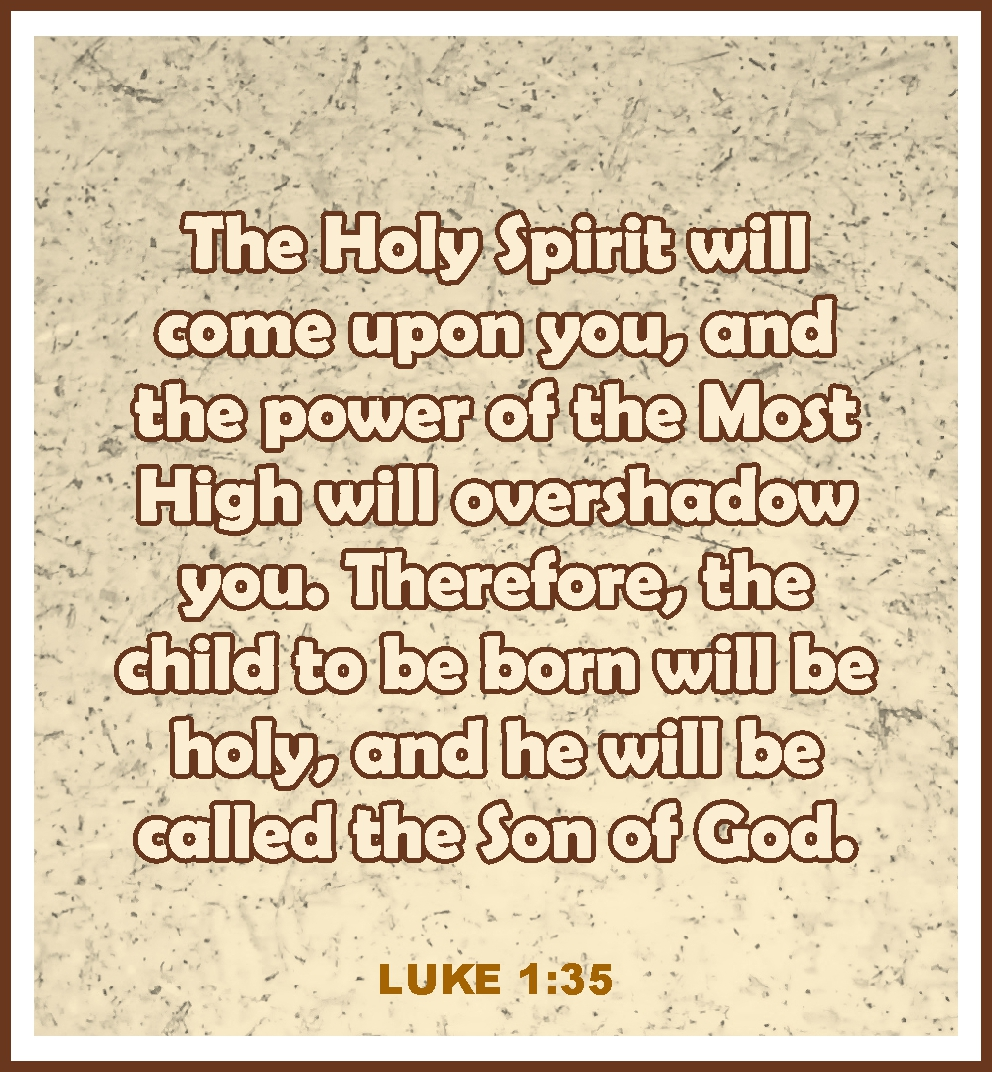
In the image at the head of this page, we have quoted from Luke 1:35. The verse reveals Mary’s intimate and special relationship with the Holy Trinity. God selected her—the only creature—to fully participate in his Redemptive plan.
Mary in the Mystery of the Trinity
When the angel Gabriel announces, “The Holy Spirit will come upon you, and the power of the Most High will overshadow you” (Luke 1:35), Mary receives this word in childlike faith. She is the humble daughter of the Father, trusting His will as a child trusts her parent. Tradition often calls her the “Daughter of Zion,” the purest fruit of Israel’s longing. St John Damascene wrote: “Mary is the daughter of Adam, yet she became the Mother of God.” Her childlike obedience reveals that true greatness lies in surrender to the Father’s plan.
The overshadowing of the Spirit makes Mary uniquely His spouse. Not in a carnal sense, but in a mystical union: the Spirit plants the divine Word within her womb. St Maximilian Kolbe beautifully expressed this mystery: “The Holy Spirit is the uncreated Immaculate Conception, and Mary is the created Immaculate Conception. Their union is so profound that the Spirit acts only through her.” In this way, Mary becomes the living sanctuary where heaven and earth meet, the Spirit’s chosen partner in bringing forth the Incarnation.
Mary’s fiat—“Let it be done to me according to your word”—ushers in her motherhood of the Son. She is not merely mother of His humanity, but of the divine Person who is both God and man. The Council of Ephesus (431 AD) affirmed her as Theotokos, “God-bearer,” safeguarding the truth that Jesus is one divine Person. St Augustine explained: “She conceived Him in her heart before she conceived Him in her womb.” Her motherhood is thus both physical and spiritual, embracing the whole mystery of Christ.
To contemplate Mary as Child, Spouse, and Mother is to see her life woven into the very mystery of the Trinity: As Child of the Father, she teaches us trust. As Spouse of the Spirit, she shows us openness to divine action. As Mother of the Son, she leads us to Christ with tender love.
This triple relationship is not about elevating Mary above God, but about showing how God drew her into His own life so that salvation might come to us. She is the masterpiece of grace, the one who mirrors the Father’s will, the Spirit’s power, and the Son’s love.
Mary’s identity is inseparable from the Trinity: daughter, spouse, mother. In her, we see what it means to be fully given to God. To pray with Mary is to step into this mystery—becoming children of the Father, temples of the Spirit, and disciples of the Son.
“O Mary, Daughter of the Father, Spouse of the Spirit, Mother of the Son—teach us to live as you lived, wholly surrendered to the love of God.”