
SIGN OF THE CROSS
(Rich History Rooted in Early Christian Practices)
In the Name of the Father, and of the Son and of the Holy Spirit. Amen.
LATIN
| signum crucis |
In nómine Patris, et Fílii, et Spíritus Sancti. Amen.
The SIGN OF THE CROSS has a rich history rooted in early Christian practices, symbolizing faith in the Holy Trinity and the redemptive power of Christ’s sacrifice. It remains a central in Christian worship and personal devotion.
Origins
The SIGN OF THE CROSS is a one of the oldest Christian rituals, going back to the earliest century of the Church symbolizing the believer’s faith in the Holy Trinity and the salvific power of the Cross. It began as a small mark on the forehead, made with the thumb or one finger, symbolizing the seal of God on believers (refers to Ezekiel 9:4, Revelation 7:3 and others).
An early clear testimony is found in Chapter 3 of De Corona (204) by Tertullian (155–220), which says that Christians marked the sign on their foreheads “…at every forward step and movement, at every going in and out, when we put on our clothes and shoes, when we bathe, when we sit at table, when we light the lamps, on couch, on seat, in all the ordinary actions of daily life, we trace upon the forehead the sign.”
St Cyprian (210- 258) in his Treatises affirmed its power, declaring: “That in the passion and the sign of the cross is all virtue and power.” (Against the Jews, Book II, Chapter 21)—and other early Fathers also reference it as a common devotion, often for protection against evil or temptation. By the 3rd century, the Apostolic Tradition prescribed its use in baptismal rites, minor exorcisms, and daily prayer.
St Cyril of Jerusalem (313-386) urged Christians in his Catechetical Lectures: “Let us not then be ashamed to confess the Crucified. Be the Cross our seal made with boldness by our fingers on our brow and in everything.”
According to St Basil the Great (330-379) in his seminal work De Spiritu Sancto (Chapter 27, §66), wrote: “We have learned to mark the sign of the cross on our foreheads by an unwritten tradition, which comes from custom.” Attributing it to Apostolic times.
Baptism
The SIGN OF THE CROSS is closely associated with the sacrament of Baptism, where individuals are marked with the cross to signify their belonging to Christ. This practice is supported by scriptural references, such as Ephesians 1:13, which speaks of being sealed with the Holy Spirit.
Evolution
The earliest form of the SIGN OF THE CROSS was often made as a small mark on the forehead, resembling the Tau Cross (Τ). This symbol is deeply rooted in Scripture: in Ezekiel 9:4, the faithful were marked with a protective sign, which early Christians understood as the Tau.
Origen ((185-253)) explained that the Tau foreshadowed the Christian cross, saying it resembled the figure of Christ’s cross and was a prophecy of the sign believers make upon their foreheads.
In his Homilies On Ezekiel interprets the meaning of the mark: “The shape of the letter ‘Tau’ presented a resemblance to the figure of the Cross and that therein was contained a prophesy of the sign, which is made by Christians upon their foreheads, for all the faithful make this sign in commencing any undertaking and especially at the beginning of prayer or of reading Holy Scripture.”
For St Cyprian the Tau was not just a letter but a living seal of salvation, protection, and belonging to Christ. It wasn’t just an abstract theological idea—Cyprian saw the Tau as a real, protective seal, a daily reminder of redemption and a shield against evil. This is why later writers could say that for Cyprian, the Tau was a living sacramental sign: salvation marked upon the body.
Later, St Francis of Assisi adopted the Tau as his personal emblem, he signed letters with the Tau, painted it on walls, and encouraged his followers to use it as a visible reminder of humility, simplicity, and belonging to God. For him, the Tau was not a decorative symbol but a living seal—a pledge to imitate Christ crucified and to be a servant of peace and love.
By the 4th–9th centuries, the Sign expanded from forehead to chest and shoulder to shoulder, accompanied by the Trinitarian invocation (“In the name of the Father, and of the Son, and of the Holy Spirit. Amen”).
Around the 4th–5th centuries, amid heresies like Monophysitism, three fingers (thumb, index, middle) came into use to affirm the Trinity, while two folded fingers represented Christ’s dual natures. This became standard in most places.
By the 9th century, the SIGN OF THE CROSS had become firmly embedded in Christian liturgical practice. What began as a personal devotional gesture in the early centuries of the Church—used by believers to invoke Christ’s protection—was gradually formalized into the structure of worship. This development reflects the Church’s movement toward ritual uniformity and the desire to make the Cross not only a private sign of faith but also a communal, liturgical expression. By the medieval period, the SIGN OF THE CROSS was inseparable from Christian worship, shaping both personal devotion and public liturgy.
Eastern vs Western Traditions
Originally, both East and West made the sign from right to left shoulder order, using two or three fingers. Eastern Orthodox and Eastern Catholics retain the ancient practice: three fingers joined (Trinity), right shoulder first, then left. This symbolizes descending from heaven to earth and Christ’s place at the Father’s right hand.
Western Catholics (Latin rite) shifted around the 12th–13th centuries to left to right with an open hand (symbolizing Christ’s five wounds). This aligned with how priests blessed congregations (left-to-right from their perspective, which the faithful mirror). Pope Innocent III (1161-1216) noted both directions were acceptable but left-to-right became dominant in the Catholic Church.
Today
Through the SIGN OF THE CROSS, we proclaim the core mysteries of Christianity: the Holy Trinity—Father, Son, and Holy Spirit—and Christ’s redemptive sacrifice on the Cross. This blend of spoken words and physical gesture serves as a creed, affirming our faith. By making this Sign, we identify ourselves as followers of Christ.
MORE ON "SIGN OF THE CROSS"
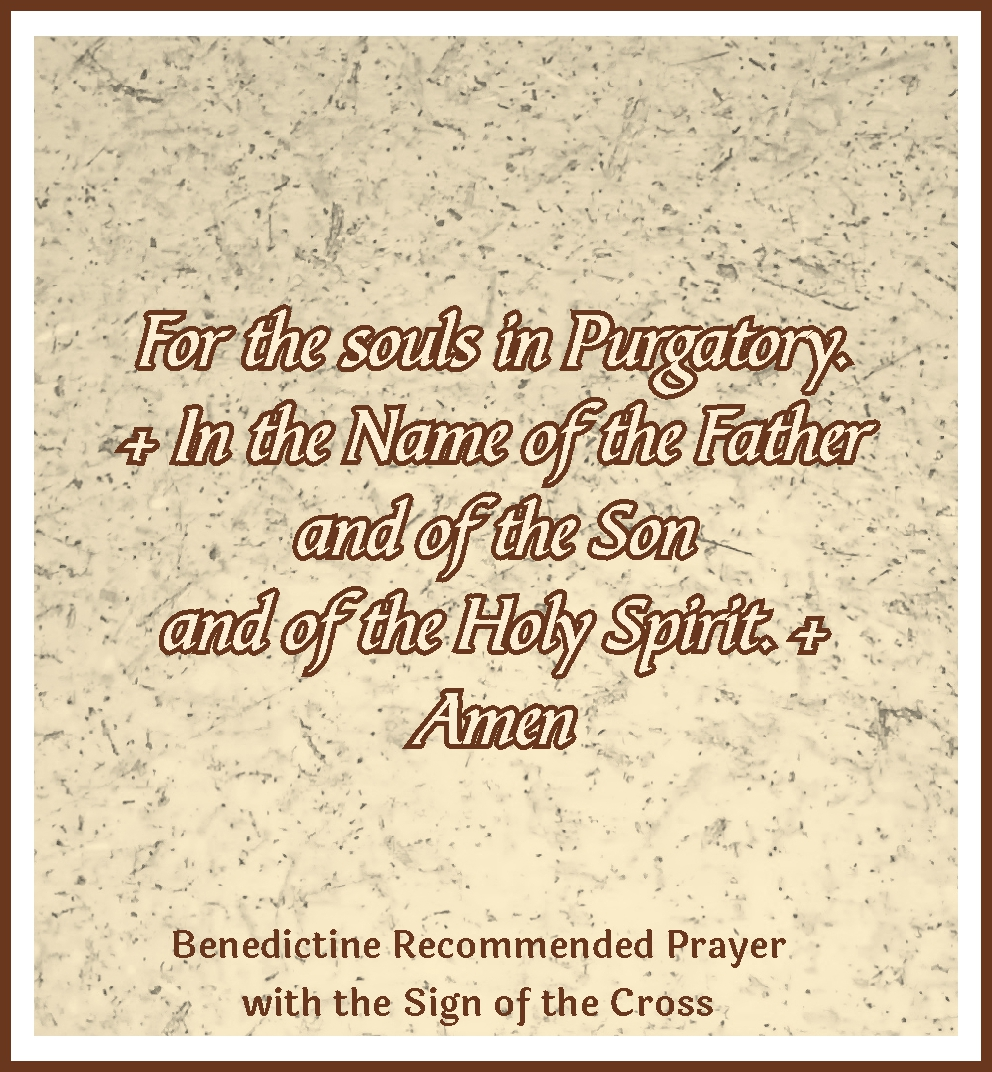
In the image at the head of this page has a quote from a book by Benedictine nuns: “Assist the Souls in Purgatory“.
For the Souls in Purgatory.
+ In the Name of the Father, and of the Son and of the Holy Spirit. + Amen.
Here the SIGN OF THE CROSS—a powerful prayer in itself—is combined with a petition: For Souls in Purgatory. Similarly, we can place any petition with the SIGN OF THE CROSS. For example:
- For <name> that he returns to the Catholic faith. +
- For persecuted Christians throughout the world. +
- For all those who are dying today. +
- For Catholic Priests and Religious. +
We can place our petition to the Holy Trinity through the Cross according to our personal need/intention. This short prayer can be said throughout the day even in the midst of our busy life.
COMMENT
The beauty of the SIGN OF THE CROSS is that it’s both deeply personal and universally shared—it can be a shield, a prayer, or simply a way of centering oneself.
In the first centuries, believers often traced the SIGN OF THE CROSS on their foreheads as a quiet mark of faith. It was a way to identify themselves to one another without words, especially in times when openly professing Christianity could be dangerous. For them, it was both a prayer and a secret badge of courage.
When missionaries traveled to distant regions, they often began their work by blessing the land and people with the SIGN OF THE CROSS. It symbolized bringing Christ’s presence into unfamiliar territory. For example, St Francis Xavier is said to have used it frequently when baptizing and healing in India and Japan.
In many cultures, the SIGN OF THE CROSS is made at the start and end of daily tasks—before meals, journeys, or even simple chores. It transforms ordinary actions into moments of prayer, reminding people that God is present in the rhythm of daily life.
What is striking is that how this simple gesture has carried such weight across centuries—sometimes a shield, sometimes a declaration, sometimes a quiet whisper of faith.
Here are some remarkable miracle stories tied to the SIGN OF THE CROSS that have been passed down through tradition and testimony:
It’s said that when St Francis of Paola was crossing the sea with companions, a storm threatened to overturn their boat. He made the SIGN OF THE CROSS over the waters, and the storm immediately calmed, allowing them to continue safely. For those present, it was a vivid reminder of divine protection.
One of the most famous stories is about St Benedict. His enemies once tried to poison him by offering a cup of wine. Before drinking, he made the SIGN OF THE CROSS over the cup—and it shattered instantly, spilling the poisoned wine harmlessly away. This became a symbol of the Cross as a safeguard against evil.
There are accounts of people making the SIGN OF THE CROSS over the sick and witnessing recovery. While not every story is formally recognized as a miracle, countless believers have experienced comfort, peace, and even healing through this simple act of faith.
In busy cities, some commuters quietly make the SIGN OF THE CROSS before stepping onto crowded trains or buses. It’s not about spectacle—it’s about carrying a sense of divine presence into the chaos of everyday life.
What’s striking is how the SIGN OF THE CROSS is never just a gesture—it’s a prayer in motion, believed to carry divine strength.