
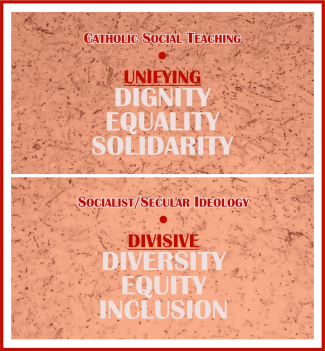
DOES CST SUPPORT DEI?
(NO)
Short answer: No, Catholic Social Teaching (CST) does not in any way imply support for DEI (Diversity, Equity, and Inclusion). Here’s why.
DEI is a recent framework (popularized post 2010 by corporate and academic spheres) that emphasizes demographic—
- Diversity —by race, gender, and identity,
- Equity —interpreted as engineered equality of outcomes rather than equal opportunity, and
- Inclusion —via policies like preferential hiring, training on systemic oppression, and identity-based programming.
Its intellectual roots frequently trace to Critical Theory and Identity Politics, which view society through group-based power dynamics.
Some liberal Catholic institutions (certain colleges, Jesuit schools, and administrators) explicitly claim alignment, arguing that CST’s emphasis on human dignity, anti-racism, and the “preferential option for the poor” makes DEI a practical expression of those values. They cite documents like the USCCB’s 2018 pastoral letter Open Wide Our Hearts (against racism as a structural evil) or the seven themes of CST to frame DEI initiatives as fulfilling solidarity and inclusion. This is an interpretation, not an implication.
CST long predates DEI and never references or requires its specific methods or ideology. In fact, several core CST elements actively conflict with common DEI practices:
Equal dignity vs. group-based equity:
CST insists every individual has equal inherent worth before God, independent of race, sex, or identity group (see Gaudium et Spes and the Catechism (CCC §§1933-1934).
DEI’s idea of “equity” often decides people’s outcomes based on things they can’t change—like race or sex—using quotas or rules that punish unequal results. Catholic Social Teaching says this is wrong and unfair because it treats people as if they are just interchangeable representatives of their group, instead of unique individuals.
Catholic thinkers propose “Dignity, Equality, and Solidarity” (DES) as the authentic alternative:
- Dignity honors real differences without discrimination.
- Equality means equal moral regard and opportunity under the same rules.
- Solidarity builds unity rather than divisive grievance.
Subsidiarity and merit:
CST teaches problems should be addressed closest to the people affected, and work/wages should reflect objective contribution and the common good.
Top-down DEI mandates (training, hiring preferences, or “equitable” grading) often override this and can discriminate, which earlier Popes like Leo XIII explicitly rejected as artificial leveling that ignores natural differences in ability and vocation.
Anthropology and truth:
CST is rooted in objective reality (including biological sex, the family, and the human person as body-soul unity).
DEI frameworks frequently incorporate gender ideology, intersectionality , and the idea that disagreement equals harm—positions the Church has repeatedly condemned as ideological colonization.
Even proponents sometimes admit they are adapting or “partnering” CST with DEI rather than deriving the latter from the former.
Critics across the spectrum note that broad justice rhetoric can superficially overlap, but DEI as always implemented elevates contested secular values over CST’s emphasis on conversion of heart, merit, universal truth, and the Church’s own hierarchical, sacramental structure.
A telling indicator when a U.S. bishop’s essay equating “DEI” with “God” was briefly posted on USCCB platforms in 2025, it was quickly removed amid backlash—showing no settled official endorsement.
In short, CST calls Catholics to pursue true justice, protect the week, and reject all unjust discrimination. But it does not—and cannot—logically imply endorsement of the DEI ideology or toolkit, which many faithful Catholics view as incompatible in key respects. Any claimed support is a selective contemporary overlay, not a consequence of CST itself.
The Church’s social teaching stands on its own timeless foundations.
Subsidiarity and merit:
CST teaches problems should be addressed closest to the people affected, and work/wages should reflect objective contribution and the common good.
Top-down DEI mandates (training, hiring preferences, or “equitable” grading) often override this and can discriminate, which earlier Popes like Leo XIII explicitly rejected as artificial leveling that ignores natural differences in ability and vocation.
Anthropology and truth:
CST is rooted in objective reality (including biological sex, the family, and the human person as body-soul unity).
DEI frameworks frequently incorporate gender ideology, intersectionality , and the idea that disagreement equals harm—positions the Church has repeatedly condemned as ideological colonization.
Even proponents sometimes admit they are adapting or “partnering” CST with DEI rather than deriving the latter from the former.
Critics across the spectrum note that broad justice rhetoric can superficially overlap, but DEI as always implemented elevates contested secular values over CST’s emphasis on conversion of heart, merit, universal truth, and the Church’s own hierarchical, sacramental structure.
A telling indicator when a U.S. bishop’s essay equating “DEI” with “God” was briefly posted on USCCB platforms in 2025, it was quickly removed amid backlash—showing no settled official endorsement.
In short, CST calls Catholics to pursue true justice, protect the week, and reject all unjust discrimination. But it does not—and cannot—logically imply endorsement of the DEI ideology or toolkit, which many faithful Catholics view as incompatible in key respects. Any claimed support is a selective contemporary overlay, not a consequence of CST itself.
The Church’s social teaching stands on its own timeless foundations.
SEND A COMMENT
Links to our Massage Box
DOWNLOAD AS PDF
Printable version of this Page
MORE ON "Does CST support DEI?"
Many institutes, including some Catholic ones, have aggressive DEI [indoctrination] programs, within and outside their curriculum. These institutions have set DEI goals for their admissions and administration. From a Catholic (and social) perspective it is fraught with dangers.
A 2024 Rutgers/NCRI controlled experiment (“Instructing Animosity,” national replication) exposed college students to standard DEI/anti-racist materials: it significantly increased “hostile attribution bias“—students perceived more racism/microaggressions/harm in neutral scenarios, endorsed harsher punishments, and agreed more with extreme demonization. Effects held across demographics.
FIRE’s annual College Free Speech Rankings (68,000+ students surveyed) and related polls show poor national campus climate scores (average ~59/100 “failing”), with 25%+ of students self-censoring often in classes/peers (especially on race/gender/politics) and rising tolerance for disrupting speakers. This is often linked to DEI-driven conformity climates.
There are many other personal and social negative impact of DEI indoctrination. So, the question we are discussing here is:
Can Catholic students protect themselves from “brainwashing” DEI exposure?
Yes—and the Church equips you perfectly for it.
Catholicism’s tradition of faith and reason (see Fides et Ratio 1998, Pope John Paul II) gives you an objective measuring stick that no ideology can manipulate. You don’t need to “feel” your way through DEI; you can test it against unchanging truth. Here’s a clear, step-by-step method any young Catholic can use right now to evaluate any DEI program, training, or policy honestly—and protect yourself from groupthink.
1. Anchor first in official Catholic teaching (your non-negotiable foundation)
Read these primary sources directly: Catechism of the Catholic Church §§1928–1948 (on justice and human dignity). Key CST documents: Rerum Novarum, Gaudium et Spes, Compendium of the Social Doctrine of the Church.
Focus on three unchanging principles:
- Every person has infinite individual dignity (imago Dei) — not derived from group identity.
- Justice means giving each person their due (equal moral worth plus treatment based on merit and truth)—not engineered group outcomes.
- Subsidiarity and solidarity where problems solved at the lowest level, and unity is built on truth and charity—not grievances, which bred discord.
2. Learn the positive Catholic alternative DES (Dignity–Equality–Solidarity)
Faithful Catholic thinkers offer Dignity, Equality, and Solidarity as the authentic response to the real problems DEI claims to solve — without its serious flaws.
- Dignity honors real human differences—without reducing people to racial/gender stereotypes.
- Equality insists on the same moral regard and rules for everyone—no reverse discrimination.
- Solidarity builds real unity through love of neighbor—not compelled ideological conformity.
Start here (short, excellent, and free):
This framework takes justice seriously while staying rooted in the imago Dei and natural law.
3. Ask these six logical questions of any DEI material
Apply them to the actual policies, trainings, or statements (ignore their marketing material):
- Does it treat people as unique individuals with immortal souls, or primarily as members of oppressor/oppressed identity groups?
- Does it promote equal opportunity plus merit (Catholic equality), or equal outcomes via preferences/quotas (which the Church has always rejected as unjust)?
- Does it respect objective reality (biology, competence, truth), or subordinate it to feelings and identity claims?
- Does “inclusion” include faithful Catholics who uphold Church teaching on marriage, gender, and life or label them as harmful?
- What are the actual fruits? (True harmony or division and resentment?)
- Would St Thomas Aquinas or Pope St John Paul II recognize this as justice?
If the honest answer to most is “no,” it fails the Catholic test.
4. Check real-world evidence (reason demands it)
Look beyond slogans:
- Many corporate/academic DEI trainings show little lasting reduction in bias and often increase resentment or backlash (recent studies confirm mixed or negative effects on commitment).
- Empirical results are contested, but outcome data (retention, performance, campus climate) frequently underperform the promises.
5. Practical habits to stay free
- Always read primary sources yourself—DEI authors + CST side-by-side—then test it ruthlessly against truth.
- Pray daily for prudence and the gift of counsel. (Like the prayer on this website)
- Seek solid Catholic mentors (priest, teachers, professors, or groups like Word on Fire, Aquinas Institute, The Thomistic Institute, or your diocese’s faith formation programs).
RED FLAG: Any program that calls honest questions “harmful,” “unsafe,” or “racist” instead of answering them is trying to replace your conscience.
You were made for truth, not slogans. Using this method, you can pursue genuine justice for the vulnerable (the real heart of CST) while rejecting anything that treats people as props or demands you deny reality. The Catholic Church has already given you everything you need — use it.