
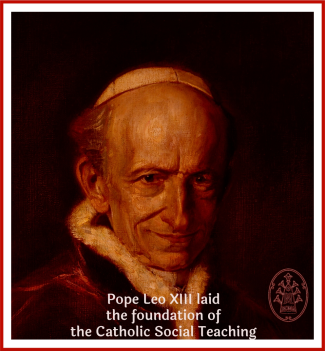
WHAT IS THE FOUNDATION OF CST?
Catholic Social Teaching (CST) is the Church’s body of doctrine—not a dogma—on how to build a just society, rooted in Scripture, Tradition, and papal encyclicals. Church documents identify the permanent principles that form “the very heart of Catholic Social Teaching” as:
- Dignity of the human person (the prime and greatest principle).
- Subsidiarity (decisions at the lowest level)
- Solidarity (we are one human family).
The concept was first developed in the late 19th century with Pope Leo XIII’s encyclical “Rerum Novarum” and has evolved since through subsequent teachings. While CST reflects the Church’s moral vision and is expected to be followed by Catholics, it is not infallible doctrine or a requirement for faith.
To quickly understand its foundation, let’s take a look at the highlights of what the of Pope Leo XIII’s encyclical says:
“Rerum Novarum” was issued on May 15, 1891, and became the foundational document of modern Catholic Social Teaching. It essentially addresses the social and economic challenges of the Industrial Revolution, particularly the relationship between capital (employers) and labor (employees).
Its core teaching emphasizes the dignity of human work, the mutual rights and duties of employers and employees, and the need for JUSTICE * primarily through the lens of rights and duties in society to protect workers from exploitation while rejecting socialism and unbridled capitalism.
The Pope admits that “The discussion is not easy, nor is it void of danger. It is no easy matter to define the relative rights and mutual duties of the rich and of the poor, of capital and of labor. And the danger lies in this, that crafty agitators are intent on making use of these differences of opinion to pervert men’s judgments and to stir up the people to revolt.” (Rerum Novarum §2)
Its key elements are:
Right to private property: The central tenet of the encyclical is that private ownership is inherently just and derived from human nature and labor: “every man has by nature the right to possess property as his own,” and “it cannot but be just that he should possess that portion as his very own, and have a right to hold it without any one being justified in violating that right.“
JUSTICE involves enabling more people, including workers, to acquire property through fair means, rather than forced redistribution. Socialism is condemned as “emphatically unjust” because it abolishes private property, robbing individuals of their earnings and incentives.
Just Wages and Working Conditions: JUSTICE requires fair compensation and humane treatment: “wages ought not to be insufficient to support a frugal and well-behaved wage-earner,” and “it is neither just nor human so to grind men down with excessive labor as to stupefy their minds and wear out their bodies.”
Exploitation, such as defrauding wages or profiting from others’ needs, is a “great crime” that violates divine and human laws.
Workers have a right to rest and protection from hazardous conditions, particularly for women and children.
Role of the State in Distributive Justice: The state must promote “strict justice—with that justice which is called distributive—toward each and every class alike.”
It should protect natural rights, intervene to safeguard the vulnerable, and prevent injury, but without overstepping into family or individual liberties.
The encyclical notes the “misery and wretchedness pressing so unjustly on the majority of the working class,” calling for remedies that respect rights while addressing inequalities.
Harmony Between Classes: Society is likened to the human body, where classes must coexist in “harmony and agreement” for JUSTICE to prevail.
While JUSTICE ensures rights like fair pay, the encyclical distinguishes it from charity: aiding the poor beyond basic duties is an act of Christian love, not JUSTICE.
Role of Religion: Christianity plays a vital role in fostering moral virtue, associations, and brotherly love to bridge divides.
Rejection of extremes: The encyclical criticizes socialism for violating natural rights and causing disorder and condemns unchecked capitalism for leading to worker misery through greed and competition.
Overall, it calls for a just society where economic relations uphold human dignity, protect private property, ensure fair labor practices, and integrate moral and religious values. It calls for active participation in society to build a just order, emphasizing ethical norms over purely economic or political ideologies.
FOOTNOTE
*In “Rerum Novarum” JUSTICE refers to the moral obligation to act in a way that upholds the dignity of all individuals and promotes the common good. It is a fundamental principle that should guide Catholics in their actions and decisions, ensuring that they do not exploit others or take advantage of them. In the development of Pope Leo XIII’s views JUSTICE evolved into SOCIAL JUSTICE—What is the difference?
SOCIAL JUSTICE is the result of applying the principles of JUSTICE to the world, aimed at promoting social change in institutions and political structures. In practice it is not individual acts of charity but primarily the implementation of JUSTICE through SOCIAL action, such as non-profit organizations (NGOs) and community services. SOCIAL JUSTICE is about addressing the systemic issues that contribute to social inequality and injustice.
However, it has been observed, and there are many instances, that the concept of SOCIAL JUSTICE has become a false front for NGOs led by Catholic, non-Catholic, and secular groups to enrich themselves, promote social divide, and even break their country’s laws: in contradiction to the very essence of “Rerum Novarum“.
Starting with “Rerum Novarum“, Catholic Social Teaching has been expanded to its modern form through three major documents (summarized below). Later, in 2004, the Church synthesized these teachings in “The Compendium of the Social Doctrine of the Church“
SEND A COMMENT
Links to our Massage Box
DOWNLOAD AS PDF
Printable version of this Page
THE MODERN FOUNDATION OF CST
Pope Pius XI: Quadragesimo Anno (1931)
“Quadragesimo Anno“ (1931)
by Pope Pius XI
__________
The title is Latin for “In the 40th Year” written in 1931 this papal encyclical commemorating the 40th anniversary of Leo XIII’s “Rerum Novarum.” It expands on Catholic Social Teaching amid the Great Depression (1929–1939), critiquing both permissive capitalism and socialism/communism for exploiting workers and widening inequalities.
In the encyclical emphasis is on the following:
Subsidiarity: Decisions should be handled at the lowest effective level, empowering individuals, families, and communities over centralized state control.
Just Wages and Workers’ Rights: Advocates for living wages, fair labor conditions, and the right to form unions to ensure dignity and prevent exploitation.
Property and Distribution: Supports private property but stresses its social function—wealth should benefit the common good, with a call for equitable distribution to address poverty and class conflict.
Reconstruction of Social Order: Proposes “vocational groups” to foster cooperation between employers and employees, promoting solidarity and ethical economics over individualism or collectivism.
Overall, it calls for a moral renewal of society, where economic systems serve human dignity and the common good, influencing modern concepts of social justice in labor rights, welfare, and ethical capitalism.
Vatican Council II: Gaudium et Spes (1965)
“Gaudium et Spes” (1965)
promulgated by Pope Paul VI
__________
The title is Latin for “Joy and Hope”, promulgated by Pope Paul VI in 1965 as part of Vatican II, is a pastoral constitution addressing the Catholic Church’s engagement with the modern world.
It emphasizes human dignity, solidarity, and the common good as foundational to social justice, urging the Church to dialogue with contemporary society amid rapid changes like industrialization, urbanization, and global conflicts.
Its key themes include:
Human Dignity and Rights: Affirms the inherent worth of every person, created in God’s image, and calls for respect of fundamental rights, including freedom, equality, and protection from oppression. It critiques atheism, materialism, and systems that dehumanize individuals.
Economic Justice: Advocates for equitable distribution of resources, fair wages, and worker participation in economic decisions. It condemns exploitation, poverty, and the gap between rich and poor nations, promoting development aid and ethical economics over communism and unchecked capitalism.
Social Structures and Subsidiarity: Stresses building just institutions that foster community, with decisions made at the most local level possible (subsidiarity). It promotes solidarity among peoples, encouraging cooperation to address global issues like hunger and inequality.
Peace and International Relations: Rejects war as a means of justice, calling for disarmament, dialogue, and a world order based on mutual respect. It urges active involvement in promoting human rights and alleviating suffering.
Overall, the document calls for a transformative social justice rooted in Gospel values, where the Church collaborates with all people of goodwill to build a more humane world, influencing later Catholic teachings on Liberation Theology and Global Ethics.
Pope John Paul II: Centesimus Annus (1991)
“Centesimus Annus” (1991)
by Pope John Paul
__________
The title is Latin for “The Hundredth Year”, issued by Pope John Paul II in 1991, commemorates the centenary of Leo XIII’s “Rerum Novarum” and updates Catholic Social Teaching in the post-Cold War era (Cold War ended on December 25, 1991), reflecting on the fall of communism and the rise of global capitalism.
Its key themes include:
Human Dignity and Work: Reaffirms work as central to human fulfillment, emphasizing rights to fair wages, safe conditions, and participation in economic life. It critiques systems that treat people as mere commodities.
Critique of Ideologies: Condemns totalitarian socialism for suppressing freedom and private initiative, while warning against consumerist capitalism that fosters inequality, exploitation, and moral relativism.
It advocates a “free economy” guided by ethics and solidarity.
Subsidiarity and Solidarity: Stresses local empowerment and global interdependence, calling for structures that support the poor and marginalized through aid, debt relief, and equitable development.
Preferential Option for the Poor: Urges prioritizing the vulnerable in policymaking, addressing poverty, unemployment, and environmental degradation as moral imperatives for a just society.
Role of the State and Market: Supports market mechanisms for efficiency but insists on state intervention to ensure the common good, human rights, and protection from market excesses.
Overall, the encyclical promotes a “civilization of love” where economic systems serve integral human development, influencing debates on globalization, ethics in business, and sustainable development in Catholic social doctrine.