
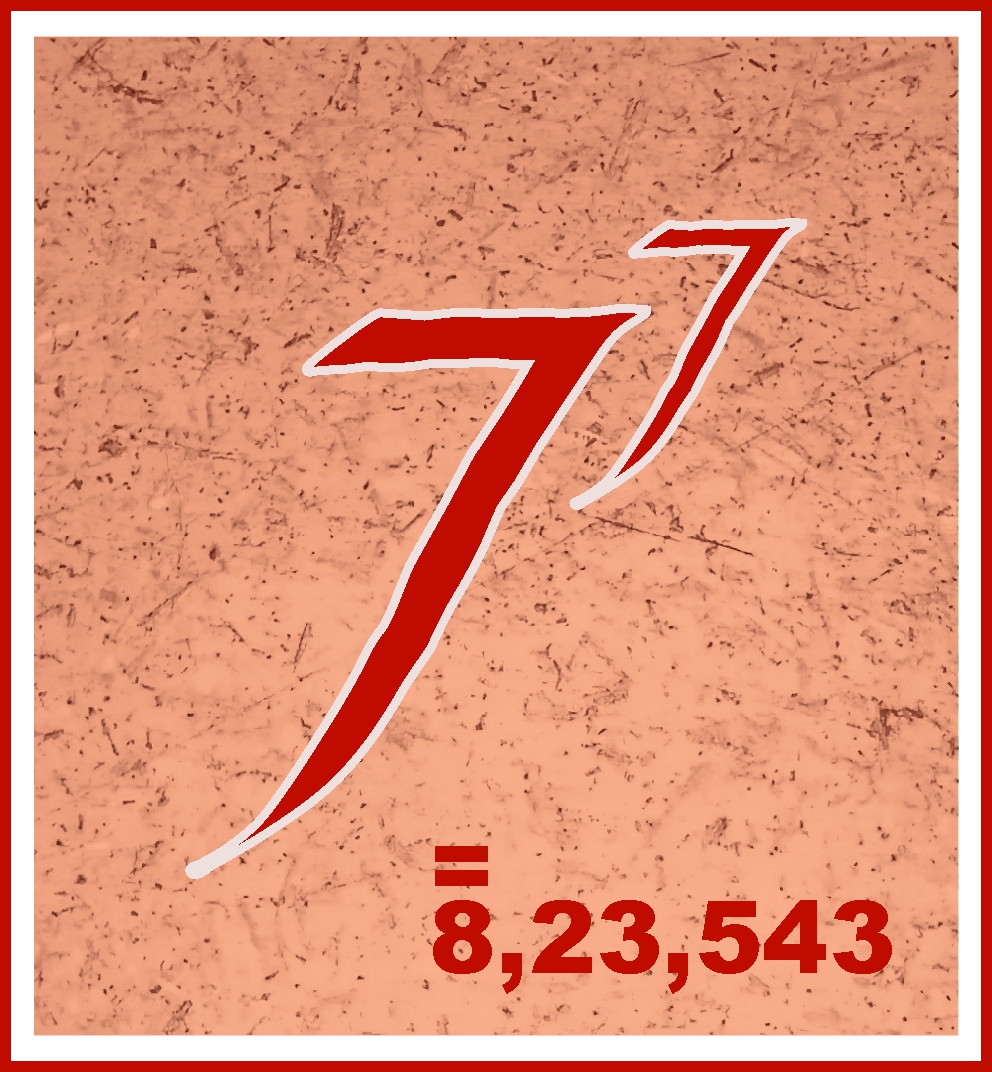
WHAT IS THE 7^7-CLAIM IN KJV?
(Looks Manipulated)
The 7^7-claim in KJV refers to what is known as the ‘Elton Anomaly’—also called the 7^7 anomaly—a numerological claim that surfaced in late 2023 within KJV-only Protestant circles.
It claims that the entire printed King James Bible—when counted in a specific ‘standardized way’—totals exactly 823,543 which equals 7^7, (77).
The KJV-only advocates see this as a divine ‘signature’ or ‘seal of perfection’ on the KJV, tying into the Bible’s frequent symbolic use of the number 7 to represent completeness, fullness, or divine perfection (like the 7 days of creation in Genesis 1, 7 seals and trumpets in Revelation, etc.).
A South African man named Elton discovered it on October 23, 2023. It was quickly verified and popularized by a Brandon Peterson (known online as @TruthisChrist on sites like kjvcode.com and truthischrist.com).
However, and this is important, the exact count is not just the words in the biblical text. It also includes:
- Book titles (example, ‘THE BOOK OF GENESIS’)
- Chapter and verse numbers
- Psalm titles
- The 22 Hebrew alphabetic divisions in Psalm 119*
- Colophons (like ‘Unto the Galatians written from Rome’)
- The cover page words (‘HOLY BIBLE KING JAMES VERSION’)
*Not found in the original KJV Psalm 119.
But the Elton Anomaly—exactly 823,543 by including all of the above—does not hold true for the original 1611 KJV. It only applies to the specific modern editions that its claimants use—the Cambridge Concord KJV (CCK) and the nearly identical Pure Cambridge Edition (PCE), both published in the mid-20th century (with roots in the 1769 Blayney revision not in the original KJV).
Even in the word count between these two new KJV editions (CCK vs. PCE), there exists slight differences, though claimants say the count holds with minor title ‘adjustments‘. (Manipulations?)
Similar heptadic numeric claims have been made for centuries about the Bible’s original languages (like, by Ivan Panin in the early 1900s), but this one is KJV-specific and includes the full printed book.
Ivan Panin (1855–1942): A Russian mathematician and former agnostic who converted to Christianity. Starting in 1890, he spent over 50 years manually analyzing the original Hebrew (OT) and Greek (NT) texts. He documented thousands of numeric features—primarily multiples of 7—in word counts, letter counts, vocabulary subsets (such as, nouns, words starting with vowels), and gematria.
In the genealogy in Matthew 1:1–17 there are 49 vocabulary words (7×7), 266 letters in certain groups (multiples of 7), etc., with dozens of interlocking 7s per passage. He claimed these prove supernatural inspiration—too complex for humans—and even used them for textual criticism to select the “correct” reading among variants. He produced a “Numeric New Testament” and ~43,000 pages of data.
Panin is often referenced positively as historical precedent for the 7-patterns, but some (including TruthisChrist site) explicitly call it “faulty/pointless” and replicable in non-inspired texts like “Lord of the Rings”.
When people download a generic or different KJV text file (say from holy-bible.online) and apply the same formatting, they often get 823,542 (one off).
The 7^7-claims in KJV counter that only the ‘standardized’ CCK or PCE (published mid-20th century) are the ‘correct texts’—but this classic circular reasoning. The claim only works for the specific editions chosen after the fact. Plain verse-text-only counts (without the extras) are ~789,629 words, far from 7^7 (823,543 words).
Experts (including some KJV supporters) challenge the claims’ methodology, selectivity, reproducibility across editions, and theological significance.
The total only reaches 7^7 by including later added paratext that are listed above. These are not part of the original Hebrew/Greek manuscripts or even the 1611 KJV text.
This is ‘manipulated’—you can add/subtract elements to force the pattern. This is plainly just a derived number by adding or subtracting individual elements as required to get the pre-determined outcome. Verse numbers and chapter divisions are explicitly a medieval development, not a part of the original text.
This is post-hoc pattern-seeking, like Ivan Panin’s claims, which the KJV claimants distance themselves from as ‘faulty’ or replicable in non-inspired texts.
Changing one word or title breaks it that doesn’t prove supernatural design—any large text could be tweaked to fit a target number.
The original 1611 printing (the first edition of what became known as the King James Version) differs from the modern CCK/PCE in several ways that directly affect the exact count. Like spelling, punctuation, and word division.
1611 used archaic forms such as, ‘in stead’ or ‘in to’ as separate words, long s (ſ), different orthography. These change how words are tokenized. Some patterns (like certain word counts) differ between 1611 and modern KJVs—for example, ‘Words of God’ in Genesis 1 is 344 in the 1611 vs. exactly 343 (7×7×7) in the modern KJB.
The 1611 title page and headings were not worded as the modern prints (“KING JAMES VERSION”). The exact wordings in the original cover were:
“THE HOLY BIBLE, Conteyning the Old Teſtament, AND THE NEW: Newly Tranſlated out of the Originall tongues: & with the former Tranſlations diligently compared and reuiſed, by his Maiesties speciall Comandement. Appointed to be read in Churches. Imprinted at London by Robert Barker, Printer to the Kings moſt Excellent Maiestie. ANNO DOM. 1611. C. Boel ſecit in Richmont.”
The anomaly’s structural count includes the precise modern cover “HOLY BIBLE KING JAMES VERSION” = 5 words and modern book titles and colophons. The 1611 lacked this formatting.
The 1611 included the Apocrypha (between the Old and the New Testament), plus marginal notes and other paratext that the anomaly deliberately excludes. Modern CCK/PCE editions used for the count omit the Apocrypha.
The 1611 original had minor printer’s errors and variants that were corrected over centuries (from 1613 to 1769 revisions). The exact 7^7 total secretly entered the revised KJV text in the early 1900s and became permanent with the Cambridge Concord (late 1950s).
The pattern of 7^7-claim in KJV does not appear in the original 1611 but only in later 20th century editions, making it selective. This word count claim is not based on the Original KJV 1611.
If you have access to a physical 1611 facsimile or a 1611-based digital text, the count won’t match even under the same rules (verse numbers + titles + etc.). The anomaly is presented as evidence for the latest printed KJV as God’s preserved English Bible, not the 1611 first edition or later revisions and editions. This whole thing clearly looks manipulated.
SEND A COMMENT
Links to our Massage Box
DOWNLOAD AS PDF
Printable version of this Page
Further Comments on "THE 7^7-CLAIM IN KJV"
WORD COUNT DIFFERENCE: ORIGINAL KJV VS NEW CCK
Cambridge Concord KJV:
The pure Bible text—meaning only the words in the verses themselves (like, “In the beginning was the Word…”), excluding all extras such as the cover title, book titles, chapter/verse numbers, Psalm 119 divisions, superscriptions, and colophons—contains 789,629 words.
When superscriptions (1,034 words) and colophons (186 words) are added, the broader Bible text total becomes 790,849.
The 32,694 extras (structure elements like the 5-word cover, 376-word book titles, 1,189 chapters counted as words/numbers, 31,102 verses counted as numbers, and 22 Psalm 119 divisions) are what push the grand total (words + numbers) to exactly 823,543 = 7^7.
Original 1611 KJV:
The pure Bible text (verse words only, on the same basis as above) is commonly cited as 788,280 words in sources that analyze the 1611 printing.
This figure reflects the original 1611 spelling and orthography (including the split compounds like “him selfe,” “to day,” “any thing,” etc., that we discuss below.
Exact 1611 verse-text counts vary slightly across digitization because of how early printing quirks (line justification, ampersands, etc.) are handled, but 788,280 is the most frequently referenced number for the Protestant 66-book text.
In 7^7 anomaly discussions, the 1611 edition is said to reach exactly 823,543 (7^7) as well when you adjust for how its chapter headings were printed (Roman numerals like “CHAP. I.” were often not treated as full “words” the same way modern “CHAPTER 1” is). The net effect of ~1,700 split compounds in 1611 (which increase its count), later compounding in modern editions, plus a handful of added/removed words in the 1629–1769 revisions, keeps the scripture word counts extremely close (within ~80–1,000 words depending on exact counting rules).
These are not changes to the translation or meaning—just the normal evolution of English spelling, punctuation, and word-joining between 1611 and the Cambridge Concord text. No Apocrypha, footnotes, marginal notes, or front/back matter is included in either count.
Here are a few verse examples showing how individual words were joined (made into one compound word) from the original 1611 King James Version through later revisions, up to the Cambridge Concord KJV. These updates reflect the natural evolution of the English language—standardizing spelling, punctuation, and word forms for readability.
| Original 1611 KJV | Cambridge Concord KJV |
|
Luke 20:42: “And Dauid him selfe sayth in the booke of Psalmes, The Lord said vnto my Lord, Sit thou on my right hand,” “Dauid him selfe” counted as 3 words. |
Luke 20:42: “And David himself saith in the book of Psalms, The Lord said unto my Lord, Sit thou on my right hand,” “David himself” counted as 2 words. |
|
Romans 14:22: “Hast thou faith? haue it to thy selfe before God. Happie is he, that condemneth not him selfe in that thing which hee alloweth.” “to thy selfe” (3) and “him selfe” (2) counted as 5 words. |
Romans 14:22: “Hast thou faith? have it to thyself before God. Happy is he that condemneth not himself in that thing which he alloweth.” “to thyself” (2) and “himself” (1 word) counted as 3 words. |
|
Luke 23:43: “And Iesus said vnto him, Verily I say vnto thee, To day shalt thou be with me in Paradise.” “To day” (2). |
Luke 23:43: “And Jesus said unto him, Verily I say unto thee, Today shalt thou be with me in paradise. “Today” (1). |
|
Deuteronomy 8:9: “A land wherein thou shalt eate bread without scarcenes, thou shalt not lacke any thing in it, a land whose stones are yron, and out of whose hils thou mayest digge brasse.” “any thing” (2). |
Deuteronomy 8:9: “A land wherein thou shalt eat bread without scarceness; thou shalt not lack anything in it; a land whose stones are iron, and out of whose hills thou mayest dig brass. “anything” (1). |
In these examples 1611 original KJV has more words due to the common early-modern English practice of separating compound words (“him selfe”). Modern editions join it into the single word “himself.”
These are just four of hundreds of similar orthographic changes across the Bible that contribute to the overall word-count variance between the 1611 edition and today’s Cambridge Concord (or Pure Cambridge) editions. Sources note roughly ~1,700 split compounds in the 1611 edition that were later joined.
Why then does the 1611 KJV have lesser count of the total verse text than the CCK? This is because many compound words in 1611 were split (changed as separate words) in the modern editions (reverse pattern) like:
1611 ⇒ CCK
- “menchildren” ⇒ “men children”
- “housetops” ⇒ “house tops”
- “twoedged” ⇒ “two edged”
- “stumblingblock” ⇒ “stumbling block”
- “fellowsoldier” ⇒ “fellow soldier”
- “wellbeloved” ⇒ “well beloved”
Bible examples
- 2 Kings 19:26 “…on the housetops…” ⇒”…on the house tops…”
- Isaiah 37:27 “…upon the housetops…” ⇒”…upon the house tops…”
The “7^7” claim (823,543) used to prove the King James Version is divinely inspired fails its own test. The figure is not calculated from the original inspired text alone. Even modern editions reach exactly 823,543 only by including extra features that translators, editors, and printers added after the 1611 KJV—such as verse numbers, headings, cross-references, and other explanatory material. These additions were never part of the “inspired” text; they were inserted later for reader convenience.
This is clearly a 20th-century Protestant proselytizing tactic. It was designed to dazzle people with a “miracle” so they would be amazed and believe — without ever checking the facts for themselves.