
Library of Resources on Purgatory
(Collection of Books, Articles, Recordings and Art)
BOOKS LIBRARY
«»
In Treatise on Purgatory, St. Catherine of Genoa describes the purpose of Purgatory, the intense suffering souls experience there, and the great hope they hold, awaiting reunion with God in Heaven for eternity.
«»
Many of the faithful overlook the Dogma of Purgatory and the need to support the Church Suffering by offering Mass, prayers, almsgiving, and various acts of charity, despite knowing they may one day be there.
«»
The Manuscript on Purgatory contains very interesting statements about the life beyond the grave specifically in purgatory. The details are intermingled with much spiritual direction.
«»
Assist the Souls in Purgatory is a short book on the doctrine of Purgatory and what we know of the place and then focuses on how Christians can help the souls there. It includes a number of prayers.
«»
This little guidebook shows us How to Avoid Purgatory by using the means God has so generously offered us, and then it also shows how the use of these means is within the reach of every Christian.
OTHER LIBRARY
[ ARTICLES/BLOGS ]
«»
So let’s take a look at what purgatory is (and isn’t), and how students can learn more about it, and ways their families can incorporate those lessons into their home life.
«»
Some fear it. Others hope for it. Some see it as proof of God’s mercy, others as testimony to God’s wrath. Many don’t know anything about it, while many more have forgotten what they once knew.
«»
When it comes to the most misunderstood doctrines of the Catholic Church, purgatory probably ranks at the top. Often, these misunderstandings are manifested in what everyday folks say about purgatory.
«»
Understanding Purgatory in Catholic Doctrine: Theological Foundations and Spiritual Implications provides an in-depth exploration of one of Catholicism’s most profound and often misunderstood teachings.
[ VIDEOS ]
«»
What is meant by the final purification? Understanding the Catholic notion of purgatory requires knowing the difference between a temporal consequence and an eternal consequence; this difference has nothing to do with damnation and salvation.
«»
We all want to be saints, but the struggle against sin and selfishness can feel overwhelming. There may be days where we might feel satisfied simply making it to purgatory rather than entering the pearly gates. But is this lukewarm path the only way to make it to heaven?
[ AUDIO ]
«»
COMING UP
[ ART ]
«»
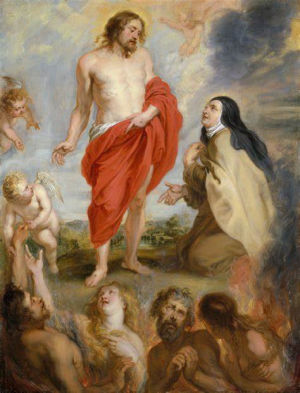
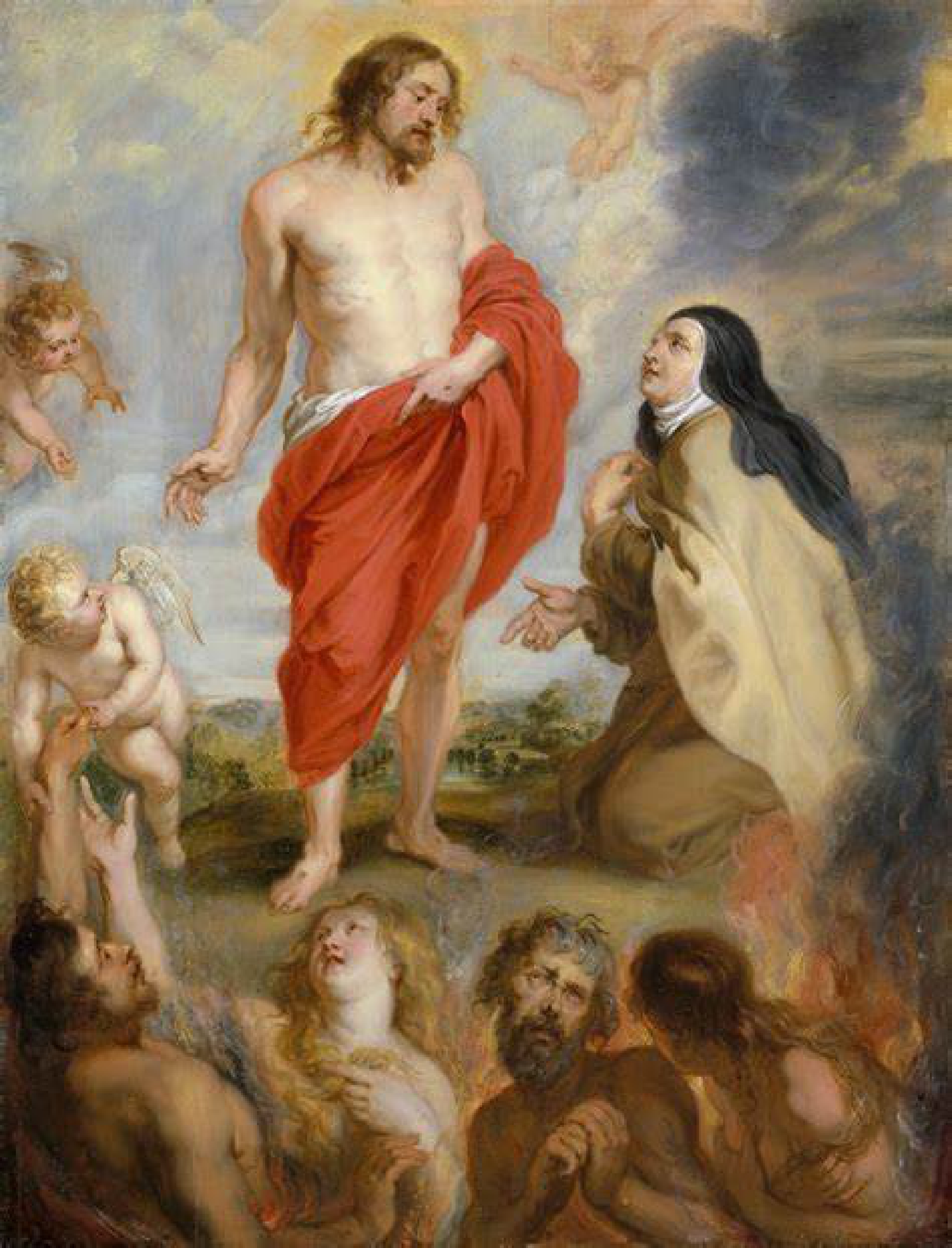
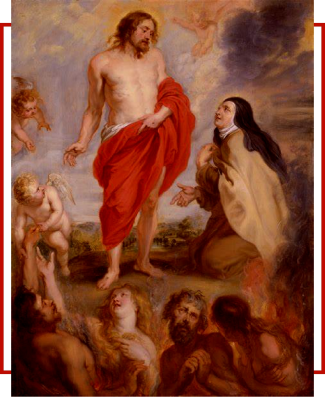
This painting at the head of this page
“Saint Teresa of Ávila Interceding for Bernardino de Mendoza in Purgatory”
by Peter Paul Rubens (1577-1640)—a Flemish artist—created between 1630 and 1635.
It’s an oil on canvas work measuring 194×140 cm and currently housed in the Royal Museum of Fine Arts Antwerp, Belgium.
The scene depicts a vision experienced by Saint Teresa of Ávila. In the composition, Christ stands prominently in the center, partially draped in a red cloth, extending a gesture toward Saint Teresa, who kneels in devotion before him. Surrounding them are cherubs in the heavens above, while below, tormented souls reach upward from the flames of purgatory, symbolizing their plea for release.
The story behind the painting draws from Saint Teresa’s own writings. Bernardino de Mendoza, a benefactor (possibly a priest or nobleman) who donated land to her for building a convent, died young before the project could be completed. In a vision, Christ appeared to Teresa, revealing that Bernardino’s soul remained in purgatory until the convent was built, prompting her intercession through prayer to secure his release.
This narrative underscores themes of Divine Mercy, intercession, and the Catholic doctrine of purgatory.
«»
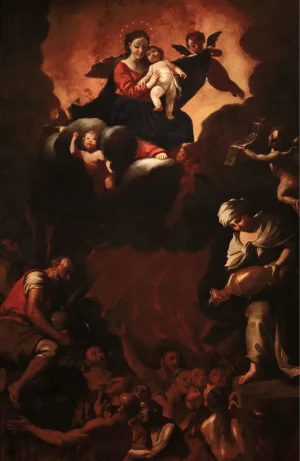
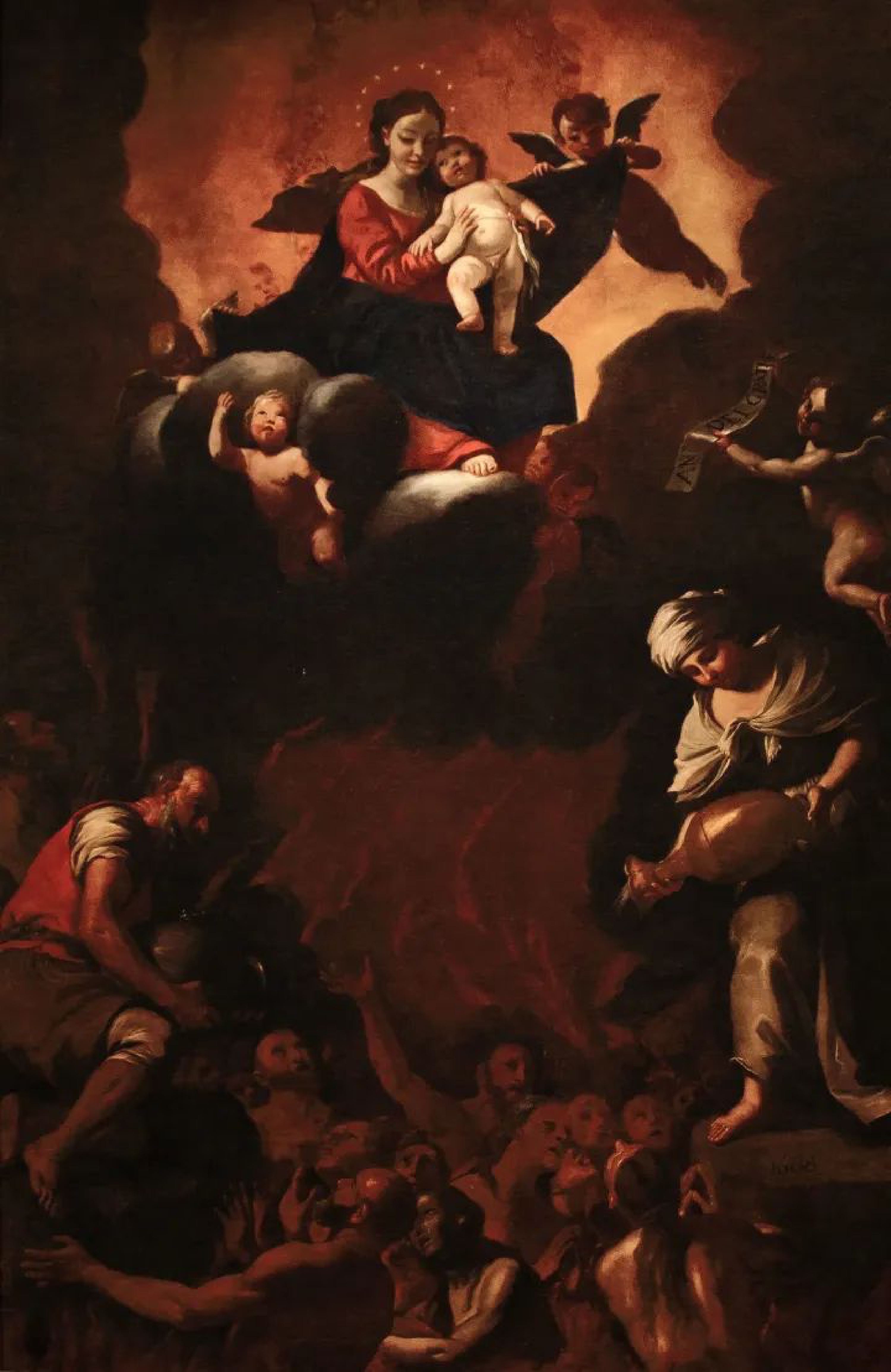
“Madonna and Child with Souls in Purgatory“
by Luca Giordano (1634-1705)—an Italian artist from Naples—created around 1665
It’s an oil on canvas measuring approximately 207.3×155.6 cm and is part of the collection at the Museum of Fine Arts, Houston, Texas, USA.
The composition is a classic Baroque representation of Catholic doctrine on purgatory and intercession. At the center, the Virgin Mary, dressed in a red tunic and blue mantle, holds the infant Jesus while floating on clouds amid cherubs. Below them, tormented souls writhe in the flames of purgatory, reaching upward in desperation for mercy and release. A nearby cherubic figure holds a brown scapular, symbolizing devotion to Our Lady of Mount Carmel—a Carmelite tradition promising that faithful wearers of the scapular will be aided in purgatory and released on the Saturday following their death.
The scene emphasizes themes of Divine Mercy, redemption, and the power of Marian intercession. Luca Giordano, nicknamed “Luca fa presto” for his rapid painting style, produced this work during his prolific career, blending dramatic chiaroscuro (light-dark contrasts) with emotional intensity to heighten the spiritual drama.
«»
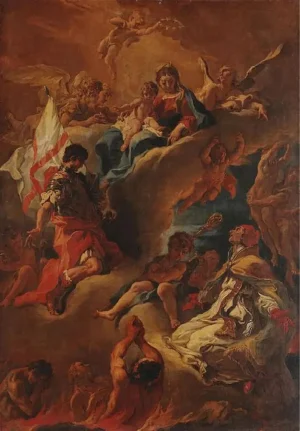
“The Virgin Interceding for the Souls in Purgatory“
by Sebastiano Ricci (1659–1734), a Venetian Baroque artist, created around 1687–1688
It’s an oil on canvas measuring approximately 284×172 cm and is housed in the Museo di Capodimonte in Naples, Italy.
The composition is a dramatic Baroque vision of Catholic theology on purgatory and intercession. The Virgin Mary, holding the infant Jesus, floats on clouds amid cherubs and angels in the upper register, extending her gesture of mercy downward. Below, a warrior saint (likely St. George, in armor and holding a banner with a red cross symbolizing resurrection) kneels on the left, while a robed saint (possibly St. Dominic) is on the right, both interceding. Tormented souls reach up from the fiery depths of purgatory, their expressions conveying agony and hope for redemption.
The work emphasizes themes of divine grace and salvation, with Ricci’s characteristic dynamic lighting, swirling clouds, and emotional intensity to evoke spiritual drama. Ricci painted this during his early career, influenced by his training in Bologna and Venice, blending grand scale with vivid color and movement.
«»
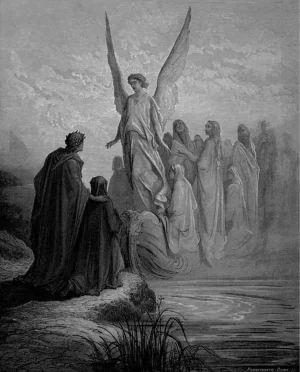
“The Boat of Souls“
by Gustave Doré (1832–1883)—a French artist—created in 1868
This was one of his renowned series of engravings for Dante Alighieri’s Divine Comedy. It specifically depicts a scene from Purgatorio, Canto 2.
This wood engraving measures approximately 25×19 cm in many editions and has been widely reproduced in publications of Dante’s work since the 19th century.
In this composition, the central figure is the celestial pilot—an angel with outstretched wings—guiding a boat filled with redeemed souls to the shore of Mount Purgatory at dawn on Easter Sunday. The souls, draped in flowing robes, appear ethereal and hopeful as they arrive for purification. On the left, Dante (the hooded figure in front) and his guide Virgil (behind, with a supportive arm) observe the miraculous arrival from the rocky bank near a serene body of water, symbolizing the boundary between the infernal and the purgatorial realms.
Doré’s dramatic use of light, shadow, and mist evokes a sense of awe and spiritual transition, characteristic of his Romantic style and the epic’s themes of redemption, mercy, and the soul’s journey toward Paradise. Doré produced 136 illustrations for the full Divine Comedy (Inferno in 1861, Purgatorio and Paradiso in 1868), which became immensely popular and influenced perceptions of Dante’s text.
«»
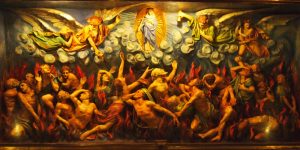
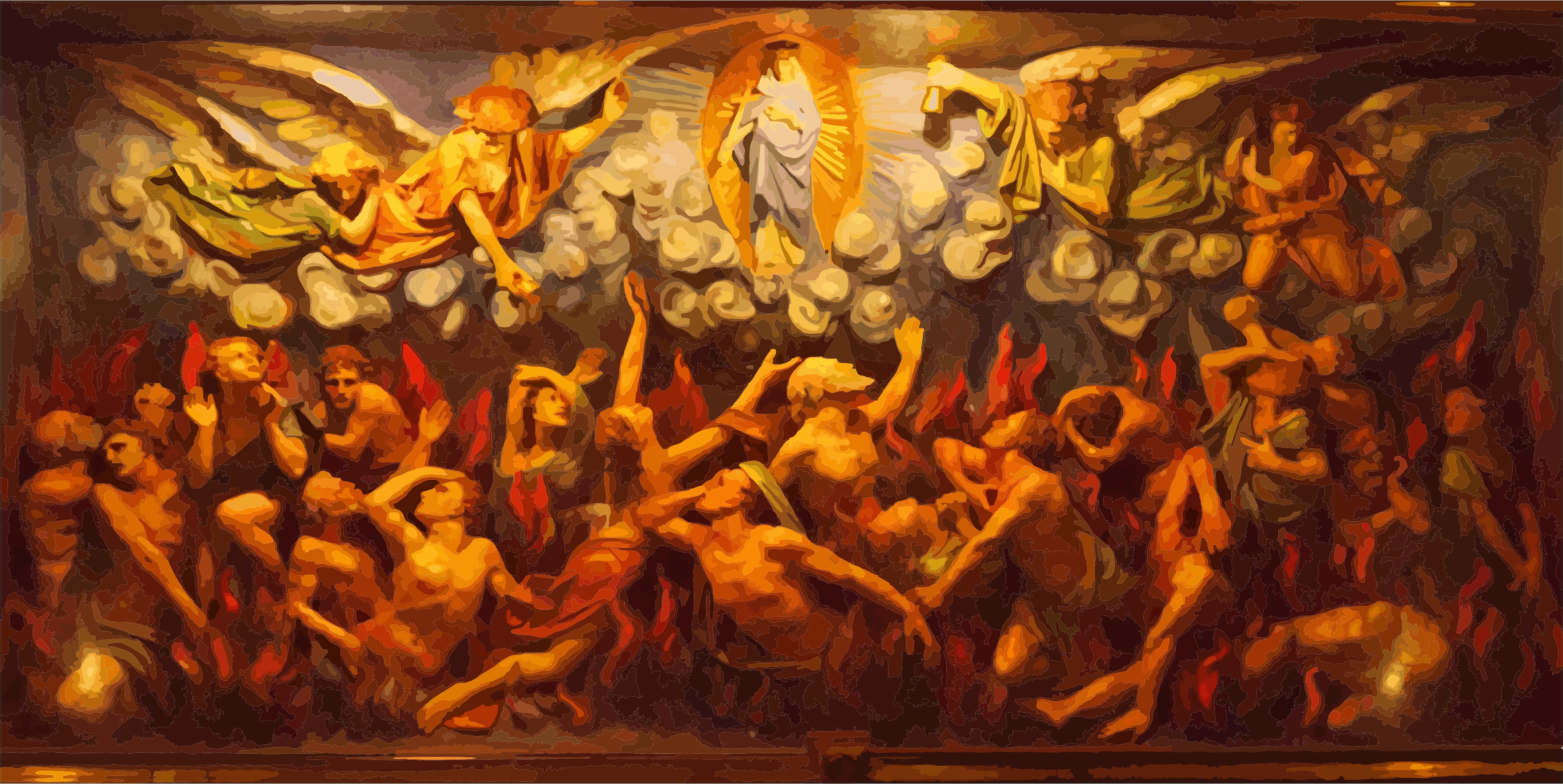
“Bas-relief at the Capela das Ánimas“
The chapel was built by architect Miguel Ferro Caaveiro. The artist is unknown.
This is a bas-relief sculpture on the façade of the Capela das Ánimas (Chapel of the Souls), a neoclassical church built in the late 18th century in Santiago de Compostela, Spain. It depicts the Virgin Mary surrounded by angels in heaven, interceding for the tormented souls in the flames of purgatory below. The golden appearance comes from the lighting and material, giving it a dramatic, illuminated effect typical of Baroque-influenced religious art.
The bas-relief sculpture on the facade of the Capela das Ánimas is commonly referred to as “Souls in Purgatory” (or “Ánimas no Purgatorio” in Galician), depicting tormented souls in flames below the Virgin Mary and angels.
It does not appear to have a more formal or official title beyond this descriptive name.