
WHAT IS REDEMPTIVE SUFFERING?
(Simple answer to a complex Theology)
REDEMPTIVE SUFFERING is a Christian theological precept addressing the idea that human suffering can provide spiritual worth when voluntarily accepted and united with the suffering and death of Jesus Christ on the Cross.
This union allows the individual’s pain to contribute to the redemption of sins—their own and/or those of others—or to other spiritual benefits, such as the salvation of souls or personal growth in holiness.
So suffering, when lived in union with Christ, becomes a path to redemption, purification, and sanctification.
It is not about earning forgiveness, which comes solely from God’s grace through Christ, but rather about participating in the application of Christ’s redemptive work.
This practice draws from the belief that Christ’s sacrifice tough complete invites the mystical body of Christ to share in it, as St. Paul in Colossians 1:24, speaks of “Now I rejoice in my sufferings for your sake, and in my flesh I am filling up what is lacking in the afflictions of Christ on behalf of his body, which is the church.“
[Note: Christ’s suffering is complete and perfect in itself—nothing is missing from what he endured on the Cross. However, Christians are united with him as part of his “body“—the Church. Through our own hardships and pains, we continue and fulfill the ongoing Paschal Mystery of his Death and Resurrection. (See also CCC §618)]
The precept of Redemptive suffering goes beyond mere endurance of pain; it is an active, intentional spiritual discipline that is rooted in theology. At its core, it involves consciously uniting one’s personal hardship—whether physical, emotional, or spiritual—with the redemptive work of Jesus Christ.
This union is not passive but requires a deliberate act of the will, often expressed through prayer, where the individual ‘offers up’ their hardships as a form of sacrifice. For instance, someone facing chronic illness might pray, “Lord, I offer this pain for the conversion of my loved ones,” thereby transforming the suffering from a random burden into a participatory act in God’s salvific plan.
Pope John Paul II elaborated on this in his apostolic letter Salvifici Doloris, emphasizing that suffering, when joined to Christ’s passion, can model individuals to Him and foster a deeper spiritual union.
This concept is depicted vividly in by St Faustina (Diary #446):
“Then I saw the Lord Jesus nailed to the cross. When He had hung on it for a while, I saw a multitude of souls crucified like Him. Then I saw a second multitude of souls, and a third. The second multitude were not nailed to crosses but were holding them firmly in their hands. The third were neither nailed to crosses nor holding them firmly in their hands but were dragging crosses behind them and were discontent. Jesus then said to me,
“Do you see these souls? Those who are like Me, in the pain and contempt they suffer, will be like Me also in glory. And those who resemble Me less in pain and contempt will also bear less resemblance to Me in glory.”
Examples of hardships commonly understood include all forms of illness (especially terminal diseases or chronic conditions), loss (like the death in the family or financial distress), and persecution (ranging from social ostracism to martyrdom). These are elevated to prayer or sacrifice through simple, heartfelt invocations, such as the traditional Catholic phrase “offer it up,” which serves as a reminder to dedicate the moment to God. Even voluntary acts like fasting and living frugally can be a form of self-imposed suffering for redemptive purposes, as it fosters detachment from worldly comforts and unites the person with Christ’s own deprivations.
The fruits of this practice are varied. First, it can console others by providing spiritual support or intercession; for example, a person might offer their grief over a loss to comfort a friend in similar distress, believing that God channels this sacrifice into graces for healing. Second, it serves as reparation for sins, acting as a form of penance that helps atone for personal or collective wrongdoing, much like how voluntary sacrifices in the Old Testament prefigured Christ’s ultimate offering. Third, it aids in the conversion of souls, where the sufferer directs their pain toward the spiritual awakening of others—perhaps unbelievers, lapsed family members, or even entire communities.
Historical figures illustrate this vividly: St. John Vianney, the Curé of Ars, endured demonic torments and physical ailments, offering them for the conversion of sinners, reportedly leading to the salvation of thousands. Similarly, St. Faustina Kowalska documented in her diary how God revealed that her Lenten sufferings had secured graces for a thousand souls’ true conversion.
In contemporary contexts, this concept remains alive through stories like that of Chiara Luce Badano, a young Italian woman who, dying of bone cancer in the late 20th century, offered her excruciating pain for the youth of the world, inspiring many to faith even after her death. Or consider Audrey Santo, who, after a childhood accident left her in a vegetative state, became a focal point for pilgrims; her family’s offering of her condition was seen as redemptive, drawing others closer to God.
Even everyday acts, such as an elderly person praying the rosary while bedridden and dedicating each bead to a grandchild’s spiritual well-being, embody this transformation of suffering.
Ultimately, Redemptive suffering reframes pain not as pointless or punitive but as a profound expression of love, mirroring Christ’s own voluntary sacrifice. It fosters resilience, combats despair, and aligns the individual with divine grace, turning human frailty into a channel for eternal good. As St Paul put it: “…we also glory in our sufferings, because we realize that suffering develops perseverance, and perseverance produces character, and character produces hope. Such hope will not be doomed to disappointment, because the love of God has been poured into our hearts through the Holy Spirit that has been given to us.” (Romans 5:3-5)
Redemptive suffering is distinct from masochism, as it is motivated by charity rather than self-harm, and it emphasizes joy in participation with Christ rather than fatalistic resignation. It is distinct from a victim mentality, as it is meant to be life-affirming and rooted in joy, not despair.
SEND A COMMENT
Links to our Massage Box
DOWNLOAD AS PDF
Printable version of this Page
Further Comments on "Redemptive Suffering"
<>
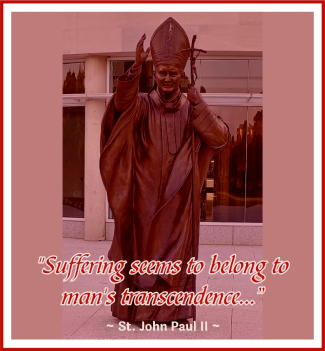
The image at the head of this page is a recent photograph of the prominent bronze statue of St John Paul II located at the entrance of the St John Paul II National Shrine in Washington, D.C. The shrine, operated by the Knights of Columbus, serves as a center for worship, education, and devotion to the saint, featuring exhibits on his life, papacy, and legacy.
The statue was installed to focuses on his role in promoting faith, hope, and human dignity, drawing from his extensive papacy (1978–2005) and global influence.
Created by Chas Fagan, an American sculptor, known for historical and religious figures.
COMMENT
In his Apostolic Letter Salvifici Doloris (February 11, 1984), Pope John Paul II goes deep into the Christian understanding of human suffering, framing it as a pathway to salvation through union with Christ’s redemptive suffering. The document is structured into eight sections, exploring suffering’s origins, meaning, and transformative power in light of Scripture and theology.
Introduction and the World of Human Suffering
The letter opens by highlighting suffering’s universality and its connection to human transcendence, drawing from St. Paul’s words in Colossians 1:24. Suffering is not merely physical or moral pain but a profound experience tied to evil as a deprivation of good, creating a “world” of shared human affliction, especially amplified in modern times by wars, injustices, and technological threats.
“Suffering seems to belong to man’s transcendence: it is one of those points in which man is in a certain sense ‘destined’ to go beyond himself.”
“Man suffers whenever he experiences any kind of evil… man suffers because of a good in which he does not share.“
The Quest for Meaning and Jesus Christ as the Answer
Addressing the perennial question of “why” suffering exists, the letter references the Book of Job to show that suffering is not always punishment for sin but can test the righteous or lead to conversion.
The ultimate response is found in Divine Love, revealed through Christ’s Passion, which conquers sin and death, transforming suffering into a means of redemption.
“While it is true that suffering has a meaning as punishment, when it is connected with a fault, it is not true that all suffering is a consequence of a fault and has the nature of a punishment.“
“For God so loved the world that he gave his only Son, that whoever believes in him should not perish but have eternal life” (John 3:16).
“He was wounded for our transgressions; he was bruised for our iniquities; upon him was the chastisement that made us whole” (Isiah 53:5).
Sharers in Christ’s Suffering and the Gospel of Suffering
Christians are invited to participate in Christ’s redemptive work by uniting their sufferings with His, as Paul did, fostering endurance, hope, and glory. This “Gospel of Suffering” emphasizes that persecutions and trials, when borne with faith, unleash love and grace, drawing people closer to God and contributing to the salvation of others.
Mary’s role at the Cross exemplifies this maternal participation.
“Now I rejoice in my sufferings for your sake, and in my flesh, I complete what is lacking in Christ’s afflictions for the sake of his body, that is, the Church” (Colossians 1:24).
“Suffering is, in itself, an experience of evil. But Christ has made suffering the firmest basis of the definitive good, namely the good of eternal salvation.“
“If any man would come after me… let him take up his cross daily” (Luke 9:23).
The Good Samaritan
The parable of the Good Samaritan calls Christians to active compassion toward the suffering, viewing aid as service to Christ Himself. This transforms society into a “civilization of love.”
In conclusion, suffering’s meaning is both supernatural (rooted in Redemption) and human (revealing dignity and vocation), with Christ illuminating its purpose through His Incarnation and Cross.
“Truly, I say to you, as you did it to one of the least of these my brethren, you did it to me” (Matthew 25:40).
“Suffering… is present in the world in order to release love, in order to give birth to works of love towards neighbor.“
“Through Christ and in Christ, the riddles of sorrow and death grow meaningful.“
Practical Steps to Offer Up Suffering
<>
Catholics are encouraged to approach suffering with purpose, without masochism or resignation, but with trust in God’s plan. Here’s how it should be typically done:
Set an Intention: When pain arises, mentally or verbally unite it with Christ’s suffering. For instance, say, “Lord, I offer this pain for [specific intention, like the souls in purgatory, a loved one’s conversion, or reparation for sins].” This turns passive endurance into active participation.
Use Prayer: A common practice is the “Morning Offering,” a daily prayer where you dedicate all joys, works, and sufferings of the day to God. An example from traditional Catholic devotion is:
O Jesus, through the Immaculate Heart of Mary, I offer You my prayers, works, joys, and sufferings of this day for all the intentions of Your Sacred Heart, in union with the Holy Sacrifice of the Mass throughout the world, in reparation for my sins, for the intentions of all my relatives and friends, and in particular for the intentions of the Holy Father. Amen.
(This prayer was written by Fr Francois Xavier Gautrelet SJ founder of “The Apostleship of Prayer” in 1844 in Vals, France.)
Recite this in the morning to preemptively offer any sufferings that may come.
Participate in the Sacraments: The Eucharist is central, as it re-presents Christ’s sacrifice. During Mass, consciously offer your sufferings alongside the bread and wine.
The Sacrament of Reconciliation can also help by purifying intentions and uniting contrition with Christ’s mercy.
Embrace It as Love: View suffering as an opportunity to grow in virtue, countering a culture of complaint. It’s an act of charity, potentially aiding others spiritually, even if the effects aren’t immediately visible.
This practice fosters resilience and closeness to Christ, who suffered willingly for humanity.
If chronic illness or severe pain is involved, combine it with medical help and spiritual direction from a priest.