
DO CATHOLICS WORSHIP MARY?
Catholics do not worship Mary. According to Catholic teaching, worship (also called adoration or latria) is reserved for God alone—the Father, Son, and Holy Spirit.
Mary is honored with the highest form of veneration (called hyperdulia), which is a profound respect and devotion because she is the Mother of God (theotokos), the one who said “yes” to the Incarnation (Luke 1:38), and the model of perfect discipleship (Luke 1:46-55).
Veneration is not the same as adoration and is explicitly distinguished from it. Worshiping Mary would be considered idolatry, which Catholic teaching explicitly forbids.
The Catechism of the Catholic Church states it clearly:
“The Church’s devotion to the Blessed Virgin is intrinsic to Christian worship. The Church rightly honors ‘the Blessed Virgin with special devotion… This very special devotion… differs essentially from the adoration which is given to the incarnate Word and equally to the Father and the Holy Spirit and greatly fosters this adoration.” (CCC §971)
The honor we give to God alone is properly called adoration, the highest honor we can give. The honor we give to Mary and the saints is called veneration. Proper veneration of the saints does not interfere with the worship due to God alone but rather fosters it.
Why the confusion arises
Prayers like the Hail Mary or the Rosary: These are not worship. They are requests for Mary’s intercession—asking her to pray for us to God, just as we might ask a friend to pray for us. Catholics believe in the “communion of saints” so those in heaven (including Mary) can intercede.
Statues and images: Catholics do not pray to statues—that would be idolatry. Statues are reminders, like family photos. The honor passes to the person they represent, not the object itself.
Titles like “Queen of Heaven” or “Mediatrix”: These describe Mary’s unique role in salvation history—always subordinate to Christ, —not divine status. A Recent Vatican document (Mater Populi Fidelis) has clarified that titles for Mary should never suggest she is equal to or replaces Jesus as Redeemer.
In short, everything about Catholic devotion to Mary is meant to lead people to Jesus, not away from Him. As Catholics believe that “Our Lady never points to herself; she points to Jesus.”
This distinction has been consistent Catholic doctrine for centuries and is not a matter of personal opinion—any Catholic who claims to “worship” Mary in the divine sense is simply mistaken according to the Church’s own teaching.
SEND A COMMENT
Links to our Massage Box
DOWNLOAD AS PDF
Printable version of this Page
Further Comments on "DO CATHOLICS WORSHIP MARY?"
<>
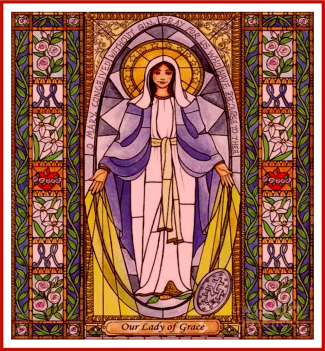
The image at the head of this page is adapted from a stained-glass style image of the original artwork titled “Our Lady of Grace: Queen of the Miraculous Medal,” created in watercolor and ink by artist Cecilia Lawrence (known online as Theophilia) in 2017. It portrays the Virgin Mary based on the 1830 apparition to St. Catherine Labouré, where Mary appeared as Our Lady of Grace. Key elements include Mary in a white dress and blue mantle, standing on a globe while crushing a serpent (symbolizing victory over evil), with rays of grace emanating from her outstretched hands.
COMMENT
The title “Mary, Queen of Heaven” is a longstanding doctrine in Catholic theology, formally proclaimed in Pope Pius XII’s 1954 encyclical Ad Caeli Reginam. It emphasizes Mary’s exalted role as the mother of Jesus Christ, who is depicted in Scripture as the eternal King in the line of David.
While the Bible does not explicitly use the phrase “Queen of Heaven” for Mary in a positive sense (and in fact uses it negatively for a pagan deity in Jeremiah 7:18 and 44:17-19, 25), Catholic interpreters draw a biblical foundation from typological* and contextual readings of both Old and New Testament passages.
These portray Mary as the gebirah (queen mother) in the restored Davidic kingdom.
Old Testament Foundations:
The Role of the Queen Mother
In the ancient Davidic kingdom of Israel, the king’s mother held a position of authority and intercession, often referred to as the gebirah (Hebrew for “great lady” or queen mother). This was distinct from the king’s wives, as the king could have multiple spouses, but only one mother. She sat at the king’s right hand, advised him, and mediated requests from the people.
1 Kings 2:19-20: When Bathsheba (mother of King Solomon) approaches her son, “the king rose to meet her, and bowed down to her; then he sat on his throne, and had a seat brought for the king’s mother; and she sat on his right.” Solomon tells her, “Make your request, my mother; for I will not refuse you.” This establishes the queen mother’s honored status and intercessory role.
Psalm 45:9: This royal wedding psalm, often seen as messianic (pointing to a future king like Christ), describes the king’s bride but also notes, “At your right hand stands the queen in gold of Ophir.” Catholic scholars interpret this as foreshadowing Mary’s queenship beside her son, the Messiah.
Kings 24:12 and Jeremiah 13:18: These reference the queen mother (gebirah) being captured or addressed alongside the king, underscoring her official role in the monarchy.
Proponents argue that since Jesus is the ultimate Davidic King (fulfilling prophecies like 2 Samuel 7:12-16), his mother Mary inherits this queenly role in the heavenly kingdom.
This is not about Mary being divine but about her maternal authority and closeness to Christ. Since Christ is King, Mary is the Queen Mother.
New Testament Connections:
Mary as Mother of the King
The New Testament links Jesus explicitly to the Davidic throne, extending the queen mother tradition to Mary.
Luke 1:31-33: The angel Gabriel tells Mary, “You will conceive in your womb and bear a son, and you shall call his name Jesus. He will be great, and will be called the Son of the Most High; and the Lord God will give to him the throne of his father David, and he will reign over the house of Jacob forever; and of his kingdom there will be no end.” Here, Jesus is the eternal Davidic King, making Mary the queen mother by extension.
Revelation 12:1-5: “And a great portent appeared in heaven, a woman clothed with the sun, with the moon under her feet, and on her head a crown of twelve stars; she was with child… She brought forth a male child, one who is to rule all the nations with a rod of iron.” This “woman” is interpreted by Catholics as Mary (the mother of the Messiah), crowned in heaven, symbolizing her queenship. The twelve stars represent the twelve tribes of Israel or apostles, tying back to the Davidic lineage. The child’s rule echoes Psalm 2:9, (see also Revelation 19:15) a messianic prophecy.
+
* Typology in the context of the Bible is a method of biblical interpretation (hermeneutics) in which certain people, events, objects, or institutions in the Old Testament—called types (from the Greek typos, meaning “pattern,” “figure,” or “example”)—serve as divinely intended historical foreshadowings or “living prophecies” that prefigure and find their fulfillment in corresponding realities in the New Testament, especially in relation to Jesus Christ and His redemptive work (called the antitype).
It is not random symbolism or allegory (which often ignores or overrides the literal, historical meaning of the text). Instead, typology is grounded in real history: the type is a real person or event in its own right, yet God sovereignly designed it to point forward to a greater escalation or fulfillment in Christ.
The New Testament itself models and authorizes this approach (Romans 5:14 explicitly calls Adam a “typos” of Christ).
Core Characteristics
Historical reality — The type actually happened; it is not a fictional symbol.
Correspondence + escalation — There is a genuine parallel, but the antitype is greater (the fulfillment surpasses the foreshadowing).
Divine intent — God orchestrated the type to reveal His redemptive plan progressively.