
Story of OLPS Devotion
(History of the Spread of the Devotion to Our Lady of Perpetual Succor)
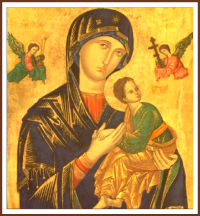
The OLPS devotion (Our Lady of Perpetual Succor) centers on a famous 15th-century Byzantine icon of the Virgin Mary holding the Child Jesus.
This title emphasizes Mary’s role as a constant source of help and intercession, particularly in times of distress or need.
The devotion is strongly associated with the Redemptorist order (Congregation of the Most Holy Redeemer) and has spread worldwide through their missions, featuring weekly novenas, processions, and reported miracles.
ORIGIN OF THE ICON
The icon is a Cretan-school Byzantine work, likely painted between roughly 1325 and 1480 (confirmed by carbon-14 dating on the walnut wood panel). It belongs to the “Virgin of the Passion” (Amolyntos) style, showing Mary in a dark red robe (Byzantine imperial color) gazing compassionately at the viewer while pointing to her Son.
The frightened Child Jesus clings to her, with one sandal dangling from his foot; two angels (St. Michael and St. Gabriel) hold the instruments of the Passion (cross, nails, lance, and sponge).
Greek inscriptions identify the figures (MP ΘΥ for “Mother of God” and IC XC for “Jesus Christ”). Art historians often attribute it to a Cretan painter like Andreas Rizo de Candia. While pious legends sometimes link it to earlier figures like St. Luke or a specific Cretan monastery (Keras Kardiotissas or Kardiotissa), historical records begin in the late 15th century.
HOW THE ICON CAME TO ROME
According to longstanding tradition (supported by early accounts and a parchment record), a merchant (sometimes described as Greek or a wine merchant) acquired the icon from a church or monastery on the island of Crete around 1495–1498.
During the sea voyage to Rome, a violent storm threatened the ship; the crew prayed to Mary, and the vessel was saved. On his deathbed in Rome, the merchant instructed a friend to place the image in a church for public veneration.
However, the friend kept it privately in his home instead. Tradition holds that the Blessed Virgin appeared in a dream to the friend’s six-year-old daughter, directing that the icon be enshrined in the Church of St. Matthew the Apostle on Via Merulana. After hesitation and consultation with clergy, the family complied.
The icon was solemnly transferred and enshrined there on March 27, 1499. It quickly gained a reputation for miracles and was venerated publicly for nearly 300 years under the care of the Augustinian friars (including Irish Augustinians from 1739 onward).
“HIDDEN YEARS”AND REDISCOVERY
In 1798, during the Napoleonic occupation of Rome (when French forces under General Berthier dissolved the Papal States), the Church of St. Matthew was destroyed.
The Augustinians safeguarded the icon, moving it first to the Church of St. Eusebius and later to a private chapel in Santa Maria in Posterula near the Tiber River, where it remained largely forgotten for decades (known locally as “Our Lady of Grace” or simply stored away). Public devotion waned during this period.
The Redemptorists unknowingly purchased the ruins of St. Matthew’s church in 1855 to build their new Roman headquarters, the Church of St. Alphonsus Liguori on Via Merulana. A young Redemptorist priest, Fr. Michael Marchi (who as a boy had heard stories from an elderly Augustinian brother, Augustine Orsetti, about the “miraculous Virgin of St. Matthew”), recalled the icon’s history.
The Redemptorists petitioned Pope Pius IX, who had prayed before the image as a child in St. Matthew’s. By pontifical decree in 1865–1866, the Pope granted the icon to the Redemptorists, ordering its return to the Via Merulana site.
He is traditionally quoted as instructing them: “Make her known throughout the world!” The icon was retrieved in January 1866, cleaned and restored by artist Leopold Nowotny, and transferred in solemn procession to St. Alphonsus on April 26, 1866.
Pope Pius IX issued a decree on May 5, 1866, formally approving the title Nostra Mater de Perpetuo Succursu (Our Mother of Perpetual Succour), authorizing its canonical coronation (performed in 1867), and promoting its veneration.
SPREAD OF THE DEVOTION
Under Redemptorist care, the OLPS devotion exploded globally in the late 19th and 20th centuries. Copies of the icon were sent to parishes worldwide, often accompanied by novenas and missions.
Pope Pius IX fixed the feast day on June 27 (later adjusted in some calendars; it remains a major observance for Redemptorists and in countries like Haiti, where Mary under this title is the national patroness).
The Redemptorists integrated it into their spirituality, emphasizing Mary’s intercession alongside the Passion of Christ. Today, the original icon remains enshrined in a prominent glass case above the main altar in the Church of St. Alphonsus in Rome, drawing pilgrims.
OLPS devotion is especially strong in places like the Philippines (Baclaran Shrine), India, the United States, and Latin America, with thousands attending weekly Perpetual Succor novenas.