
Sorrowful Mysteries History
(History of Contemplation on the Passion through the Sorrowful Mysteries)
THE ORIGIN
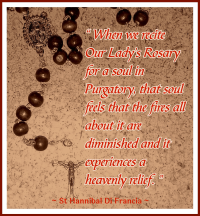
The practice of reciting the Sorrowful Mysteries of the Rosary specifically for the souls in purgatory is rooted in Catholic tradition, particularly the broader devotion to the Holy Rosary and its intercessory power for the deceased. While the Rosary as a whole has long been associated with aiding the Holy Souls in Purgatory, the Sorrowful Mysteries—focusing on Christ’s Passion and suffering—lend themselves especially well to this intention due to their themes of redemptive pain, sacrifice, and mercy.
The Rosary’s history traces back to the early Christian use of prayer beads or knotted ropes for repetitive prayers, such as reciting the Psalms or Our Fathers, by Desert Fathers in the 3rd and 4th centuries.
THE MODERN FORM
However, the modern form of the Rosary, including its mysteries, is traditionally attributed to St. Dominic (1170–1221), founder of the Dominican Order. According to Catholic tradition, in 1214, the Blessed Virgin Mary appeared to St. Dominic during a time of intense prayer in a forest near Toulouse, France, amid his efforts to combat the Albigensian heresy (a dualistic belief system that denied the goodness of the material world and the resurrection).
Blessed Virgin Mary instructed St. Dominic to preach the “Angelic Psalter” (an early name for the Rosary), consisting of 150 Hail Marys divided into three sets of mysteries: Joyful (focusing on Christ’s incarnation and childhood), Sorrowful (His Passion), and Glorious (His resurrection and Mary’s heavenly role).
This apparition included promises from Mary, later formalized as the “Fifteen Promises to Those Who Recite the Rosary.” Among them is the assurance that devotion to the Rosary would be a powerful means of delivering souls from purgatory.
St. Dominic preached the Rosary fervently, establishing the Confraternity of the Holy Rosary to promote it. He emphasized its role in conversion, spiritual warfare, and intercession, including for the dead. The Sorrowful Mysteries, in particular, were seen as a meditation on Christ’s redemptive suffering, which could be offered as a suffrage (spiritual aid) to alleviate the purifying sufferings of souls in purgatory.
Early accounts describe supernatural signs accompanying his preaching, such as storms ceasing and conversions occurring when people recited the Rosary with these intentions.
By the late 13th century, the Rosary had spread across Europe, with Popes like Innocent III endorsing it. Indulgences (remissions of temporal punishment for sins) were attached to its recitation, many of which could be applied to souls in purgatory, reinforcing the practice.
DECLINE AND REVIVAL
After St. Dominic’s death, devotion to the Rosary waned for about a century due to wars, plagues, and spiritual neglect. It was revived in 1460 by Blessed Alan de la Roche (1428–1475), a Dominican priest. According to accounts, Jesus appeared to him in the Eucharist, reproaching him for not preaching the Rosary, followed by visions from Mary and St. Dominic urging its restoration.
Blessed Alan re-established confraternities, enrolling over 100,000 members, and emphasized the Rosary’s power for the Church Suffering (souls in purgatory). He taught that the Sorrowful Mysteries, as “thorns” in the mystical rose tree of the Rosary, symbolized Christ’s Passion and could ease the pains of purgatorial souls through meditative prayer.
One promise revealed to him was that faithful recitation would grant full remission of sins at death, and suffrages from the Rosary would refresh and liberate suffering souls in purgatory.
A notable story from this era, recounted in later works, involves a young woman named Alexandre who appeared to St. Dominic after her death, revealing she was condemned to 700 years in purgatory. Through the confraternity’s Rosaries, she was quickly released and urged continued preaching of the devotion for the Holy Souls.
THE 18th CENTURY
The Rosary gained further prominence through St. Louis de Montfort (1673–1716), a French priest whose book “The Secret of the Rosary” (published in 1710) became a seminal text. He described the Rosary as a “school of Christian life” and a weapon against heresy, drawing on the legacies of St. Dominic and Blessed Alan. St. Louis emphasized meditating on the Sorrowful Mysteries to imitate Christ’s virtues of sorrow for sin, mortification, humility, patience, and love of the Cross.
He taught that offering these mysteries specifically for purgatorial souls aligns with the Rosary’s threefold purpose: aiding the Church Militant (on earth), Triumphant (in heaven), and Suffering (in purgatory).
St. Louis shared stories illustrating the Rosary’s efficacy, such as a nun who endured great suffering in illness to merit the prayer’s graces, and exorcisms where demons fled during recitation, symbolizing liberation akin to freeing souls from purgatory’s “bonds.”
He urged daily recitation of the full Rosary (all mysteries) for these intentions, noting that even partial recitations (like one set of mysteries) could apply indulgences to the dead.
MODERN DEVEMOPMENTS
The Rosary’s form was standardized in the 16th century by Pope St. Pius V, who in 1571 credited its recitation with the victory at the Battle of Lepanto and instituted the Feast of Our Lady of the Rosary.
Indulgences for praying for the Holy Souls continued to expand, with many applicable via the Sorrowful Mysteries.
In the 20th century, devotions like the “Purgatory Rosary” emerged, explicitly using the Sorrowful Mysteries with tailored intentions for different categories of suffering souls (example, the Agony in the Garden for those who resisted holiness, the Scourging for those who sinned through lust).
Pope St. John Paul II added the Luminous Mysteries in 2002, but the traditional focus on the Sorrowful Mysteries for souls in purgatory has persisted.
TODAY
November (the month dedicated to the Holy Souls) often sees increased emphasis on this practice, aligned with All Souls’ Day.
This devotion reflects Catholic belief in the Communion of Saints, where prayers and merits can aid the deceased. While not a formal dogma, it has been encouraged by saints, popes, and apparitions (example, at Fatima in 1917, where Mary urged Rosary recitation for sinners and peace, implicitly including purgatorial aid).